


doi: 10.1093/nar/gkg606.
FootPrinter: A program designed for phylogenetic footprinting
Affiliations
- PMID: 12824433
- PMCID: PMC169012
- DOI: 10.1093/nar/gkg606
Item in Clipboard
FootPrinter: A program designed for phylogenetic footprinting
Nucleic Acids Res.
.
Abstract
Phylogenetic footprinting is a method for the discovery of regulatory elements in a set of homologous regulatory regions, usually collected from multiple species. It does so by identifying the best conserved motifs in those homologous regions. This note describes web software that has been designed specifically for this purpose, making use of the phylogenetic relationships among the homologous sequences in order to make more accurate predictions. The software is called FootPrinter and is available at http://bio.cs.washington.edu/software.html.
Figures
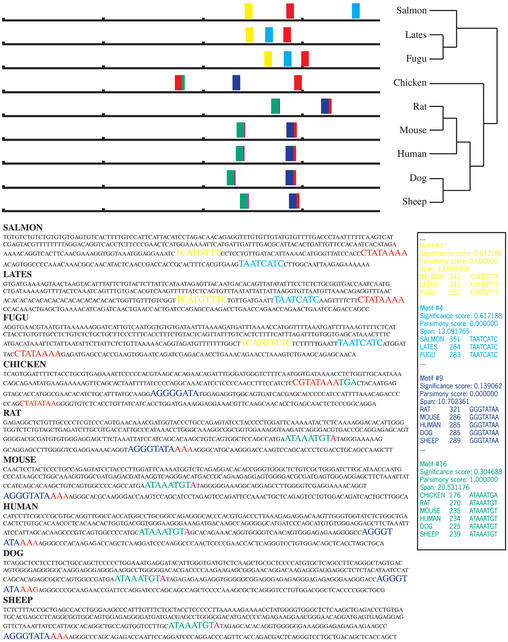
Sample FootPrinter output on the upstream regions of nine growth hormone genes. We searched for motifs of size 8 with at most two mutations. Motif losses were allowed, at a cost of one mutation. The subregion size was set to 100 bp with a subregion change cost of one mutation. The motif list reported on the right has been trimmed to fit on the page.
References
-
- Tagle D., Koop,B., Goodman,M., Slightom,J., Hess,D. and Jones,R. (1988) Embryonic ɛ and γ globin genes of a prosimian primate (Galago crassicaudatus); nucleotide and amino acid sequences, developmental regulation and phylogenetic footprints. J. Mol. Biol., 203, 439–455. - PubMed
-
- Duret L. and Bucher,P. (1997) Searching for regulatory elements in human noncoding sequences. Curr. Op. Struct. Biol., 7, 399–405. - PubMed
-
- Blanchette M., Schwikowski,B. and Tompa,M. (2002) Algorithms for phylogenetic footprinting. J. Comput. Biol., 9, 211–223. - PubMed
-
- Blanchette M., Kwong,S. and Tompa,M. (2003) An empirical comparison of tools for phylogenetic footprinting. In Third IEEE Symposium on Bioinformatics and Bioengineering, IEEE Press, Los Alamitos, CA, pp. 69–78.
