


Drug resistance patterns of recombinant herpes simplex virus DNA polymerase mutants generated with a set of overlapping cosmids and plasmids
- PMID: 12829822
- PMCID: PMC161916
- DOI: 10.1128/jvi.77.14.7820-7829.2003
Drug resistance patterns of recombinant herpes simplex virus DNA polymerase mutants generated with a set of overlapping cosmids and plasmids
Abstract
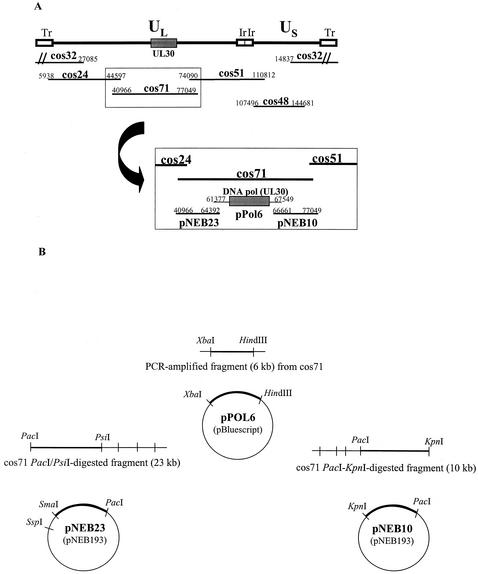
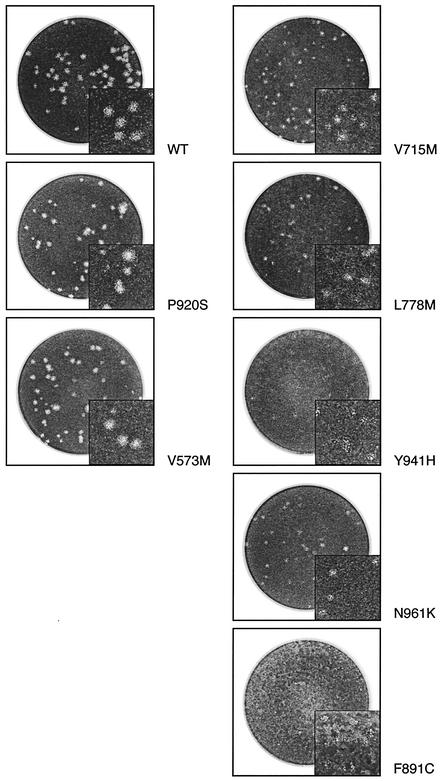
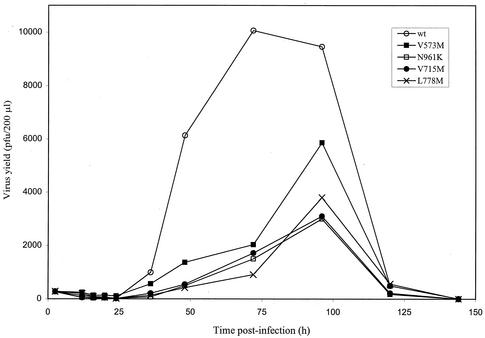
Herpes simplex virus (HSV) DNA polymerase (Pol) mutations can confer resistance to all currently available antiherpetic drugs. However, discrimination between mutations responsible for drug resistance and those that are part of viral polymorphism can be difficult with current methodologies. A new system is reported for rapid generation of recombinant HSV type 1 (HSV-1) DNA Pol mutants based on transfection of a set of overlapping viral cosmids and plasmids. With this approach, twenty HSV-1 recombinants with single or dual mutations within the DNA pol gene were successfully generated and subsequently evaluated for their susceptibilities to acyclovir (ACV), foscarnet (FOS), cidofovir (CDV), and adefovir (ADV). Mutations within DNA Pol conserved regions II (A719T and S724N), VI (L778M, D780N, and L782I), and I (F891C) were shown to induce cross-resistance to ACV, FOS, and ADV, with two of these mutations (S724N and L778M) also conferring significant reduction in CDV susceptibility. Mutant F891C was associated with the highest levels of resistance towards ACV and FOS and was strongly impaired in its replication capacity. One mutation (D907V) lying outside of the conserved regions was also associated with this ACV-, FOS-, and ADV-resistant phenotype. Some mutations (K522E and Y577H) within the delta-region C were lethal, whereas others (P561S and V573M) induced no resistance to any of the drugs tested. Recombinants harboring mutations within conserved regions V (N961K) and VII (Y941H) were resistant to ACV but susceptible to FOS. Finally, mutations within conserved region III were associated with various susceptibility profiles. This new system allows a rapid and accurate evaluation of the functional role of various DNA Pol mutations, which should translate into improved management of drug-resistant HSV infections.
Figures
References
-
- Andrei, G., R. Snoeck, E. De Clercq, R. Esnouf, P. Fiten, and G. Opdenakker. 2000. Resistance of herpes simplex virus type 1 against different phosphonylmethoxyalkyl derivatives of purines and pyrimidines due to specific mutations in the viral DNA polymerase gene. J. Gen. Virol. 81:639-648. - PubMed
-
- Andrei, G., R. Snoeck, and E. De Clercq. 1997. Differential susceptibility of several drug-resistant strains of herpes simplex virus type 2 to various antiviral compounds. Antivir. Chem. Chemother. 8:457-461.
-
- Andrei, G., R. Snoeck, J. Neyts, M. L. Sandvold, F. Myhren, and E. De Clercq. 2000. Antiviral activity of ganciclovir elaidic acid ester against herpesviruses. Antivir. Res. 45:157-167. - PubMed
-
- Baldanti, F., A. Sarasini, E. Silini, M. Barbi, A. Lazzarin, K. K. Biron, and G. Gerna. 1995. Four dually resistant human cytomegalovirus strains from AIDS patients: single mutations in UL97 and UL54 open reading frames are responsible for ganciclovir- and foscarnet-specific resistance, respectively. Scand. J. Infect. Dis. Suppl. 99:103-104. - PubMed
-
- Baldanti, F., M. R. Underwood, S. C. Stanat, K. K. Biron, S. Chou, A. Sarasini, E. Silini, and G. Gerna. 1996. Single amino acid changes in the DNA polymerase confer foscarnet resistance and slow-growth phenotype, while mutations in the UL97-encoded phosphotransferase confer ganciclovir resistance in three double-resistant human cytomegalovirus strains recovered from patients with AIDS. J. Virol. 70:1390-1395. - PMC - PubMed
Publication types
MeSH terms
Substances
LinkOut - more resources
Full Text Sources
