


doi: 10.1128/jvi.77.14.8166-8172.2003.
Differential hyperacetylation of histones H3 and H4 upon promoter-specific recruitment of EBNA2 in Epstein-Barr virus chromatin
Affiliations
- PMID: 12829856
- PMCID: PMC161941
- DOI: 10.1128/jvi.77.14.8166-8172.2003
Item in Clipboard
Differential hyperacetylation of histones H3 and H4 upon promoter-specific recruitment of EBNA2 in Epstein-Barr virus chromatin
J Virol.
2003 Jul.
Abstract
Epstein-Barr virus nuclear antigen 2 (EBNA2) is a transcriptional activator involved in the immortalization of B lymphocytes by the virus. EBNA2 is targeted to the promoters of its responsive genes, via interaction with cellular DNA-binding proteins. Using chromatin immunoprecipitation assays, we show for the first time the conditional recruitment of EBNA2 on two specific viral promoters in vivo and demonstrate a correlation between this recruitment and a local change in the acetylation of histones H3 and H4, which is promoter dependent.
Figures
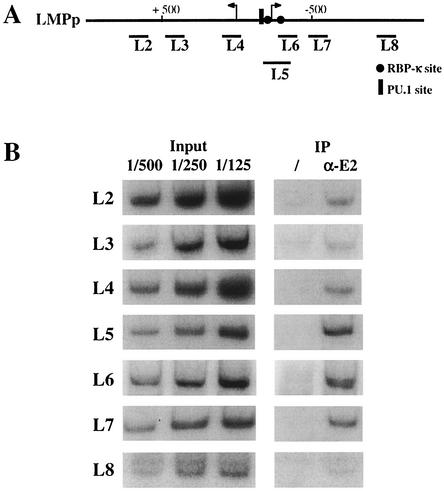
Specific recruitment of EBNA2 onto its responsive element in the LMP promoter. (A) Schematic representation of the EBV genomic region carrying the LMPp bidirectional promoter. Arrows indicate the starts of transcription. Binding sites for RBP-Jκ and PU.1 are also indicated. The positions of the PCR fragments (L2 to L8) used for the ChIP analysis of the LMPp promoter are shown underneath. (B) Primary PCR data obtained from an anti-EBNA2 ChIP experiment. Chromatin fragments (cross-linked with formaldehyde) were prepared from ER/EB2-5 cells cultivated in the presence of β-estradiol and then either immunoprecipitated with an anti-EBNA2 antibody (α-E2) or mock-immunoprecipitated (/). The coimmunoprecipitated DNA was PCR amplified with the various primer pairs (L2 to L8) listed in Table 1, in the presence of 0.1 μCi of [α-32P]dCTP. For quantification, various dilutions of DNA purified from the original chromatin preparation (input) were concomitantly PCR amplified with the same primer pairs. The PCR-amplified fragments were then analyzed on 5% polyacrylamide gels and autoradiographed. The bands were subsequently quantified with a Storm PhosphorImager. The amount of DNA amplified from the mock-immunoprecipitated chromatin was systematically subtracted from the amount of DNA amplified from the specific immunoprecipitated chromatin, and the results are expressed as a percentage of immunoprecipitated DNA relative to the quantity of DNA present before immunoprecipitation (input). The results of such a quantification for the EBNA2 coimmunoprecipitated LMPp DNA fragments are presented in Fig. 2B.
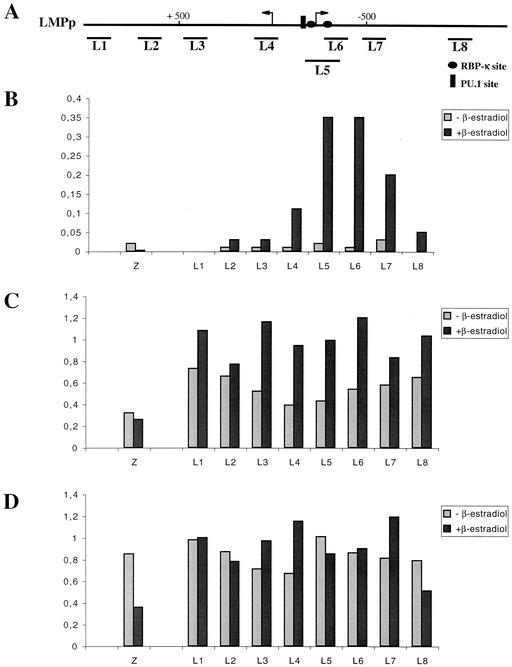
Recruitment of EBNA2 onto the LMPp promoter in vivo correlates with a local increase in the acetylation of histone H3 but not histone H4. (A) Schematic representation of the EBV genomic region carrying the LMPp bidirectional promoter. Arrows indicate the starts of transcription. Binding sites for RBP-Jκ and PU.1 are also indicated. The positions of the PCR fragments (L1 to L8) used for the ChIP analysis of the LMPp promoter are shown underneath. (B) Chromatin from ER/EB2-5 cells cultivated in the presence of β-estradiol (dark gray) or left 3 days in the absence of estrogen (light gray) was fixed by formaldehyde treatment. Chromatin fragments (L1 to L8 for the LMPp region and Z for the control Zp promoter) were precipitated with an antibody specific for EBNA2. The amounts of coimmunoprecipitated DNA determined by quantitative PCR are shown as a percentage of the respective input DNA. (C) Same as panel B except for the use of an antibody specific for diacetylated histone H3 (Ac9/14). (D) Same as panel B except for the use of an antibody specific for tetraacetylated histone H4 (tetra Ac).
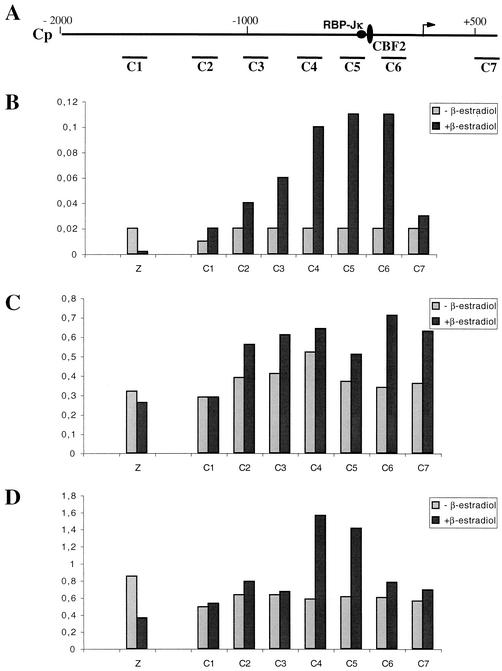
Recruitment of EBNA2 onto the Cp promoter in vivo correlates with a slight increase in the acetylation of histone H3 and a significant and very localized increase in histone H4 acetylation. (A) Schematic representation of the EBV genomic region carrying the Cp promoter. Arrows indicate the start of transcription. Binding sites for RBP-Jκ and CBF-2 are also indicated. The positions of the PCR fragments (C1 to C8) used for the ChIP analysis of the Cp promoter are shown underneath. (B) Chromatin from ER/EB2-5 cells cultivated in the presence of β-estradiol (dark gray) or left for 3 days in the absence of estrogen (light gray) was fixed by formaldehyde treatment. Chromatin fragments (C1 to C7 for the Cp region and Z for the control Zp promoter) were precipitated with an antibody specific for EBNA2. The amounts of coimmunoprecipitated DNA determined by quantitative PCR are shown as a percentage of the respective input DNA. (C) Same as panel B except for the use of an antibody specific for diacetylated histone H3 (Ac9/14). (D) Same as panel B except for the use of an antibody specific for tetraacetylated histone H4 (tetra Ac).
References
-
- Artavanis-Tsakonas, S., M. D. Rand, and R. J. Lake. 1999. Notch signaling: cell fate control and signal integration in development. Science 284:770-776. - PubMed
-
- Fahraeus, R., A. Jansson, A. Sjöblom, T. Nilsson, G. Klein, and L. Rymo. 1993. Cell phenotype-dependent control of Epstein-Barr virus latent membrane protein 1 gene regulatory sequences. Virology 195:71-80. - PubMed
Publication types
MeSH terms
Substances
LinkOut - more resources
Full Text Sources
