doi: 10.1038/sj.embor.embor888.
Circles in the sand
Affiliations
- PMID: 12835752
- PMCID: PMC1326327
- DOI: 10.1038/sj.embor.embor888
Item in Clipboard
Circles in the sand
EMBO Rep.
2003 Jul.
Abstract
Workshop on Chromosome Replication to Cell Division: 40 Years Anniversary of the Replicon Theory
Figures

A drawing in the sand of a replicon as presented in Jacob et al. (1963). The main circle represents the replicon, the square box represents the replicator, and the arrow indicates where the initiator protein is encoded, which, when synthesized, binds to the replicator. (Figure provided by M. Méchali.)
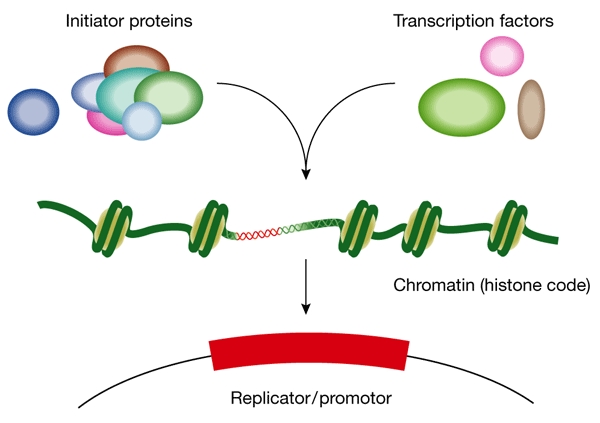
Initiation of DNA replication in eukaryotes is regulated by the presence of initiator proteins and transcription factors and depends on nucleosome localization. (Figure provided by A. Altman.)
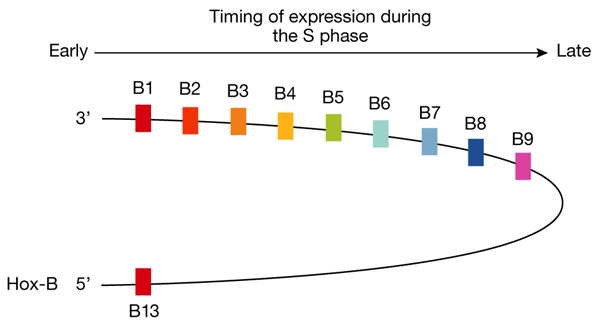
Timing of expression of the Hox-B genes correlates with genomic position and with the timing of replication of the individual genes. (Figure provided by M. Méchali.)
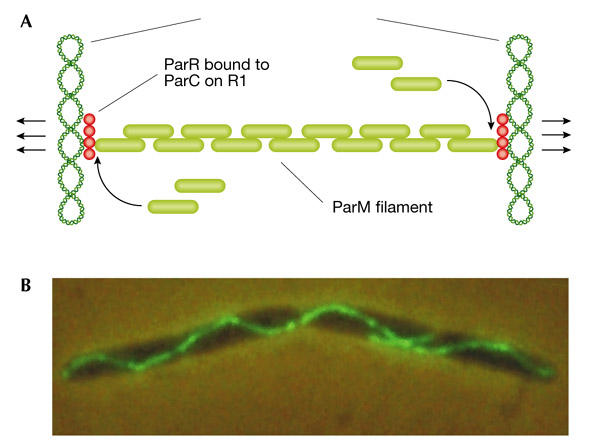
The actin-like ParM protein ensures correct partitioning of R1 plasmids in Escherichia coli. (A) Insertion of new ParM monomers (green bricks) occurs at the interface with ParR (red circles), which is bound to the R1 parC sites. This insertion pushes the R1 plasmids apart. (B) Elongated E. coli cell contaning fluorescent ParM filaments. (Figure provided by K. Gerdes.)

The EMBO workshop 'Chromosome Replication to Cell Division', organized by S.D. Ehrlich, A. Falaschi, G. Buttin, F. Cuzin, L. Jannière, M. Kohiyama, G. Pierron and J. Rouvière-Yaniv, took place in Villefranche-sur-mer, France, on 18–22 January 2003.



References
-
- Bell S.P. (2002) The origin recognition complex: from simple origins to complex functions. Genes Dev., 16, 659–672. - PubMed
-
- Jacob F., Brenner S. & Cuzin F. (1963) On the regulation of DNA replication in bacteria. Cold Spring Harbor Symp. Quant. Biol., 28, 329–348.
-
- Haering C.H., Lowe J., Hochwagen A. & Nasmyth K. (2002) Molecular architecture of SMC proteins and the yeast cohesion complex. Mol. Cell, 9, 773–778. - PubMed
-
- Lemon K.P. & Grossman A.D. (1998) Localization of bacterial DNA polymerase: evidence for a factory model of replication. Science, 282, 1516–1519. - PubMed
Publication types
MeSH terms
Substances
LinkOut - more resources
Full Text Sources