. 2003 Jul;69(7):3858-67.
doi: 10.1128/AEM.69.7.3858-3867.2003.

Microbial diversity of cryptoendolithic communities from the McMurdo Dry Valleys, Antarctica

Affiliations

Microbial diversity of cryptoendolithic communities from the McMurdo Dry Valleys, Antarctica

José R de la Torre et al. Appl Environ Microbiol. 2003 Jul.

Abstract

In the McMurdo Dry Valleys of Antarctica, microorganisms colonize the pore spaces of exposed rocks and are thereby protected from the desiccating environmental conditions on the surface. These cryptoendolithic communities have received attention in microscopy and culture-based studies but have not been examined by molecular approaches. We surveyed the microbial biodiversity of selected cryptoendolithic communities by analyzing clone libraries of rRNA genes amplified from environmental DNA. Over 1,100 individual clones from two types of cryptoendolithic communities, cyanobacterium dominated and lichen dominated, were analyzed. Clones fell into 51 relatedness groups (phylotypes) with > or =98% rRNA sequence identity (46 bacterial and 5 eucaryal). No representatives of Archaea were detected. No phylotypes were shared between the two classes of endolithic communities studied. Clone libraries based on both types of communities were dominated by a relatively small number of phylotypes that, because of their relative abundance, presumably represent the main primary producers in these communities. In the lichen-dominated community, three rRNA sequences, from a fungus, a green alga, and a chloroplast, of the types known to be associated with lichens, accounted for over 70% of the clones. This high abundance confirms the dominance of lichens in this community. In contrast, analysis of the supposedly cyanobacterium-dominated community indicated, in addition to cyanobacteria, at least two unsuspected organisms that, because of their abundance, may play important roles in the community. These included a member of the alpha subdivision of the Proteobacteria that potentially is capable of aerobic anoxygenic photosynthesis and a distant relative of Deinococcus that defines, along with other Deinococcus-related sequences from Antarctica, a new clade within the Thermus-Deinococcus bacterial phylogenetic division.


Figures
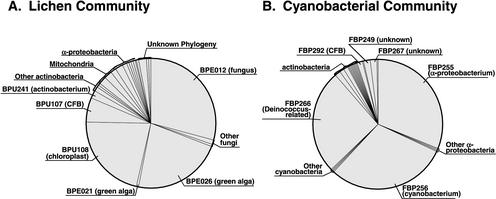
FIG. 1.
FIG. 1.
Phylotypes in clone libraries. Diagrams show the relative abundance of SSU rDNA phylotypes in clone libraries from the lichen-dominated community and the cyanobacterium-dominated community. CFB, Cytophagales-Flavobacteria-Bacteroides group.
FIG. 2.
FIG. 2.
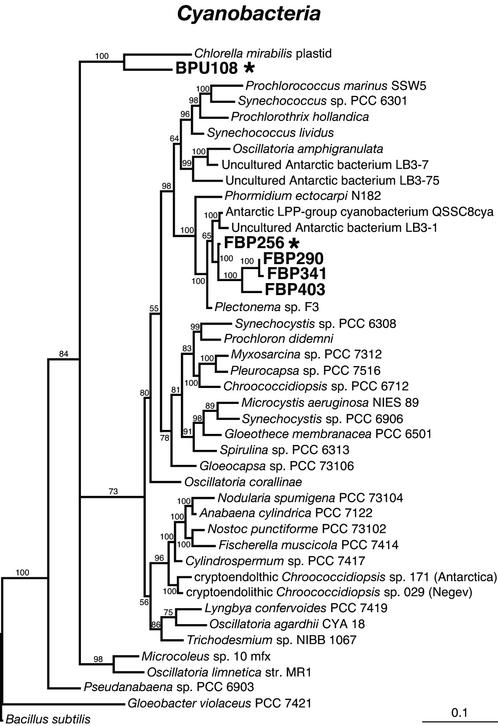
Phylogenetic tree of cyanobacterial and chloroplast SSU rRNA sequences. Maximum-likelihood analysis illustrates the relationship of selected cryptoendolithic SSU rDNA clones to representative cyanobacterial and chloroplast sequences. Clones from this study are indicated in larger, bold type. Clones marked with an asterisk indicate abundant phylotypes in the clone library (Tables 1 and 2). Sequences from two molecular surveys of McMurdo Dry Valleys lake ice covers (19, 32) and Antarctic sublithic soils (36) are indicated by the designations LB3 and QSSC, respectively. Bootstrap values, given as percentages of 100 replicate trees, are indicated for branches supported by more than 50% of the trees. The scale bar represents 0.1 nucleotide change per position.
FIG. 3.
FIG. 3.
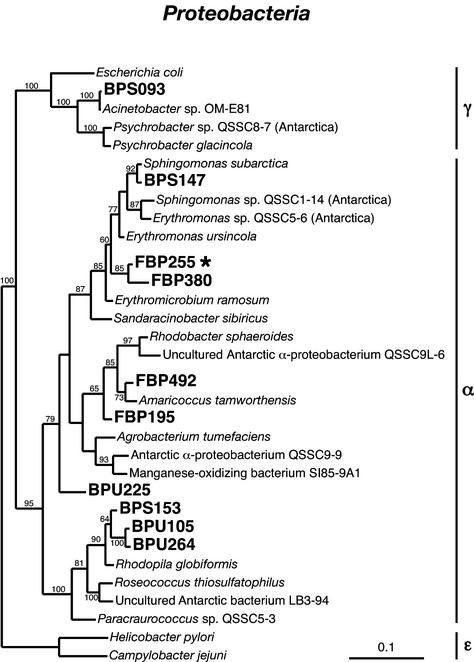
Maximum-likelihood analysis illustrating the relationship of selected cryptoendolithic SSU rDNA clones to representative sequences associated with members of the Proteobacteria. Clones from this study are indicated in larger, bold type. Clones marked with an asterisk indicate abundant phylotypes in the clone library (Tables 1 and 2). Sequences from a molecular survey of Antarctic sublithic soils (36) are indicated by the designation QSSC. Bootstrap values, given as percentages of 100 replicate trees, are indicated for branches supported by more than 50% of the trees. The scale bar represents 0.1 nucleotide change per position.
FIG. 4.
FIG. 4.
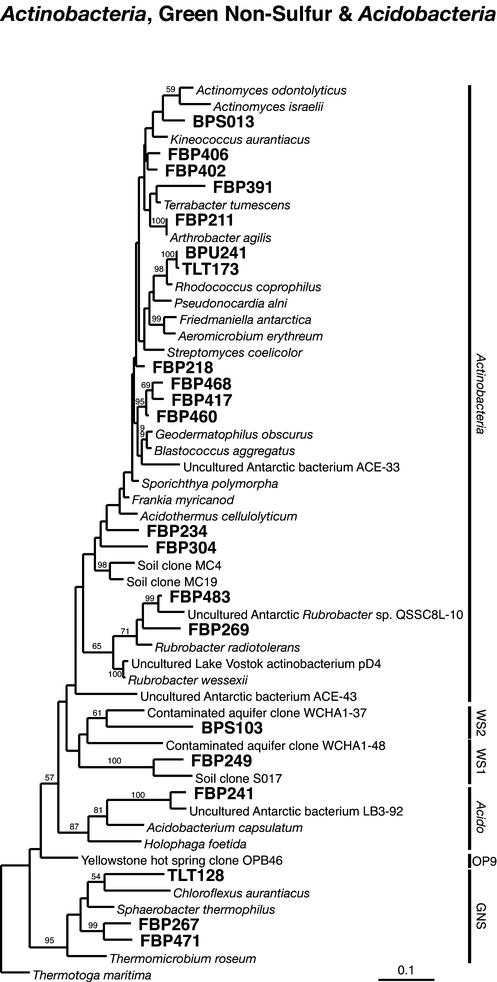
Molecular phylogenetic analysis of SSU rRNA clones related to members of the Actinobacteria, green nonsulfur bacteria, and Acidobacteria. Maximum-likelihood analysis illustrates the relationship of selected cryptoendolithic SSU rDNA clones to representative actinobacterial, green nonsulfur bacterial (GNS), and acidobacterial (Acido) sequences. Clones from this study are indicated in larger, bold type. Sequences from two molecular surveys of McMurdo Dry Valleys lake ice covers (19, 32) and Antarctic sublithic soils (36) are indicated by the designations LB3 and QSSC, respectively. Bootstrap values, given as percentages of 100 replicate trees, are indicated for branches supported by more than 50% of the trees. The scale bar represents 0.1 nucleotide change per position. WS1, WS2, and OP9, candidate phylogenetic groups (13, 22).
FIG. 5.
FIG. 5.
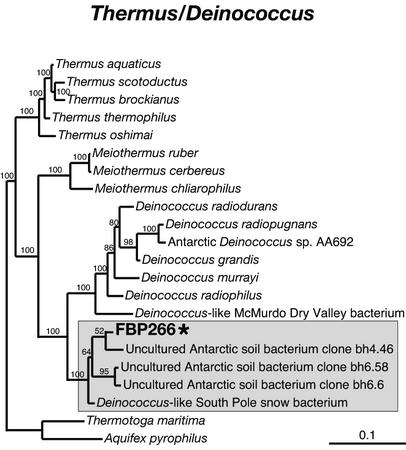
Phylogenetic tree of Thermus-Deinococcus SSU rRNA sequences. Maximum-likelihood analysis illustrates the evolutionary relationship of the cryptoendolithic SSU rDNA clone FBP266 to representative Thermus sp., Deinococcus sp., and environmental 16S rRNA sequences. Clone FBP266 from this study is indicated in larger, bold type. The asterisk by clone FBP266 indicates that it is an abundant phylotype in the clone library (Table 2). Sequences from a molecular survey of McMurdo Dry Valleys soils (Shravage et al., unpublished) are indicated by the designation “bh.” The unpublished 16S rDNA sequence for Deinococcus sp. strain AA692, a Deinococcus relative isolated by Hirsch and colleagues from a sample of the lichen-dominated community at Battleship Promontory in the McMurdo Dry Valleys (21), was kindly provided by E. Stackebrandt and P. Hirsch (personal communication). The box indicates the new clade of Deinococcus-related sequences defined by FBP266, the South Pole snow Deinococcus-related sequence, and the Antarctic soil clones. All of the sequences in this proposed new clade have been found exclusively in Antarctic microbial communities. Bootstrap values, given as percentages of 100 replicate trees, are indicated for branches supported by more than 50% of the trees. The scale bar represents 0.1 nucleotide change per position.
FIG. 6.
FIG. 6.
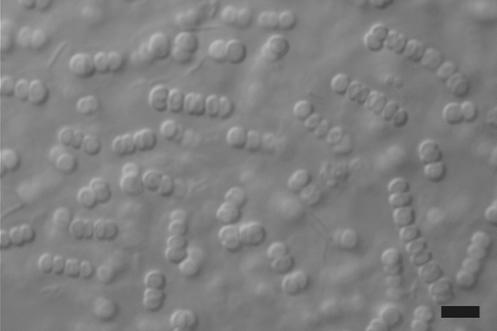
Photomicrograph of cyanobacterial cells isolated from colonies growing on oligotrophic SNAX agar at 4°C under constant illumination. Scale bar, 10 μm.

References

    1. Ahmadjian, V., and J. B. Jacobs. 1987. Studies on the development of synthetic lichens. Bibl. Lichenol. 25:47-58.
    1. Altschul, S. F., T. L. Madden, A. A. Schäffer, J. Zhang, Z. Zhang, W. Miller, and D. J. Lipman. 1997. Gapped BLAST and PSI-BLAST: a new generation of protein database search programs. Nucleic Acids Res. 25:3389-3402. - PMC - PubMed
    1. Amann, R. I., W. Ludwig, and K. H. Schleifer. 1995. Phylogenetic identification and in situ detection of individual microbial cells without cultivation. Microbiol. Rev. 59:143-169. - PMC - PubMed
    1. Archibald, P. A., E. I. Friedmann, and R. Ocampo-Friedmann. 1983. Representatives of the cryptoendolithic flora of Antarctica. J. Phycol. 19(Suppl.):7.
    1. Barns, S. M., R. E. Fundyga, M. W. Jeffries, and N. R. Pace. 1994. Remarkable archaeal diversity detected in a Yellowstone National Park hot spring environment. Proc. Natl. Acad. Sci. USA 91:1609-1613. - PMC - PubMed

Publication types

MeSH terms

Substances

Associated data

LinkOut - more resources