. 2003 Jul;139(5):998-1004.
doi: 10.1038/sj.bjp.0705328.

Evidence that central 5-HT2A and 5-HT2B/C receptors regulate 5-HT cell firing in the dorsal raphe nucleus of the anaesthetised rat

Affiliations

Evidence that central 5-HT2A and 5-HT2B/C receptors regulate 5-HT cell firing in the dorsal raphe nucleus of the anaesthetised rat

L J Boothman et al. Br J Pharmacol. 2003 Jul.

Erratum in

  • Br J Pharmacol. 2003 Sep;140(1):227-8

Abstract

1. Systemic administration of phenethylamine-derived, 5-hydroxytryptamine(2) (5-HT(2)) receptor agonists inhibits the firing of midbrain 5-HT neurones, but the 5-HT receptors involved are poorly defined, and the contribution of peripheral mechanisms is uncertain. This study addresses these issues using extracellular recordings of 5-HT neurones in the dorsal raphe nucleus of anaesthetised rats. 2. The 5-HT(2) receptor agonists DOI ((+/-)-2,5-dimethoxy-4-iodoamphetamine hydrochloride) and DOB ((+/-)-2,5-dimethoxy-4-bromoamphetamine hydrobromide), caused a dose-related (10-100 micro g kg(-1) i.v.) inhibition of 5-HT neuronal activity, with the highest dose reducing firing rates by >80%. 3. Pretreatment with the 5-HT(2) receptor antagonist ritanserin (1 mg kg(-1) i.v.) completely blocked the action of DOI. The 5-HT(2A) receptor antagonist MDL 100,907 (0.2 mg kg(-1) i.v.) blocked the action of both DOI and DOB. In comparison, the 5-HT(2B/C) receptor antagonist SB 206553 (0.5 mg kg(-1) i.v.) caused a small, but statistically significant, shift to the right in the dose response to DOI and DOB. 4. Pretreatment with the peripherally acting 5-HT(2) receptor antagonist BW 501C67 (0.1 mg kg(-1) i.v.) had no effect on the DOI-induced inhibition of 5-HT cell firing, but completely blocked the DOI-induced rise in mean arterial blood pressure. 5. These data indicate that the inhibition of 5-HT cell firing induced by systemic administration of DOI and DOB is mediated predominantly by the 5-HT(2A) receptor-subtype, but that 5-HT(2B/C) receptors also play a minor role. Moreover, central and not peripheral mechanisms are involved. Given evidence that 5-HT(2) receptors are not located on 5-HT neurones, postsynaptic 5-HT feedback mechanisms are implicated.


Figures
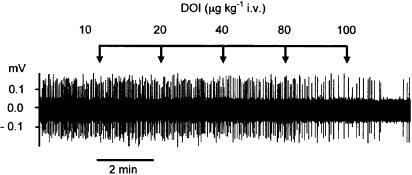
Figure 1
Figure 1
Effect of the 5-HT2 agonist DOI on the firing of a 5-HT neurone in the DRN of an anaesthetised rat. Each vertical line in the spike train represents a single action potential. DOI was administered in increasing doses at 2 min intervals as indicated.
Figure 2
Figure 2
Rate metre recordings demonstrating the effect of DOI on 5-HT cell firing either (a) alone or in rats pretreated with (b) the 5-HT2 receptor antagonist ritanserin (1 mg kg−1 i.v.), (c) the 5-HT2A receptor antagonist MDL 100,907 (0.2 mg kg−1 i.v.) or (d) the 5-HT2B/C receptor antagonist SB 206553 (0.5 mg kg−1 i.v.). Antagonists were administered 5 min prior to DOI, which was given in increasing doses at 2 min intervals. Note also the characteristic inhibitory response of the 5-HT neurones to the 5-HT1A receptor agonist 8-OH-DPAT (10 μg kg−1 i.v.).
Figure 3
Figure 3
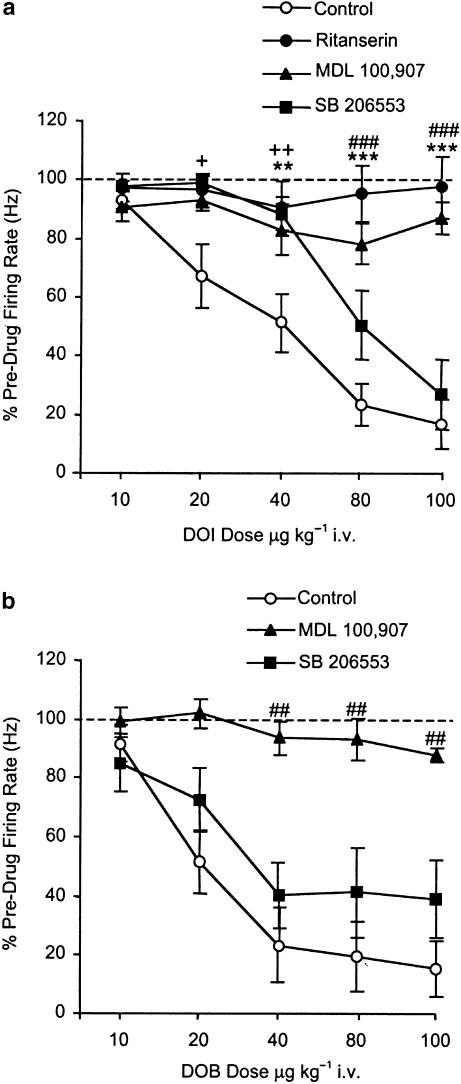
Effect of DOI (a) and DOB (b) in the presence of the 5-HT2 receptor antagonist ritanserin (1 mg kg−1 i.v.), the 5-HT2A receptor antagonist MDL 100,907 (0.2 mg kg−1 i.v.) or the 5-HT2B/C receptor antagonist SB 206553 (0.5 mg kg−1 i.v.). Antagonists were administered 5 min prior to either DOI or DOB, which was given in increasing doses at 2 min intervals. Controls received DOI or DOB alone. Data points are mean±s.e.m. of nobservations at agonist doses of 10, 20, 40, 80, 100 μg kg−1 respectively: (a) control n=8,8,8,8,6; ritanserin n=6,6,5,4,4; MDL 100,907 n=7,6,4,4,4; SB 206553 n=7,6,6,5,5; (b) control n=5,5,5,5,5; MDL 100907 n=3,3,3,3,3; SB 205663 n=8,8,8,6,6. **P<0.01, ***P<0.001 for control versus ritanserin, ##P<0.01, ###P<0.001 for control versus MDL 100907, +P<0.05, ++P<0.01 for control versus SB 206553 (two-way ANOVA with Bonferroni's post hoc test).
Figure 4
Figure 4
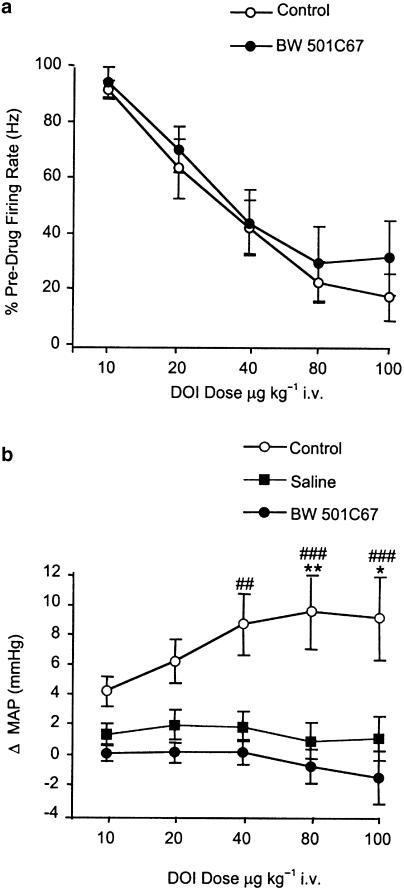
Effect of DOI on 5-HT neuronal activity (a) and mean arterial blood pressure (b) in the presence and absence of the peripheral 5-HT2 receptor antagonist BW 501C67 (0.1 mg kg−1 i.v.). DOI was given in increasing doses at 2 min intervals. When tested, BW 501C67 was administered 5 min prior to DOI. Controls received DOI alone and the saline condition received five sequential injections of saline. Data points are mean±s.e.m. of n observations at agonist doses of 10, 20, 40, 80,100 μg kg−1 respectively: (a) control n=8,8,8,8,6; BW 501C67 n=8,7,6,6,5; (b) control n=6,6,6,6,6; saline n=4,4,4,4,4; BW 501C67 n=6,6,6,6,6. *P<0.05, **P<0.01 for control versus saline, ##P<0.01, ###P<0.001 for control versus BW 501C67 (two-way ANOVA with Bonferroni's post hoc test).
Figure 5
Figure 5
Effect of 5-HT receptor antagonists and vehicle alone on the firing rate (a), and firing regularity (b) of 5-HT neurones. Data for 5-HT2 receptor agonists are also included in (b). Measurements were made during the final 1 min of a 5 min pretreatment for antagonists or a 2 min period for agonist or vehicle. Doses were ritanserin (1.0 mg kg−1 i.v.), MDL 100,907 (0.2 mg kg−1 i.v.), SB 206553 (0.5 mg kg−1 i.v.), BW 501C67 (0.1 mg kg−1 i.v.), DOI (40 μg kg−1 i.v.), DOB (40 μg kg−1 i.v.). Data are mean±s.e.m. from groups of 3–10 rats. P>0.05 versus predrug values (Student's two-tailed paired t-tests).

References

    1. AGHAJANIAN G.K.Feedback regulation of central monoaminergic neurones: evidence from single cell recording studies Essays in Neurochemistry and Neuropharmacology 1978Chichester: J. Wiley and Sons Ltd; 1–32.ed. M Youdim, D.S., Lovenberg, W., Lagnado, J. pp - PubMed
    1. AGHAJANIAN G.K., FOOTE W.E., SHEARD M.H. Action of psychotogenic drugs on single midbrain raphe neurons. J. Pharmacol. Exp. Ther. 1970;171:178–187. - PubMed
    1. AGHAJANIAN G.K., WANG R.Y. Habenular and other midbrain raphe afferents demonstrated by a modified retrograde tracing technique. Brain Res. 1977;122:229–242. - PubMed
    1. ARTIGAS F., CELADA P., LARUELLE M., ADELL A. How does pindolol improve antidepressant action. Trends Pharmacol. Sci. 2001;22:224–228. - PubMed
    1. BARNES N.M., SHARP T. A review of central 5-HT receptors and their function. Neuropharmacology. 1999;38:1083–1152. - PubMed

Publication types

MeSH terms

LinkOut - more resources