. 2003 Jul 5;311(2):263-74.
doi: 10.1016/s0042-6822(03)00122-3.

The spacing between adjacent binding sites in the family of repeats affects the functions of Epstein-Barr nuclear antigen 1 in transcription activation and stable plasmid maintenance

Affiliations

The spacing between adjacent binding sites in the family of repeats affects the functions of Epstein-Barr nuclear antigen 1 in transcription activation and stable plasmid maintenance

Christy Hebner et al. Virology. .

Abstract

Epstein-Barr virus (EBV) and the closely related Herpesvirus papio (HVP) are stably replicated as episomes in proliferating latently infected cells. Maintenance and partitioning of these viral plasmids requires a viral sequence in cis, termed the family of repeats (FR), that is bound by a viral protein, Epstein-Barr nuclear antigen 1 (EBNA1). Upon binding FR, EBNA1 maintains viral genomes in proliferating cells and activates transcription from viral promoters required for immortalization. FR from either virus encodes multiple binding sites for the viral maintenance protein, EBNA1, with the FR from the prototypic B95-8 strain of EBV containing 20 binding sites, and FR from HVP containing 8 binding sites. In addition to differences in the number of EBNA1-binding sites, adjacent binding sites in the EBV FR are typically separated by 14 base pairs (bp), but are separated by 10 bp in HVP. We tested whether the number of binding sites, as well as the distance between adjacent binding sites, affects the function of EBNA1 in transcription activation or plasmid maintenance. Our results indicate that EBNA1 activates transcription more efficiently when adjacent binding sites are separated by 10 bp, the spacing observed in HVP. In contrast, using two separate assays, we demonstrate that plasmid maintenance is greatly augmented when adjacent EBNA1-binding sites are separated by 14 bp, and therefore, presumably lie on the same face of the DNA double helix. These results provide indication that the functions of EBNA1 in transcription activation and plasmid maintenance are separable.


Figures
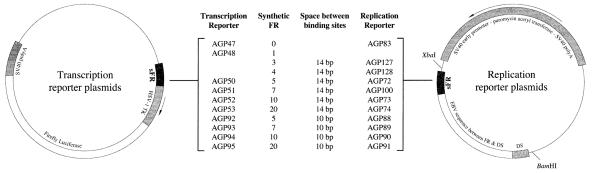
Fig. 1
Fig. 1
Schematic representations of the transcription and replication reporter plasmids used in this study. The name of each plasmid, the number of EBNA1-binding sites within the sFR element in the plasmid, and the space between adjacent EBNA1-binding sites in sFR is indicated. Transcription reporter plasmids contain the firefly luciferase gene under the control of the HSV-1 thymidine kinase promoter. Replication reporter plasmids were constructed using pPUR as a backbone and contain the DS element from EBV, along with EBV sequences between FR and DS. The location of XbaI and BamHI recognition sites used in Southern hybridization experiments is indicated.
Fig. 2
Fig. 2
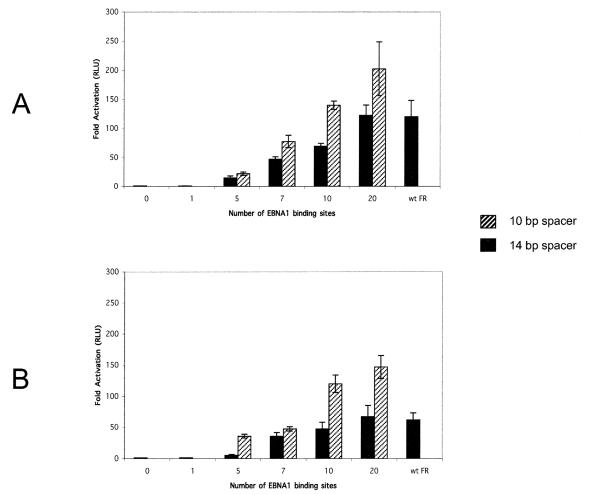
EBNA1-binding sites spaced 14 bp apart activate transcription more efficiently in C33A/EBNA1 cells than EBNA1-binding sites spaced 14 bp apart. Luciferase assays were performed 2 days (A) or 4 days (B) after introducing the transcription reporter plasmids described in Fig. 1 into C33A/1553 cells. The y-axis represents the fold induction of luciferase activity over that observed with the backbone reporter AGP47 48 h posttransfection, and the number of binding sites in sFR is indicated on the x-axis. The solid bars represent results from reporters in which adjacent EBNA1-binding sites are separated by 14 bp, while hatched bars represent results from reporters in which adjacent EBNA1-binding sites are separated by 10 bp. wtFR refers to use of the plasmid 985, FR-TK-luciferase, as the transcription reporter.
Fig. 3
Fig. 3
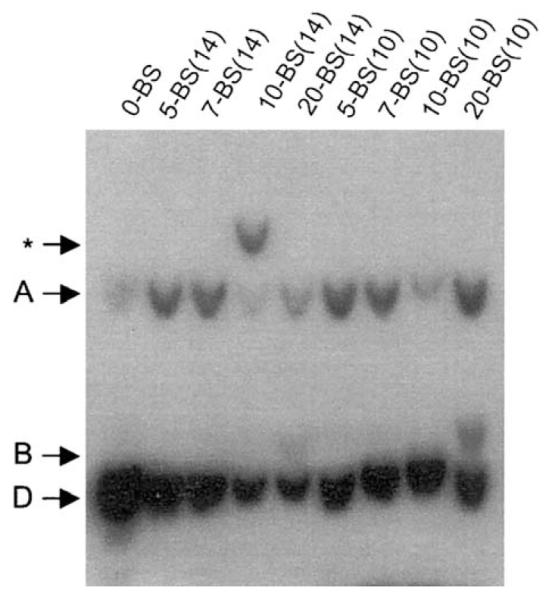
The distance between adjacent EBNA1-binding sites in sFR and the number of EBNA1-binding sites in sFR do not affect synthesis of oriP-plasmids 4 days after their introduction into 293/EBNA1 cells. 293/EBNA1 cells were transfected with the replication reporter plasmids described in Fig. 1. Four days after transfection, episomal DNAs were recovered from transfected cells, digested with DpnI, BamHI, and XbaI, and quantified by Southern hybridization. Digested DNA recovered from 1 × 10⁷ cells was loaded in each lane. The number of EBNA1-binding sites in sFR is indicated above each lane, and the spacer between adjacent EBNA1-binding sites in sFR is indicated in parentheses. DpnI-resistant, BamHI/XbaI-digested fragments are designated as A and B. The intensity of A was used to estimate the copy number of newly synthesized plasmids per cell, by comparison with standards. AGP73 recalcitrant to BamHI-digestion as described in the text is designated as *. D represents the largest fragment created after DpnI-digestion of the input bacterially dam-methylated reporter DNAs.
Fig. 4
Fig. 4
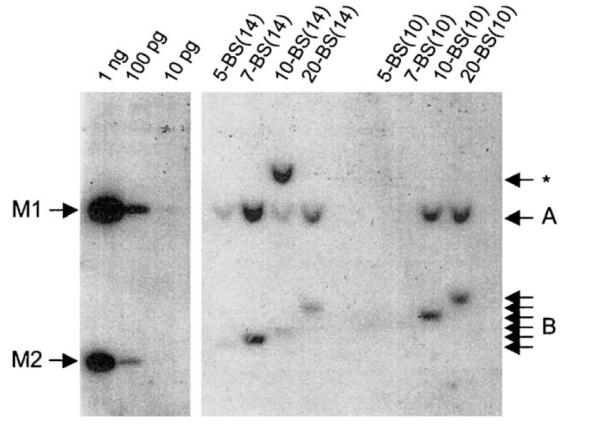
EBNA1-binding sites in FR spaced 14 bp apart support stable replication more effectively than binding sites spaced 10 bp apart. 293/EBNA1 cells were transfected with the replication reporter plasmids described in Fig. 1 and subjected to 3 weeks of puromycin selection. Episomal DNAs were recovered from pools of resistant cells, digested as described in Fig. 3, and quantified by Southern hybridization. Digested DNA recovered from 5 × 10⁶ cells were loaded in each lane. The blot is labeled as in Fig. 3. The number of EBNA1-binding sites in sFR is indicated above each lane, and the spacer between adjacent EBNA1-binding sites in sFR is indicated in parentheses. Measures of 10 pg, 100 pg, or 1 ng of BamHI/XbaI-digested AGP83 were used as standards during quantitation. Probe hybridized to the standards is indicated by M1 and M2.
Fig. 5
Fig. 5
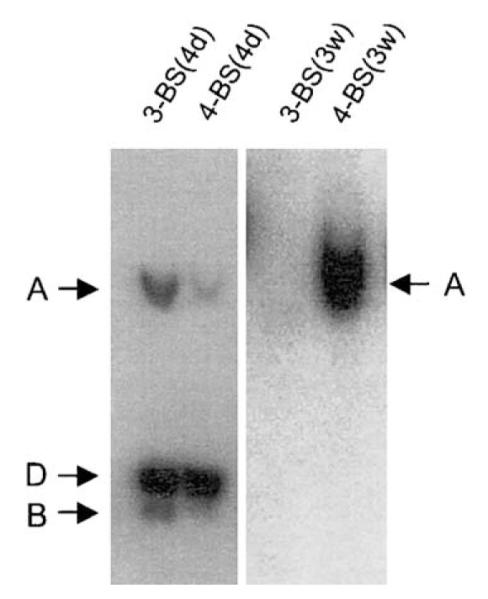
Maintenance of replicated oriP-plasmids in 293/EBNA1 cells requires at least four EBNA1-binding sites spaced 14 bp apart in sFR. Replication reporters that contain three binding sites in sFR, AGP127, or four binding sites, AGP128, were introduced into 293/EBNA1 cells. Episomal DNAs were recovered either 4 days (4d) posttransfection, or from pooled colonies after 3 weeks (3w) of puromycin selection. The number of binding sites in sFR is indicated above each lane, and the time posttransfection is indicated in parentheses. Each lane was loaded with DpnI/BamHI/XbaI-digested DNAs recovered from 1 × 10⁷ cells (4d) or 2 × 10⁷ cells (3w).

References

    1. Adams A. Replication of latent Epstein–Barr virus genomes in Raji cells. J. Virol. 1987;61(5):1743–1746. - PMC - PubMed
    1. Aiyar A, Sugden B. Fusions between Epstein–Barr viral nuclear antigen-1 of Epstein–Barr virus and the large T-antigen of simian virus 40 replicate their cognate origins. J. Biol. Chem. 1998;273(49):33073–33081. - PubMed
    1. Aiyar A, Tyree C, Sugden B. The plasmid replicon of EBV consists of multiple cis-acting elements that facilitate DNA synthesis by the cell and a viral maintenance element. EMBO J. 1998;17(21):6394–6403. - PMC - PubMed
    1. Ambinder RF, Shah WA, Rawlins DR, Hayward GS, Hayward SD. Definition of the sequence requirements for binding of the EBNA-1 protein to its palindromic target sites in Epstein-Barr virus DNA. J. Virol. 1990;64(5):2369–2379. - PMC - PubMed
    1. Baer R, Bankier AT, Biggin MD, Deininger PL, Farrell PJ, Gibson TJ, Hatfull G, Hudson GS, Satchwell SC, Seguin C, et al. DNA sequence and expression of the B95-8 Epstein-Barr virus genome. Nature. 1984;310(5974):207–211. - PubMed

Publication types

MeSH terms

Substances

LinkOut - more resources