. 2003 Oct 1;552(Pt 1):185-95.
doi: 10.1113/jphysiol.2003.046904. Epub 2003 Jul 4.

Role of elastin in spontaneously hypertensive rat small mesenteric artery remodelling

Affiliations

Role of elastin in spontaneously hypertensive rat small mesenteric artery remodelling

Ana M Briones et al. J Physiol. .

Abstract

Chronic hypertension is associated with resistance artery remodelling and mechanical alterations. However, the contribution of elastin has not been thoroughly studied. Our objective was to evaluate the role of elastin in vascular remodelling of mesenteric resistance arteries (MRA) from spontaneously hypertensive rats (SHR). MRA segments from Wistar Kyoto rats (WKY) and SHR were pressurised under passive conditions at a range of physiological pressures with pressure myography. Confocal microscopy was used to determine differences in the quantity and organisation of elastin in intact pressure-fixed arteries. To assess the contribution of elastin to MRA structure and mechanics, myograph-mounted vessels were studied before and after elastase incubation. When compared with WKY, MRA from SHR showed: (1) a smaller lumen, (2) decreased distensibility at low pressures, (3) a leftward shift of the stress-strain relationship, (4) redistribution of elastin within the internal elastic lamina (IEL) leading to smaller fenestrae but no change in fenestrae number or elastin amount. Elastase incubation (1) fragmented the structure of IEL in a concentration-dependent fashion, (2) abolished all the structural and mechanical differences between strains, and (3) decreased distensibility at low pressures. The study shows the overriding role of elastin in determining vascular dimensions and mechanical properties in a resistance artery. In addition, it informs hypertensive remodelling. MRA remodelling and increased stiffness are accompanied by elastin restructuring within the IEL and elastin degradation reverses structural and mechanical alterations of SHR MRA. Differences in elastin organisation are, therefore, a central element in small artery remodelling in hypertension.


Figures
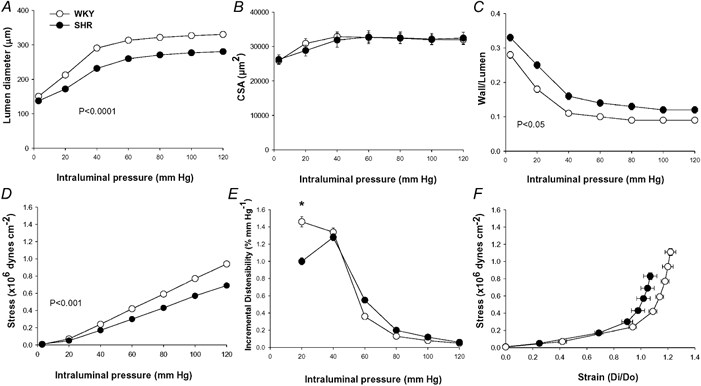
Figure 1
Figure 1. Comparison of structural and mechanical parameters in mesenteric resistance arteries (MRA) from WKY and SHR
Lumen diameter−intraluminal pressure (A), cross-sectional area (CSA)−intraluminal pressure (B) and wall:lumen ratio-intraluminal pressure (C), stress-intraluminal pressure (D), incremental distensibility-intraluminal pressure (E) and stress-strain (F) curves in fully relaxed MRA from SHR and WKY rats. Data are expressed as means ± s.e.m. Number of animals = 7−10. P values indicate statistical difference between strains by two-way (rat strain−pressure) ANOVA with repeated measures on the pressure factor. * P < 0.05 SHR vs.WKY at 20 mmHg by Student's unpaired t test.
Figure 2
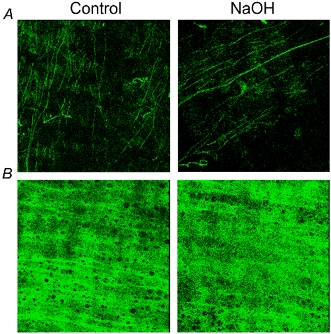
Figure 2. Confocal projections showing the effect of NaOH on elastin autofluorescence of mesenteric resistance arteries (MRA)
MRA segments from WKY rat were incubated for 60 min with 0.1 m NaOH at 75 °C and mounted intact on a slide. Projections were obtained of serial optical sections of the adventitia (A) and internal elastic lamina (B) captured with a fluorescence confocal microscope (×63 oil immersion objective). Image size 238 × 238 μm.
Figure 3
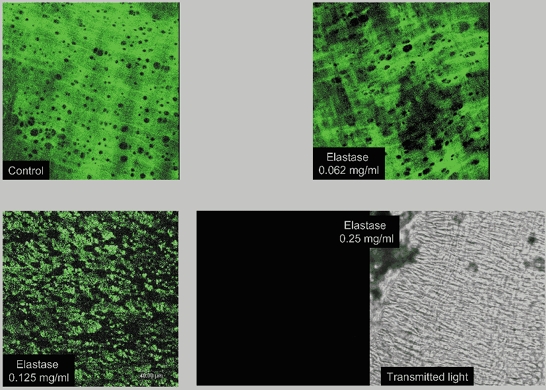
Figure 3. Confocal projections showing the effect of different concentrations of elastase on internal elastic lamina autofluorescence of mesenteric resistance arteries (MRA)
MRA segments from WKY rats were pressurised at 70 mmHg, incubated for 60 min with 0.062, 0.125 or 0.25 mg ml−1 elastase at 37 °C, fixed at 70 mmHg and mounted intact on slides. Projections were obtained of serial optical sections of internal elastic lamina captured with a fluorescence confocal microscope (×63 oil immersion objective lens). Control, without elastase. Right bottom panels show a confocal projection of the internal elastic lamina without fluorescence and the corresponding transmitted light image. Image size 238 × 238 μm.
Figure 4
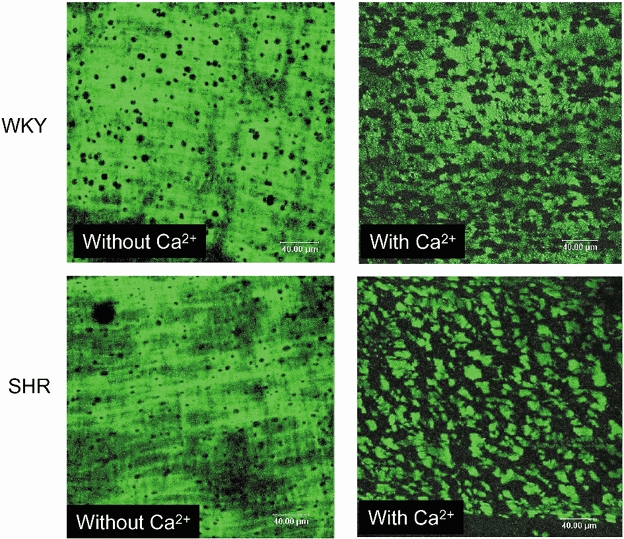
Figure 4. Confocal projections showing the effect calcium on internal elastic lamina degradation by elastase of SHR and WKY mesenteric resistance arteries (MRA)
MRA segments from SHR and WKY rats were pressurised at 70 mmHg, incubated for 60 min with 0.125 mg ml−1 elastase at 37 °C in the presence or absence of calcium, fixed at 70 mmHg and mounted intact on slides. Projections were obtained of serial optical sections of internal elastic lamina captured with a fluorescence confocal microscope (×63 oil immersion objective lens). Image size 238 × 238 μm.
Figure 5
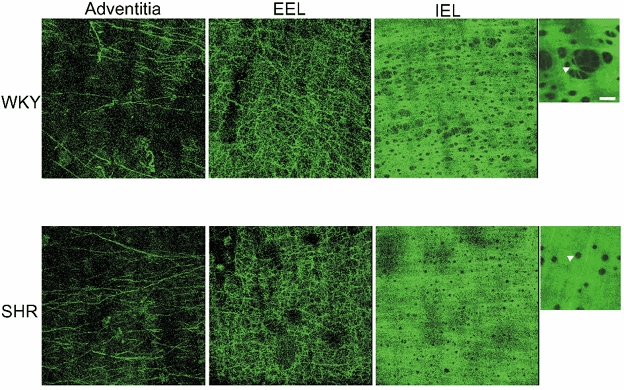
Figure 5. Confocal projections of the adventitia, external elastic lamina and internal elastic lamina from WKY and SHR mesenteric resistance arteries (MRA)
MRA segments were pressure-fixed at 70 mmHg and mounted intact on a slide. Projections were obtained from serial optical sections captured with a fluorescence confocal microscope (×63 oil immersion objective lens). Images show autofluorescence of isolated fibres in the adventitia, external elastic lamina (EEL) and internal elastic lamina (IEL) from WKY and SHR. Image size 238 × 238 μm. Small panels show a detail of IEL and fenestrae size (arrowheads) at higher magnification (×63 oil, zoom 4, bar = 8 μm).
Figure 6
Figure 6. Effect of incubation with elastase on structural parameters of mesenteric resistance arteries (MRA) from WKY and SHR
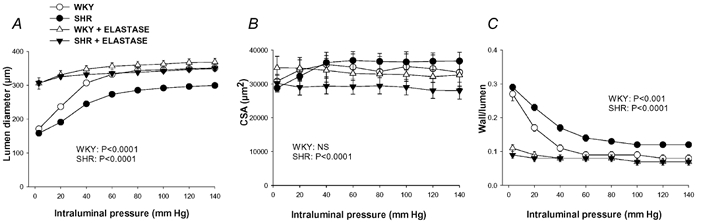
Lumen diameter, cross-sectional area (CSA) and wall:lumen ratio were measured in MRA segments pressurised at several distending pressures before and after incubation with 0.062 mg ml−1 elastase for 60 min at 37 °C (paired experiments). Data are expressed as means ± s.e.m. Number of animals = 7−8. P values indicate statistical differences after elastase incubation for each rat strain; two-way (elastase incubation, pressure) ANOVA with repeated measures on both factors.
Figure 7
Figure 7. Effect of incubation with elastase on mechanical parameters of mesenteric resistance arteries (MRA) from WKY and SHR
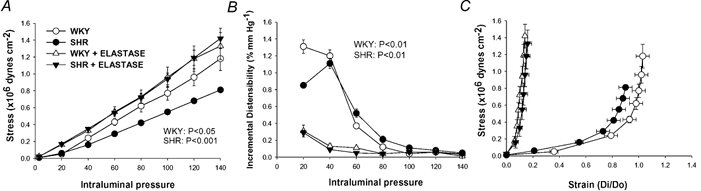
Stress, strain and incremental distensibility were calculated at several distending pressures before and after incubation with 0.062 mg ml−1 elastase for 60 min at 37 °C (paired experiments). Number of animals = 7−8. P values indicate statistical differences after elastase incubation for each rat strain; two-way (elastase incubation, pressure) ANOVA with repeated measures on both factors.

References

    1. Arribas SM, Daly CJ, McGrath JC. Measurements of vascular remodeling by confocal microscopy. In: Conn PM, editor. Methods in Enzymology. Confocal Microscopy. Vol. 307. San Diego: Academic Press; 1999. pp. 246–273. - PubMed
    1. Balo J, Banga J. The elastolytic activity of pancreatic extracts. Biochem J. 1950;46:384–387. - PMC - PubMed
    1. Baumbach GL, Heistad DD. Remodeling of cerebral arterioles in chronic hypertension. Hypertension. 1989;13:968–972. - PubMed
    1. Blomfield J, Farrar JF. The fluorescent properties of maturing arterial elastin. Cardiovasc Res. 1969;3:161–170. - PubMed
    1. Boumaza S, Arribas SM, Osborne-Pellegrin M, McGrath JC, Laurent S, Lacolley P, Challande P. Fenestrations of the carotid internal elastic lamina and structural adaptation in stroke-prone spontaneously hypertensive rats. Hypertension. 2001;37:1101–1107. - PubMed

Publication types

LinkOut - more resources