. 2003 Jul 22;100(15):8710-4.
doi: 10.1073/pnas.1536783100. Epub 2003 Jul 9.

A natural class of robust networks

Affiliations

A natural class of robust networks

Maximino Aldana et al. Proc Natl Acad Sci U S A. .

Abstract

As biological studies shift from molecular description to system analysis we need to identify the design principles of large intracellular networks. In particular, without knowing the molecular details, we want to determine how cells reliably perform essential intracellular tasks. Recent analyses of signaling pathways and regulatory transcription networks have revealed a common network architecture, termed scale-free topology. Although the structural properties of such networks have been thoroughly studied, their dynamical properties remain largely unexplored. We present a prototype for the study of dynamical systems to predict the functional robustness of intracellular networks against variations of their internal parameters. We demonstrate that the dynamical robustness of these complex networks is a direct consequence of their scale-free topology. By contrast, networks with homogeneous random topologies require fine-tuning of their internal parameters to sustain stable dynamical activity. Considering the ubiquity of scale-free networks in nature, we hypothesize that this topology is not only the result of aggregation processes such as preferential attachment; it may also be the result of evolutionary selective processes.


Figures
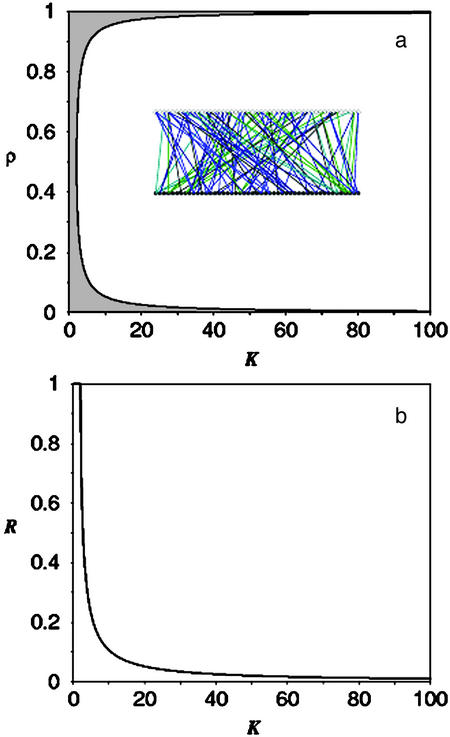
Fig. 1.
Fig. 1.
Dynamical robustness of a Boolean network with random topology. (a) The network dynamics exhibit both chaotic and robust behaviors, depending on the value of the parameters K and ρ. The parameter space K-ρ is then divided into two distinct regimes: chaotic (white) and robust (gray). The curve separating these two regimes is given by the solutions of Eq. 1. For a random network topology (Inset), the parameter space K-ρ is totally dominated by the chaotic regime. Therefore, it is necessary to fine-tune the parameters K and ρ to achieve robust dynamics. (Inset) A typical realization of the random network topology, generated by using a Poisson distribution with K = 2. All elements in the network (•) have approximately the same number of input elements (○). (b) The dynamical robustness R of the network is defined as the fraction of the interval (0,1) for which the parameter ρ gives rise to networks with a robust behavior. This quantity is a function of the mean connectivity K and decreases rapidly a K increases. For a moderate connectivity K = 20, the dynamical robustness is ≈R = 5%.
Fig. 2.
Fig. 2.
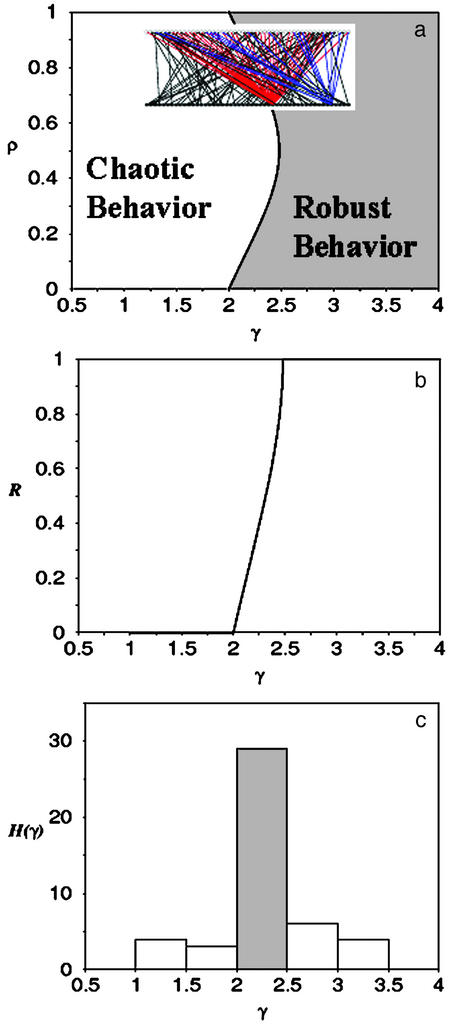
Dynamical robustness of a Boolean network with scale-free topology. (a) The mean connectivity K is not a relevant parameter to characterize the network topology for a scale-free network. The dynamics is then characterized in terms of the parameters γ and ρ, where γ is the scale-free exponent. The parameter space γ-ρ is divided in two distinct regimes: chaotic (white) and robust (gray). The transition between these two regimes, given by Eq. 2, is represented here by the solid curve. The chaotic regime does not longer dominate the parameter space. (Inset) A typical realization of the scale-free topology, generated by using a power-law distribution with λ = 2.5. The majority of the elements only have a few connections. But there are two elements connected to almost all other elements in the system. (b) Dynamical robustness R as a function of the scale-free exponent γ. The transition from the chaotic to the robust regime occurs in the interval [2, 2.5]. For γ > 2.5 the dynamics is robust for any value of ρ. The scale-free topology does not require fine-tuning of the parameters γ and ρ to achieve stability. (c) Histogram of 46 scale-free exponents reported for a wide collection of scale-free networks. This collection includes not only biological networks, but also social, ecological, and informatics networks (, –33). It is interesting to note that the majority of the exponents belong to the interval (2, 2.5) where the transition from a robust to a chaotic behavior occurs.
Fig. 3.
Fig. 3.
Dynamical stability of scale-free networks. The overlap between a perturbed trajectory and an unperturbed trajectory is computed. Both trajectories start out from the same initial configuration. In the perturbed trajectory one element σi with ki connections randomly takes the values 0 and 1 with the same probability, regardless of the configuration of its input elements. All of the other elements for this trajectory are updated according to Eq. A.1. For the unperturbed trajectory all of the elements follow the dynamics given by Eq. A.1. The graph shows the overlap x between the perturbed and the unperturbed trajectories as a function of the connectivity ki of the perturbed element σi. The different curves correspond to the three different regimes: chaotic (γ = 1.1), critical (γ = 2.5), and robust (γ = 4). In these three cases ρ = 0.5. The simulation was carried out for networks with N = 20 elements. Each point represents the average over 20,000 network realizations.
Fig. 4.
Fig. 4.
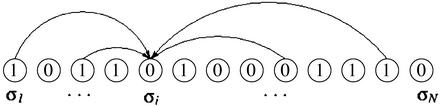
Schematic representation of the Kauffman model. Every element σi receives inputs from ki other elements of the network. The ki inputs of σi are chosen randomly from anywhere in the system. In the case shown, ki = 4.

References

    1. Hartwell, L. H., Hopfield, J. J., Leibler, S. & Murray, A. W. (1999) Nature 402, C47–C52. - PubMed
    1. Kitano, H. (2002) Science 295, 1662–1664. - PubMed
    1. Ideker, T., Thorsson, V., Ranish, J. A., Christmas, R., Buhler, J., Eng, J. K., Bumgarner, R., Goodlett, D. R., Aebersold, R. & Hood, L. (2001) Science 292, 929–934. - PubMed
    1. Savageau, M. A. (1971) Nature 229, 542–544. - PubMed
    1. Savageau, M. A. (1975) Nature 258, 208–214. - PubMed

Publication types