. 2003 Jul 22;100(15):9028-33.
doi: 10.1073/pnas.1533224100. Epub 2003 Jul 9.

The neuropeptide galanin modulates behavioral and neurochemical signs of opiate withdrawal

Affiliations

The neuropeptide galanin modulates behavioral and neurochemical signs of opiate withdrawal

Venetia Zachariou et al. Proc Natl Acad Sci U S A. .

Abstract

Much research has focused on pathways leading to opiate addiction. Pathways opposing addiction are more difficult to study but may be critical in developing interventions to combat drug dependence and withdrawal. Galanin decreases firing of locus coeruleus neurons, an effect hypothesized to decrease signs of opiate withdrawal. The current study addresses whether galanin affects morphine withdrawal signs by using a galanin agonist, galnon, that crosses the blood-brain barrier, and mice genetically engineered to under- or overexpress galanin peptide. Galnon significantly decreased morphine withdrawal signs in C57BL/6 mice. Further, knockout mice lacking galanin showed exacerbated morphine withdrawal signs, suggesting that endogenous galanin normally counteracts opiate withdrawal. Transgenic mice overexpressing galanin in noradrenergic neurons also showed decreased morphine withdrawal signs, suggesting a possible neuroanatomical locus for these effects of galanin. Both c-fos immunoreactivity, a marker of neuronal activity, and phosphorylation of tyrosine hydroxylase at Ser-40, a marker of cAMP levels, are decreased in the locus coeruleus by galnon treatment after morphine withdrawal, suggesting a possible molecular mechanism for the behavioral effects of galanin. These studies suggest that galanin normally acts to counteract opiate withdrawal and that small molecule galanin agonists could be effective in diminishing the physical signs of withdrawal.


Figures

Fig. 4.
Fig. 4.
c-fos immunoreactivity and TH phosphorylation in the LC after galnon administration after naloxone-stimulated withdrawal. Mice treated with morphine and naloxone showed significantly more c-fos immunoreactivity and phosphorylation of TH Ser-40 in the LC than mice treated with naloxone alone. Galnon significantly attenuated the induction of c-fos immunoreactivity, as well as TH phosphorylation, in morphine- and naloxone-treated mice. A decrease in c-fos immunoreactivity was seen in the LC of naloxone-treated mice after galnon (2 mg/kg) administration, but this did not reach significance. (A) Representative photomicrographs of c-fos staining at the level of the LC. A section through the LC after morphine withdrawal is shown at left to identify the areas of c-fos immunoreactivity quantified for all treatment groups. The boxed region shown at higher magnification for each treatment group represents the area counted for each section. Counts were averaged from left and right LC across two sections per mouse matched for anatomical markers (23). (B) Quantitation of c-fos immunoreactivity. There was a significant effect of naloxone-precipitated withdrawal on c-fos immunoreactivity in the LC (ANOVA, P < 0.0005). *, P < 0.05 galnon vs. vehicle. (C) Stoichiometry of TH phosphorylation at Ser-40. Representative Western blots are shown for Ser-40-P, total TH, and pyk2 (as a control for protein loading). There was a significant increase in Ser-40-P levels and stoichiometry in mice treated with morphine and naloxone that was significantly attenuated by galnon administration. S-V, saline–vehicle group; S-G, saline–galnon group; M-V, morphine–vehicle group; M-G, morphine–gainon group. *, P < 0.05 galnon vs. vehicle.
Fig. 1.
Fig. 1.
Galnon attenuates morphine withdrawal. (A) Mice were administered increasing doses of morphine every 8 h for 3 days (20, 40, 60, 80, 100, 100, and 100 mg/kg s.c.), and withdrawal was precipitated 2 h after the last morphine dose by using naloxone (1 mg/kg s.c.). One group received naloxone alone (n = 8), and a second group received 2 mg/kg galnon 15 min before naloxone injection (n = 7). After naloxone administration, withdrawal signs were scored for 30 min by an observer blind to treatment. For each withdrawal sign, comparisons were made between galnon- and vehicle-treated mice by using Student's t test. (B) The overall withdrawal score was significantly decreased by galnon administration (P < 0.01). (C) Galnon (2 mg/kg) alone did not alter pain threshold as measured on the 52°C hotplate. (D) No differences in initial analgesic response to morphine or the development of morphine tolerance was seen between galnon-treated and vehicle-treated control mice. *, P < 0.05; **, P < 0.01; ***, P < 0.001.
Fig. 2.
Fig. 2.
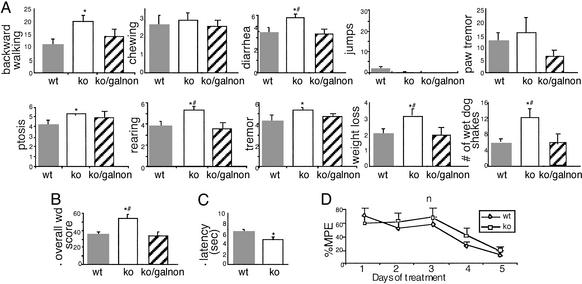
Knockout of the galanin gene exacerbates morphine withdrawal, and this is reversed by treatment with galnon. (A) Gal-/- mice on the 129OlaHsd background (n = 8) and Gal+/+ mice (n = 8) were administered increasing doses of morphine every 8 h for 3 days (20, 40, 60, 80, 100, 100, and 100 mg/kg s.c.), and withdrawal was precipitated 2 h after the last morphine dose by using naloxone (1 mg/kg s.c.). After naloxone administration, withdrawal signs were scored for 30 min by an observer blind to treatment. An independent group of Gal-/- mice was treated with 2 mg/kg galnon 15 min before naloxone injection (n = 6). One-way ANOVA was used to compare differences in withdrawal signs between Gal+/+ mice, Gal-/- mice, and Gal-/- mice treated with galnon. (B) A significant effect of genotype on overall withdrawal scores was identified by one-way ANOVA. Using the least significant difference post hoc test, overall withdrawal scores were significantly different between Gal+/+ and Gal-/- mice (P < 0.01), and between Gal-/- mice treated with vehicle or galnon (P < 0.01). (C) Pain thresholds as measured on the 52°C hotplate were slightly decreased in Gal-/- mice as compared with Gal+/+ mice. (D) No differences in initial analgesic response to morphine or the development of morphine tolerance was seen between Gal+/+ and Gal-/- mice. *, P < 0.05; *, P < 0.01; ***, P < 0.001.
Fig. 3.
Fig. 3.
Galanin overexpression under control of the DβH promoter can attenuate some signs of morphine withdrawal. (A) Transgenic mice overexpressing galanin under control of the DβH promoter (n = 10) and their wild-type siblings (n = 9) were administered increasing doses of morphine every 8 h for 3 days (20, 40, 60, 80, 100, 100, and 100 mg/kg s.c.), and withdrawal was precipitated 2 h after the last morphine dose by using naloxone (1 mg/kg s.c.). After naloxone administration, withdrawal signs were scored for 30 min by an observer blind to treatment. One-way ANOVA was used to compare differences in withdrawal signs between genotype. (B) The overall withdrawal score was significantly reduced in Gal-tg mice as compared with their wild-type siblings (P < 0.01). (C) No difference in pain threshold was seen between Gal-tg and their wild-type siblings as measured on the 52°C hotplate. (D) No differences in initial analgesic response to morphine or the development of morphine tolerance was seen between Gal-tg and wild-type mice. tg, Gal-tg mice; wt, wild-type siblings; *, P < 0.05; **, P < 0.01; ***, P < 0.001.

References

    1. Merchenthaler, I., Lopez, F. J. & Negro-Vilar, A. (1993) Prog. Neurobiol. 40, 711-769. - PubMed
    1. Zachariou, V., Parikh, K. & Picciotto, M. R. (1999) Brain Res. 831, 33-42. - PubMed
    1. Tsuda, K., Tsuda, S., Nishio, I., Masuyama, Y. & Goldstein, M. (1998) Am. J. Hypertens. 11, 1475-1479. - PubMed
    1. Ericson, E. & Ahlenius, S. (1999) Brain Res. 822, 200-209. - PubMed
    1. Koob, G. F. (2000) Ann. N.Y. Acad. Sci. 909, 170-185. - PubMed

Publication types

Substances

LinkOut - more resources