


Replication of modified vaccinia virus Ankara in primary chicken embryo fibroblasts requires expression of the interferon resistance gene E3L
- PMID: 12857909
- PMCID: PMC165266
- DOI: 10.1128/jvi.77.15.8394-8407.2003
Replication of modified vaccinia virus Ankara in primary chicken embryo fibroblasts requires expression of the interferon resistance gene E3L
Abstract
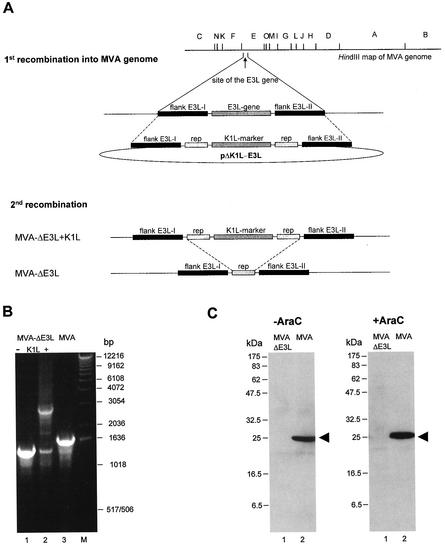
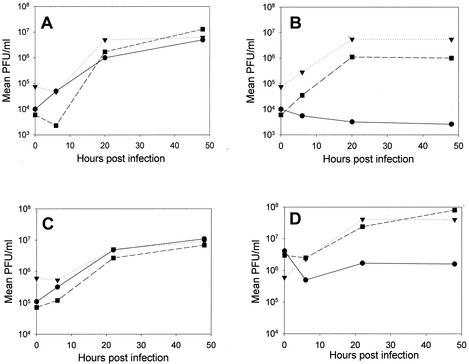
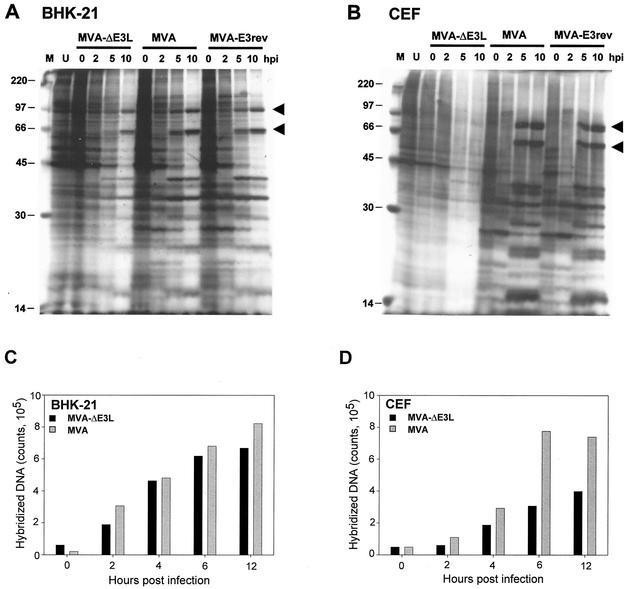
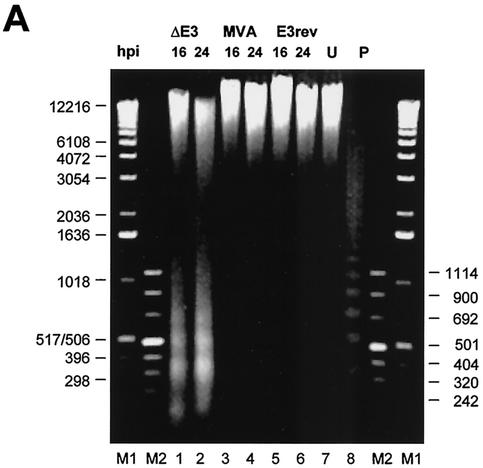
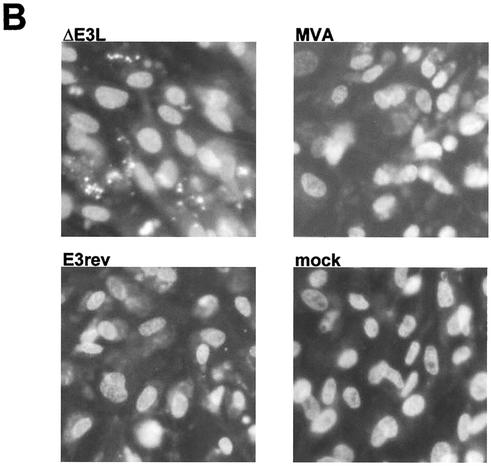
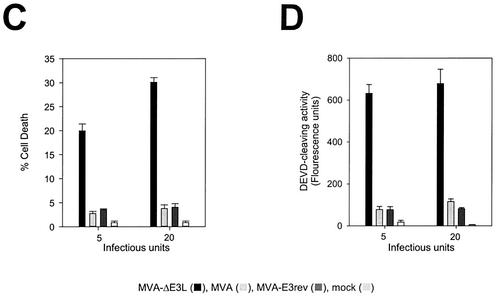
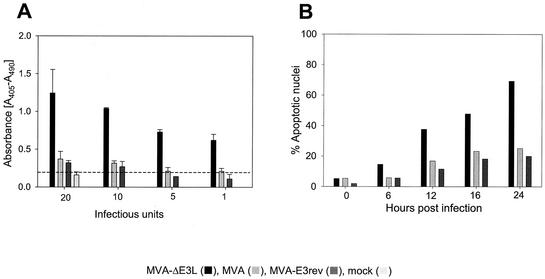
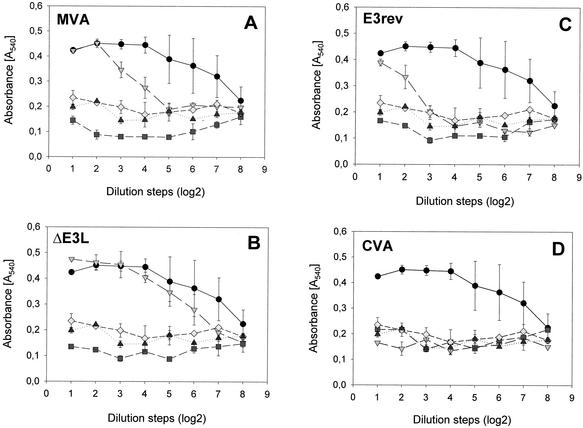
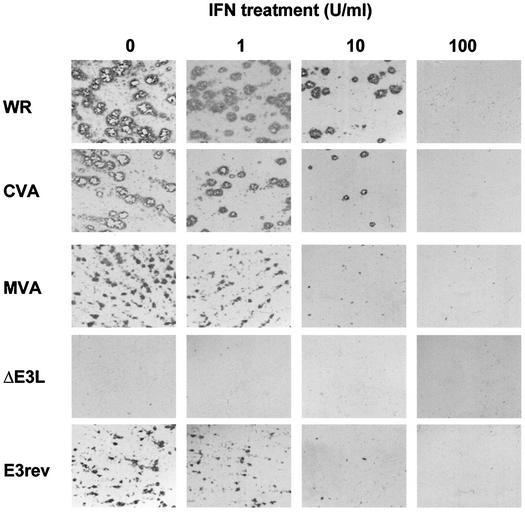
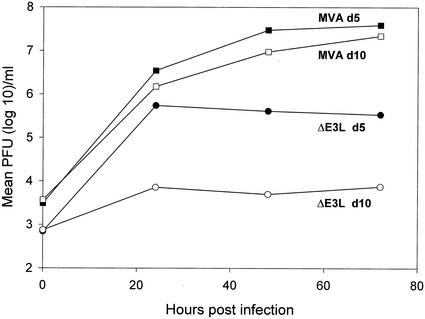
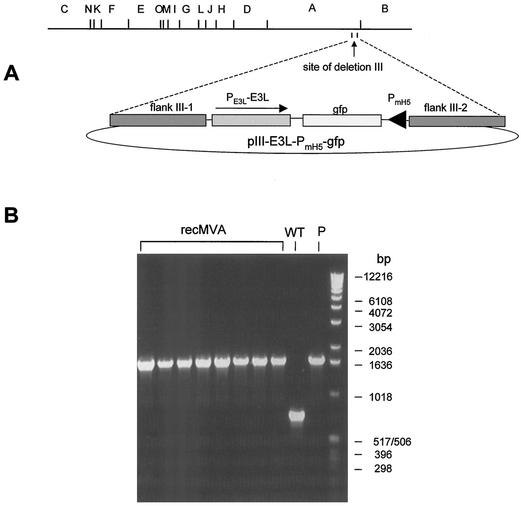
Highly attenuated modified vaccinia virus Ankara (MVA) serves as a candidate vaccine to immunize against infectious diseases and cancer. MVA was randomly obtained by serial growth in cultures of chicken embryo fibroblasts (CEF), resulting in the loss of substantial genomic information including many genes regulating virus-host interactions. The vaccinia virus interferon (IFN) resistance gene E3L is among the few conserved open reading frames encoding viral immune defense proteins. To investigate the relevance of E3L in the MVA life cycle, we generated the deletion mutant MVA-DeltaE3L. Surprisingly, we found that MVA-DeltaE3L had lost the ability to grow in CEF, which is the first finding of a vaccinia virus host range phenotype in this otherwise highly permissive cell culture. Reinsertion of E3L led to the generation of revertant virus MVA-E3rev and rescued productive replication in CEF. Nonproductive infection of CEF with MVA-DeltaE3L allowed viral DNA replication to occur but resulted in an abrupt inhibition of viral protein synthesis at late times. Under these nonpermissive conditions, CEF underwent apoptosis starting as early as 6 h after infection, as shown by DNA fragmentation, Hoechst staining, and caspase activation. Moreover, we detected high levels of active chicken alpha/beta IFN (IFN-alpha/beta) in supernatants of MVA-DeltaE3L-infected CEF, while moderate IFN quantities were found after MVA or MVA-E3rev infection and no IFN activity was present upon infection with wild-type vaccinia viruses. Interestingly, pretreatment of CEF with similar amounts of recombinant chicken IFN-alpha inhibited growth of vaccinia viruses, including MVA. We conclude that efficient propagation of MVA in CEF, the tissue culture system used for production of MVA-based vaccines, essentially requires conserved E3L gene function as an inhibitor of apoptosis and/or IFN induction.
Figures
References
-
- Amara, R. R., F. Villinger, J. D. Altman, S. L. Lydy, S. P. O'Neill, S. I. Staprans, D. C. Montefiori, Y. Xu, J. G. Herndon, L. S. Wyatt, M. A. Candido, N. L. Kozyr, P. L. Earl, J. M. Smith, H. L. Ma, B. D. Grimm, M. L. Hulsey, J. Miller, H. M. McClure, J. M. McNicholl, B. Moss, and H. L. Robinson. 2001. Control of a mucosal challenge and prevention of AIDS by a multiprotein DNA/MVA vaccine. Science 292:69-74. - PubMed
-
- Antoine, G., F. Scheiflinger, F. Dorner, and F. G. Falkner. 1998. The complete genomic sequence of the modified vaccinia Ankara strain: comparison with other orthopoxviruses. Virology 244:365-396. - PubMed
-
- Beattie, E., J. Tartaglia, and E. Paletti. 1991. Vaccinia virus-encoded eIF-2α homolog abrogates the antiviral effect of interferon. Virology 183:419-422. - PubMed
Publication types
MeSH terms
Substances
LinkOut - more resources
Full Text Sources
Other Literature Sources
