. 2003 Aug;77(15):8532-40.
doi: 10.1128/jvi.77.15.8532-8540.2003.

NF-kappaB inhibits gammaherpesvirus lytic replication

Affiliations

NF-kappaB inhibits gammaherpesvirus lytic replication

Helen J Brown et al. J Virol. 2003 Aug.

Abstract

Nasopharyngeal carcinoma, Kaposi's sarcoma, and B-cell lymphomas are human malignancies associated with gammaherpesvirus infections. Members of this virus family are characterized by their ability to establish latent infections in lymphocytes. The latent viral genome expresses very few gene products. The infected cells are therefore poorly recognized by the host immune system, allowing the virus to persist for long periods of time. We sought to identify the cell-specific factors that allow these viruses to redirect their life cycle from productive replication to latency. We find that the cellular transcription factor NF-kappaB can regulate this process. Epithelial cells and fibroblasts support active (lytic) gammaherpesvirus replication and have low NF-kappaB activity. However, overexpression of NF-kappaB in these cells inhibits the replication of the gammaherpesvirus murine herpesvirus 68 (MHV68). In addition, overexpression of NF-kappaB inhibits the activation of lytic promoters from MHV68 and human gammaherpesviruses Kaposi's sarcoma-associated herpesvirus (KSHV) and Epstein-Barr virus (EBV). In lymphocytes latently infected with KSHV or EBV, the level of NF-kappaB activity is high, and treatment of these cells with an NF-kappaB inhibitor leads to lytic protein synthesis consistent with virus reactivation. These results suggest that high levels of NF-kappaB can inhibit gammaherpesvirus lytic replication and may therefore contribute to the establishment and maintenance of viral latency in lymphocytes. They also suggest that NF-kappaB may be a novel target for the disruption of virus latency and therefore the treatment of gammaherpesvirus-related malignancies.


Figures
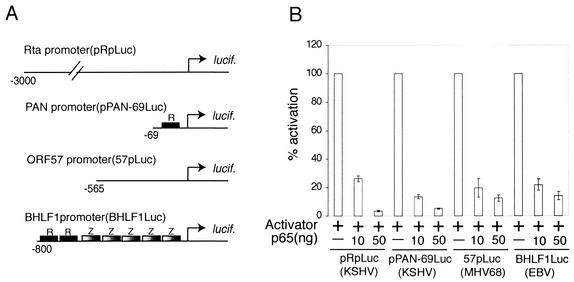
FIG. 1.
FIG. 1.
NF-κB(p65) inhibits activation of gammaherpesvirus lytic promoters. (A) Diagram of firefly luciferase (lucif.) reporter constructs used in transient-transfection assays. Constructs represent lytic genes from KSHV (pRpLuc and pPAN-69Luc), MHV68 (57pLuc), and EBV (BHLF1Luc). All reporters are highly inducible by viral immediate-early transactivators. Characterized binding sites for RTA (R) and Zebra (Z) are indicated. (B) 293T cells transiently transfected with the reporter constructs described in panel A. Cells were transfected with a fixed amount (+) of vectors expressing KSHV, MHV68, or EBV RTA/Zebra and increasing amounts of pFLAGp65. Luciferase assay data from three separate experiments are shown. Reporter activity is expressed as a percentage of activation, with activation by RTA or RTA and Zebra alone = 100%.
FIG. 2.
FIG. 2.
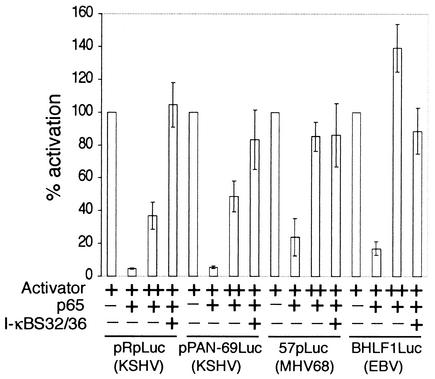
Inhibition of transactivation by NF-κB(p65) is reversible. 293T cells were transfected with the reporter constructs shown in Fig. 1A and plasmids expressing transactivator(s) RTA or RTA and Zebra. Amounts of viral transactivators were increased 4-fold (pPAN-69Luc), 5-fold (BHLF1Luc), or 10-fold (pRpLuc and 57pLuc [++]) to restore activation in the presence of p65. I-κBS32/36 is a dominant inhibitor of NF-κB.
FIG. 3.
FIG. 3.
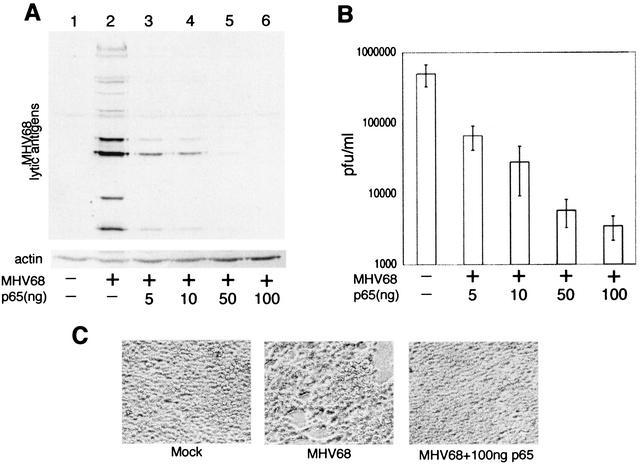
NF-κB(p65) inhibits replication of MHV68. (A) Western blot of 293T whole-cell extracts harvested 5 days posttransfection with purified MHV68 virion DNA and pCMVp65. Membranes were probed with polyclonal serum recognizing multiple MHV68 lytic antigens (upper panel) and actin MAb (lower panel). (B) MHV68 titer in supernatant from cells described for panel A. Viral titers from three separate transfection experiments are represented. (C) Phase-contrast images of cells described in panels A and B 5 days posttransfection.
FIG. 4.
FIG. 4.
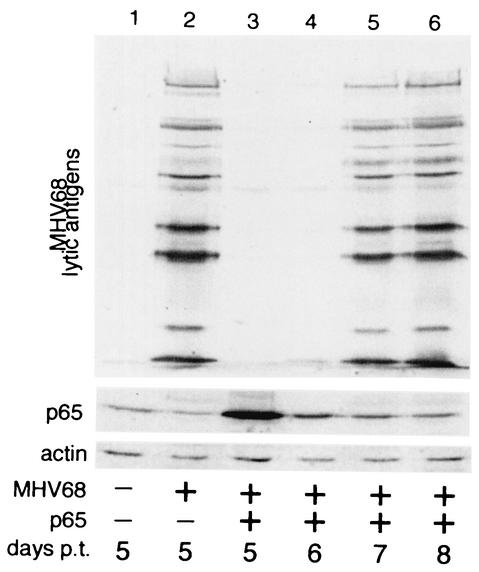
Inhibition of MHV68 replication by NF-κB(p65) is reversible. Western blot of 293T cells transfected with 1 μg of MHV68 virion DNA and 1 μg of pCMVp65 as in Fig. 3. Blots were probed with polyclonal serum against MHV68 lytic antigens (upper panel) and MAbs recognizing p65 (center panel) and actin (lower panel). p.t., posttransfection.
FIG. 5.
FIG. 5.
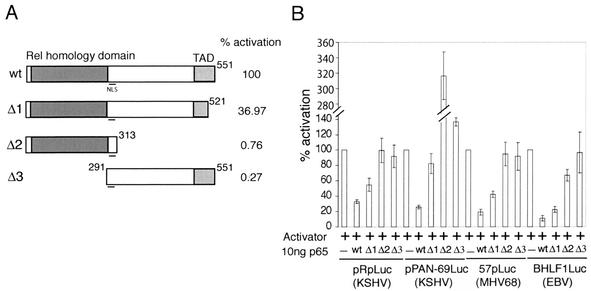
Both the activation domain and DNA binding domain of p65 are required for inhibition of MHV68 lytic gene expression. (A) Diagram of pFLAGp65 deletion mutants used in panel B and Fig. 6. The N-terminal DNA binding/dimerization (Rel homology) domain and C-terminal activation domain (TAD) are indicated. Mutants were tested for transactivation by transient transfection into 293T cells with a reporter bearing five consensus NF-κB binding sites upstream of firefly luciferase (pNF-κBLuc). The percentage of activation represents the average results comparing 5, 10, and 50 ng of each pFLAGp65 construct in three separate experiments. (B) Transient transfection of 293T cells as described for Fig. 1B. Cells were transfected with RTA or RTA and Zebra (+) and 10 ng of wild type (wt), Δ1, or Δ2 pFLAGp65.
FIG. 6.
FIG. 6.
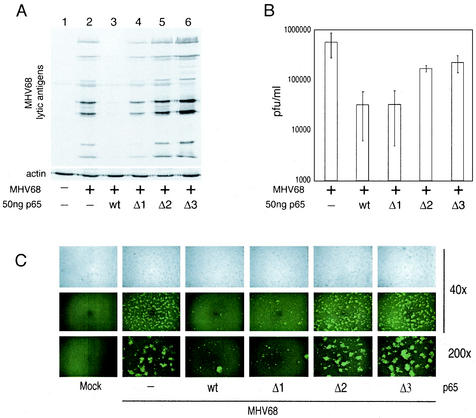
Both the activation domain and DNA binding domain of p65 are required for inhibition of MHV68 replication. (A) Western blot of 293T whole-cell extracts 5 days posttransfection with MHV68 virion DNA and pFLAGp65 constructs as described in the legend to Fig. 5. Blots were probed with polyclonal serum recognizing multiple MHV68 lytic antigens and a MAb recognizing actin. (B) MHV68 titers in supernatants from cells described for panel A. Average titers from three separate transfection experiments are represented. (C) Phase-contrast and fluorescence images of cells described for panel A, 2 days posttransfection with a recombinant MHV68 strain expressing GFP.
FIG. 7.
FIG. 7.
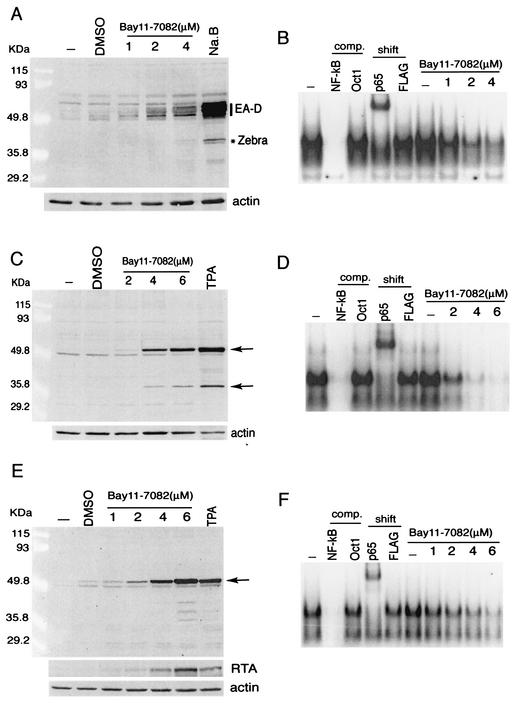
NF-κB inhibitor Bay11-7082 induces lytic protein synthesis in latent KSHV- and EBV-infected cells. (A, C, and E) Western blots of HR-1 (A), KS-1 (B), and BCBL1 (C) whole-cell extracts. Cells were treated with sodium butyrate (A [Na.B]), TPA (C and E), or Bay11-7082. Blots were probed with nasopharyngeal carcinoma patient serum (A) or Kaposi's sarcoma patient serum recognizing several lytic antigens (C and E), polyclonal anti-RTA serum (E), and a MAb recognizing actin. DMSO, dimethyl sulfoxide. (B, D, and F) EMSA analysis of NF-κB activity in HR-1 (B), KS-1 (D), and BCBL1 (F) cells. Nuclear extracts were harvested directly after the 30-min treatment with Bay11-7082. Extracts were incubated with a consensus NF-κB binding site oligonucleotide. The specificity of the shifted complex was confirmed by using cold competitor oligonucleotides (comp.) and MAbs against p65 and FLAG (shift).
FIG. 8.
FIG. 8.
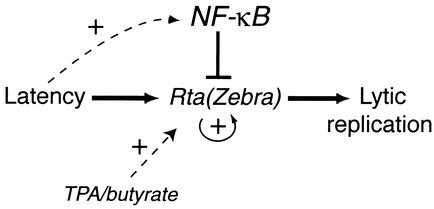
Model outlining a role for NF-κB in regulating gammaherpesvirus replication. (See text for details.)

References

    1. Adler, B., E. Schaadt, B. Kempkes, U. Zimber-Strobl, B. Baier, and G. W. Bornkamm. 2002. Control of Epstein-Barr virus reactivation by activated CD40 and viral latent membrane protein 1. Proc. Natl. Acad. Sci. USA 99:437-442. - PMC - PubMed
    1. Arenzana-Seisdedos, F., P. Turpin, M. Rodriguez, D. Thomas, R. T. Hay, J. L. Virelizier, and C. Dargemont. 1997. Nuclear localization of IκBα promotes active transport of NF-κB from the nucleus to the cytoplasm. J. Cell Sci. 110:369-378. - PubMed
    1. Baeuerle, P. A., and D. Baltimore. 1988. IκB: a specific inhibitor of the NF-κB transcription factor. Science 242:540-546. - PubMed
    1. Brown, K., S. Gerstberger, L. Carlson, G. Franzoso, and U. Siebenlist. 1995. Control of IκB-α proteolysis by site-specific, signal-induced phosphorylation. Science 267:1485-1488. - PubMed
    1. Cahir-McFarland, E. D., D. M. Davidson, S. L. Schauer, J. Duong, and E. Kieff. 2000. NF-κB inhibition causes spontaneous apoptosis in Epstein-Barr virus-transformed lymphoblastoid cells. Proc. Natl. Acad. Sci. USA 97:6055-6060. - PMC - PubMed

Publication types

LinkOut - more resources