Risk factors for pacemaker implantation following aortic valve replacement: a single centre experience
- PMID: 12860869
- PMCID: PMC1767749
- DOI: 10.1136/heart.89.8.901
Risk factors for pacemaker implantation following aortic valve replacement: a single centre experience
Abstract
Objective: To identify perioperative clinical predictors of permanent pacemaker implantation following aortic valve replacement.
Design and patients: Prospective cohort study on 276 patients submitted for aortic valve replacement: 267 patients (mean (SD) age, 57.5 (14) years) with no conduction disturbances, and nine patients (67.7 (5) years) with severe conduction disturbances requiring permanent pacing; 65 perioperative variables (38 preoperative, eight intraoperative, and 19 postoperative) were considered.
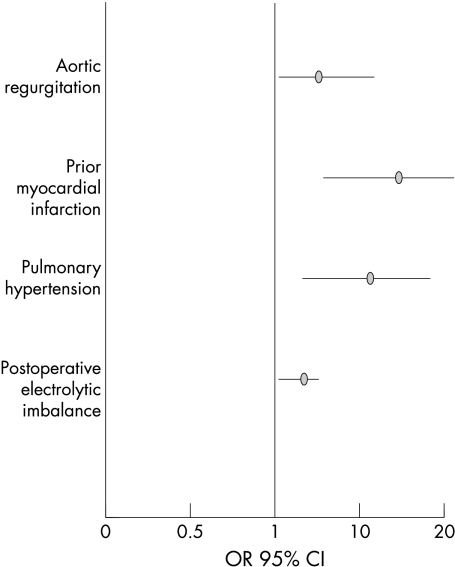
Results: Nine patients (3.2%) had irreversible second or third degree atrioventricular (AV) block requiring permanent pacing. Risk factors for permanent pacing identified by univariate analysis were: preoperative: additional valvar disease, aortic regurgitation, myocardial infarction, pulmonary hypertension, anaemia, use of digitalis; intraoperative: cardiac arrest; postoperative: cardiac arrest, conduction disturbances, electrolytic imbalance, angiotensin converting enzyme inhibitor use. Multivariate logistic regression analysis identified preoperative aortic regurgitation (p < 0.005; odds ratio (OR) 6.6, 95% confidence interval (CI) 1.6 to 12.2), myocardial infarction (p < 0.0005; OR 15.2, 95% CI 6.3 to 19.9), pulmonary hypertension (p < 0.005; OR 12.5, 95% CI 3.2 to 18.3), and postoperative electrolyte imbalance (p < 0.01; OR 4.5, 95% CI 1.3 to 6.4).
Conclusions: Irreversible AV block requiring permanent pacemaker implantation is an uncommon condition following aortic valve replacement. Previous aortic regurgitation, myocardial infarction, pulmonary hypertension, and postoperative electrolyte imbalance should be considered in order to identify patients at increased risk for advanced AV block.
Figures
References
-
- Chung MK. Cardiac surgery: postoperative arrhythmias. Crit Care Med 2000;28(suppl):N136–44. - PubMed
-
- Sloan SB, Weitz HH. Postoperative arrhythmias and conduction disorders. Med Clin North Am 2001;85:1171–89. - PubMed
-
- Baterman TM, Weiss MH, Czer LSC, et al. Fascicular conduction disturbances and ischemic heart disease: adverse prognosis despite coronary revascularization. J Am Coll Cardiol 1985;5:623–9. - PubMed
-
- Emlein G, Huang SKS, Pires LA, et al. Prolonged bradyarrhythmias after isolated coronary by-pass graft surgery. Am Heart J 1993;126:1084–90. - PubMed
-
- Blanche C, Czer LSC, Trento A, et al. Bradyarrhythmias requiring pacemaker implantation after orthotopic heart transplantation: association with rejection. J Heart Lung Transplant 1992;11:446–52. - PubMed
MeSH terms
LinkOut - more resources
Full Text Sources
Medical