. 2003 Jul;112(2):275-85.
doi: 10.1172/JCI16814.

Application of a mathematical model to prevent in vivo amplification of antibiotic-resistant bacterial populations during therapy

Affiliations

Application of a mathematical model to prevent in vivo amplification of antibiotic-resistant bacterial populations during therapy

Nelson Jumbe et al. J Clin Invest. 2003 Jul.

Abstract

The worldwide increase in the prevalence of multi-antibiotic-resistant bacteria has threatened the physician's ability to provide appropriate therapy for infections. The relationship between antimicrobial drug concentration and infecting pathogen population reduction is of primary interest. Using data derived from mice infected with the bacterium Pseudomonas aeruginosa and treated with a fluoroquinolone antibiotic, a mathematical model was developed that described relationships between antimicrobial drug exposures and changes in drug-susceptible and -resistant bacterial subpopulations at an infection site. Dosing regimens and consequent drug exposures that amplify or suppress the emergence of resistant bacterial subpopulations were identified and prospectively validated. Resistant clones selected in vivo by suboptimal regimens were characterized. No mutations were identified in the quinolone resistance-determining regions of gyrA/B or parC/E. However, all resistant clones demonstrated efflux pump overexpression. At base line, MexAB-OprM, MexCD-OprJ, and MexEF-OprN were represented in the drug-resistant population. After 28 hours of therapy, MexCD-OprJ became the predominant pump expressed in the resistant clones. The likelihood of achieving resistance-suppression exposure in humans with a clinically prescribed antibiotic dose was determined. The methods developed in this study provide insight regarding how mathematical models can be used to identify rational dosing regimens that suppress the amplification of the resistant mutant population.


Figures
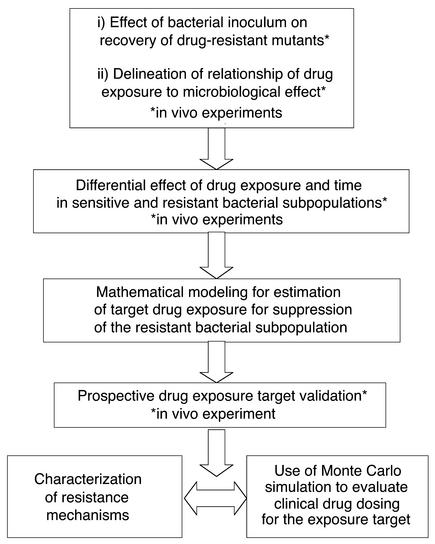
Figure 1
Figure 1
Flow diagram of the experimental design.
Figure 2
Figure 2
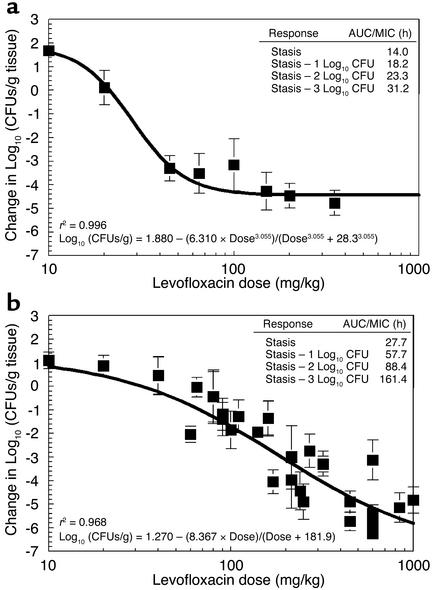
P. aeruginosa dose response. Normal mice were inoculated with about 107 (a) or 108 (b) bacteria per thigh. The levofloxacin MIC and MBC were 0.8 μg/ml and 1.6 μg/ml, respectively. The x axis displays the exposures in mg/kg doses. The model allowed calculation of the dose necessary to achieve stasis (i.e., to return the colony counts at sacrifice to that used for the challenge), as well as 1, 2, and 3 log10 (CFUs/g) reductions in bacterial counts from the stasis point. These data are displayed in the inset as AUC/MIC ratio values for each of these degrees of drug effect. Comparison of microbiological outcome endpoints shows that levofloxacin treatment of P. aeruginosa infections is inoculum dependent. Isolation of drug-resistant P. aeruginosa mutants in vitro was common and occurred with a frequency of 0.1 × 10⁻⁶ to 2 × 10⁻⁶. At the higher infection inoculum, the microbial population burden significantly exceeded the mutation frequency. At exposures that killed the sensitive population, the resistant population was able to survive. This allowed this subpopulation to be selected and amplified by the drug pressure. Subsequently, a subpopulation of mutant organisms that behaved quite differently under antibiotic pressure emerged. Only with sufficient exposure to inhibit and kill the resistant subpopulation do we attain larger overall reduction of bacterial load.
Figure 3
Figure 3
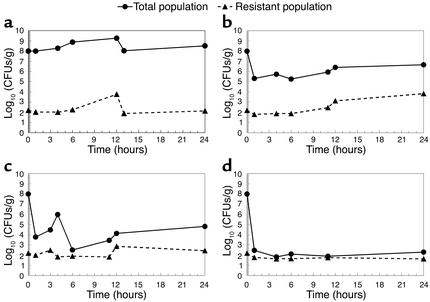
Effect of four drug doses on the total and resistant bacterial populations over 24 hours. Drug doses were 0, 90, 215, and 600 mg/kg (ad, respectively). The 90-mg/kg dose allowed amplification of the resistant population by almost 2 log10 (CFUs/g). The 215-mg/kg dose allowed only minimal amplification of resistant mutants.
Figure 4
Figure 4
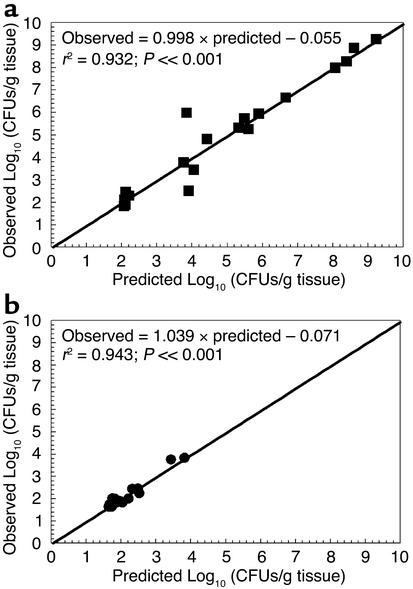
Mathematical-model performance analysis. All regimens (n = 4) were simultaneously fit in a large population model (Equations 1–7, see supplementary material). The displayed graphs are the predicted-versus-observed plots for the total and resistant subpopulations following MAP Bayesian approximation. The model explained well the survival and bactericidal kinetics for the total (a) and resistant (b) populations (r2 ≥ 0.93 for total and resistant populations).
Figure 5
Figure 5
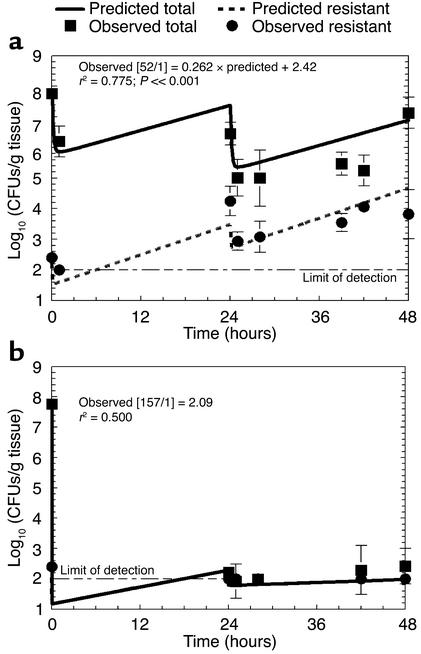
Model validation. The emergence-of-resistance model developed in this study was prospectively evaluated and validated by generation of response predictions for doses not previously studied that would encourage selection of resistance (a) or suppress emergence of resistance (b). An exposure of an AUC/MIC ratio of 157:1 was calculated to prevent emergence of resistance. Experiments were performed to 48 hours, not 24 hours as in the studies performed to generate parameter estimates; conditions predicted by the model were used. Levofloxacin dosing occurred at time 0 and at 24 hours. The lines are model predictions (not best-fit curves). Squares represent experimental measurements of the total population. Circles represent experimental measurements of the resistant subpopulation. The model predicted changes in the resistant mutant population well at both exposures.
Figure 6
Figure 6
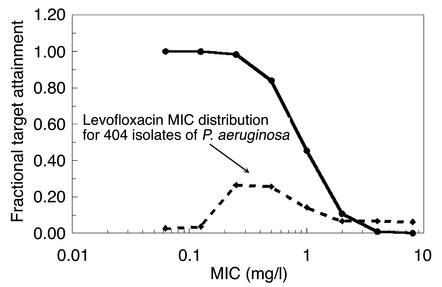
Target-attainment analysis. The fraction of 10,000 simulated subjects that attained an AUC/MIC ratio of 157:1 (target for suppression of resistance) is displayed as a function of the MIC for a distribution of 404 isolates of P. aeruginosa.

References

    1. Eagle H, Fleischman R, Levy M. Continuous versus discontinuous therapy with penicillin: the effect of interval between injections on therapeutic efficacy. N. Engl. J. Med. 1953;248:481–488. - PubMed
    1. Craig WA. Pharmacokinetic/pharmacodynamic parameters: rationale for antibiotic dosing of mice and men. Clin. Infect. Dis. 1998;26:1–10. - PubMed
    1. Craig WA. Does the dose matter? Clin. Infect. Dis. 2001;33(Suppl. 3):S233–S237. - PubMed
    1. Jourdain B, et al. Role of quantitative cultures of endotracheal aspirates in the diagnosis of nosocomial pneumonia. Am. J. Respir. Crit. Care Med. 1995;152:241–246. - PubMed
    1. Lipsitch M, Levin BR. The population dynamics of antimicrobial chemotherapy. Antimicrob. Agents Chemother. 1997;41:363–373. - PMC - PubMed

Publication types