


doi: 10.1128/JB.185.15.4615-4619.2003.
Analysis of the interaction between the transcription factor sigmaG and the anti-sigma factor SpoIIAB of Bacillus subtilis
Affiliations
- PMID: 12867473
- PMCID: PMC165760
- DOI: 10.1128/JB.185.15.4615-4619.2003
Item in Clipboard
Analysis of the interaction between the transcription factor sigmaG and the anti-sigma factor SpoIIAB of Bacillus subtilis
J Bacteriol.
2003 Aug.
Abstract
The activation of sigma(G), a transcription factor, in Bacillus subtilis is coupled to the completion of engulfment during sporulation. SpoIIAB, an anti-sigma factor involved in regulation of sigma(F), is also shown to form a complex with sigma(G) in vitro. SpoIIAA, the corresponding anti-anti-sigma factor, can disrupt the SpoIIAB:sigma(G) complex, releasing free sigma(G). The data suggest the existence of an as-yet-unknown mechanism to keep sigma(G) inactive prior to engulfment.
Figures
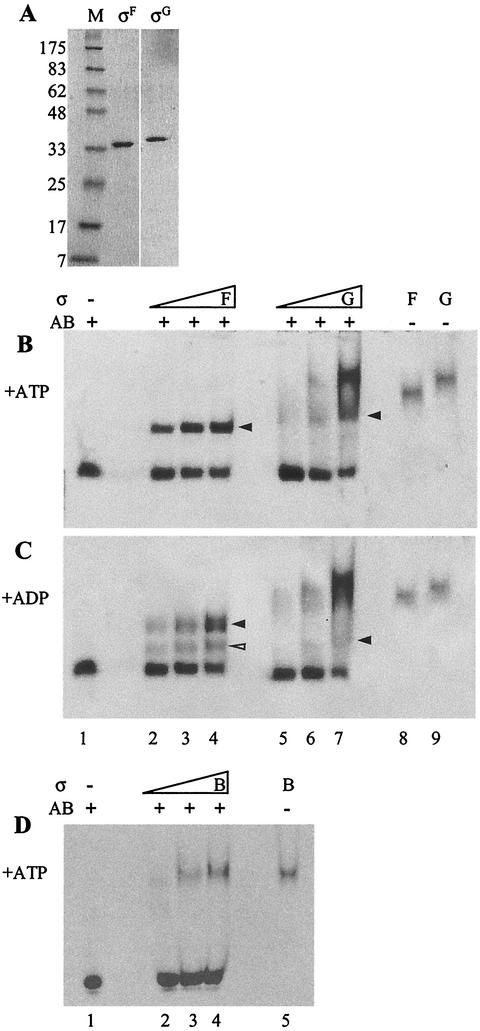
SpoIIAB forms a complex with σG in the presence of nucleotide. (A) Purified σG and σF. Fractions containing the proteins were pooled after gel filtration and run on sodium dodecyl sulfate-12% polyacrylamide gels. M, molecular weight markers. (B and C) Increasing concentrations (1, 2, and 4 μM) of σF (lanes 2 to 4) or σG (lanes 5 to 7) were incubated with purified SpoIIAB (2 μM) in the presence of ATP (B) or ADP (C). (D) Increasing concentrations (1, 2, and 4 μM) of purified σB (lanes 2 to 4) were incubated with purified SpoIIAB (2 μM) in the presence of ATP. Running positions of the purified proteins alone are shown as follows: SpoIIAB (panels B to D, lanes 1), σF (panels B and C, lanes 8), σG (panels B and C, lanes 9), and σB (panel D, lane 5). Reactions were analyzed on 10% nondenaturing PAGE with the appropriate nucleotide added to the running buffer and were visualized by Coomassie blue staining. Complexes formed by σ and SpoIIAB are indicated by arrowheads.
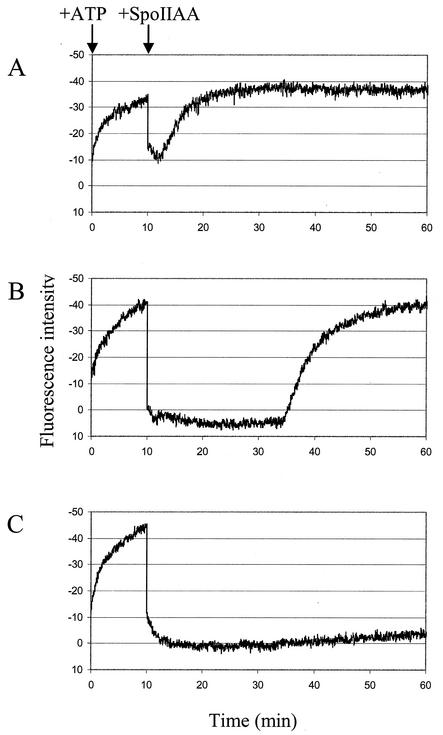
SpoIIAA induces the release of σG from SpoIIAB:σG complexes. Fluorescence spectroscopy was used to measure changes in the fluorescence intensity of the single tryptophan in σG. The results of three independent experiments are shown in panels A to C. Purified σG (0.8 μM) and SpoIIAB (1.25 μM) were mixed, and at time zero, ATP (100 μM) was added to the solution and the fluorescence intensity of the sample was determined. Different concentrations of SpoIIAA (5 μM [A], 10 μM [B], and 15 μM [C]) were added to the samples 10 min later.
References
-
- Alper, S., L. Duncan, and R. Losick. 1994. An adenosine nucleotide switch controlling the activity of a cell type-specific transcription factor in B. subtilis. Cell 77:195-205. - PubMed
-
- Campbell, E. A., S. Masuda, J. L. Sun, O. Muzzin, C. A. Olson, S. Wang, and S. A. Darst. 2002. Crystal structure of the Bacillus stearothermophilus anti-sigma factor SpoIIAB with the sporulation sigma factor σF. Cell 108:795-807. - PubMed
-
- Diederich, B., J. F. Wilkinson, T. Magnin, M. Najafi, J. Errington, and M. D. Yudkin. 1994. Role of interactions between SpoIIAA and SpoIIAB in regulating cell-specific transcription factor σF of Bacillus subtilis. Genes Dev. 8:2653-2663. - PubMed
Publication types
MeSH terms
Substances
LinkOut - more resources
Full Text Sources
