


Ligand-dependent and -independent effects of splice variant 1 of growth hormone-releasing hormone receptor
- PMID: 12867592
- PMCID: PMC170949
- DOI: 10.1073/pnas.1533185100
Ligand-dependent and -independent effects of splice variant 1 of growth hormone-releasing hormone receptor
Abstract
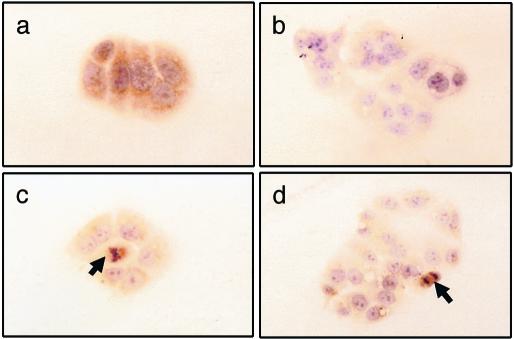
Existing evidence indicates that, in addition to its neuroendocrine action, growth hormone-releasing hormone (GHRH) acts directly on several nonpituitary tissues, especially neoplasms, and stimulates cell proliferation. We have recently reported that a splice variant of the receptor (SV1) is expressed in various normal tissues and particularly in tumor tissues, producing mitogenic effects on GHRH binding. By using HEC-1A human endometrial carcinoma cells, which express endogenous SV1, we show that, in addition to its ability to mediate the mitogenic effects of GHRH, SV1 also possesses relatively high intrinsic, ligand-independent activity. By using an antisense RNA-based approach we found that SV1 ablation reduces the efficacy of colony formation and the rate of cell proliferation of HEC-1A cells in the absence of exogenous GHRH, and decreases their sensitivity to GHRH when the neurohormone is added to the culture media. This ligand-independent stimulation of cell proliferation appears to be a characteristic property of the truncated form of the receptor, because the expression of SV1 and not of the full-length GHRH receptor stimulated the proliferation of 3T3 fibroblasts in the absence of exogenous GHRH, whereas both forms mediated the proliferative effects of GHRH. Evaluation of 21 specimens of human primary endometrial carcinoma for expression of SV1 by immunohistochemistry indicated that in contrast to the GHRH receptor, which is absent, SV1 is expressed in approximately 43% of the specimens. These findings indicate that SV1 can operate in a ligand-independent as well as a ligand-dependent manner. The overexpression of this form of GHRH receptor may be associated with carcinogenesis.
Figures


Similar articles
-
Expression of a splice variant of the receptor for GHRH in 3T3 fibroblasts activates cell proliferation responses to GHRH analogs.Proc Natl Acad Sci U S A. 2002 Jan 8;99(1):196-200. doi: 10.1073/pnas.012590999. Epub 2002 Jan 2. Proc Natl Acad Sci U S A. 2002. PMID: 11773624 Free PMC article.
-
Stimulation of proliferation of MCF-7 breast cancer cells by a transfected splice variant of growth hormone-releasing hormone receptor.Proc Natl Acad Sci U S A. 2007 Mar 27;104(13):5575-9. doi: 10.1073/pnas.0700407104. Epub 2007 Mar 19. Proc Natl Acad Sci U S A. 2007. PMID: 17372203 Free PMC article.
-
Expression of growth hormone-releasing hormone (GHRH) and splice variant of GHRH receptors in normal mouse tissues.Regul Pept. 2006 Sep 11;136(1-3):105-8. doi: 10.1016/j.regpep.2006.05.001. Epub 2006 Jun 16. Regul Pept. 2006. PMID: 16781787
-
Regulation of the pituitary somatotroph cell by GHRH and its receptor.Recent Prog Horm Res. 2000;55:237-66; discussion 266-7. Recent Prog Horm Res. 2000. PMID: 11036940 Review.
-
Signaling mechanism of growth hormone-releasing hormone receptor.Vitam Horm. 2023;123:1-26. doi: 10.1016/bs.vh.2023.06.004. Epub 2023 Jul 7. Vitam Horm. 2023. PMID: 37717982 Review.
Cited by
-
Splice variant of growth hormone-releasing hormone receptor drives esophageal squamous cell carcinoma conferring a therapeutic target.Proc Natl Acad Sci U S A. 2020 Mar 24;117(12):6726-6732. doi: 10.1073/pnas.1913433117. Epub 2020 Mar 10. Proc Natl Acad Sci U S A. 2020. PMID: 32156725 Free PMC article.
-
Ectopic GHRH production: revisiting a rare cause of acromegaly.Rev Endocr Metab Disord. 2025 Aug;26(4):593-602. doi: 10.1007/s11154-025-09961-w. Epub 2025 Apr 2. Rev Endocr Metab Disord. 2025. PMID: 40169474 Review.
-
Characterization of Somatotrope Cell Expansion in Response to GHRH in the Neonatal Mouse Pituitary.Endocrinology. 2023 Aug 28;164(10):bqad131. doi: 10.1210/endocr/bqad131. Endocrinology. 2023. PMID: 37616545 Free PMC article.
-
Growth Hormone-Releasing Hormone in Endothelial Inflammation.Endocrinology. 2022 Dec 19;164(2):bqac209. doi: 10.1210/endocr/bqac209. Endocrinology. 2022. PMID: 36503995 Free PMC article. Review.
-
Growth Hormone-Releasing Hormone Antagonists Increase Radiosensitivity in Non-Small Cell Lung Cancer Cells.Int J Mol Sci. 2025 Apr 1;26(7):3267. doi: 10.3390/ijms26073267. Int J Mol Sci. 2025. PMID: 40244089 Free PMC article.
References
-
- Schally, A. V. & Comaru-Schally A. M. (1998) in Growth Hormone Secretagogues in Clinical Practice, eds. Bercu, B. B. & Walker, R. F. (Dekker, New York), pp. 14-31.
-
- Schally, A. V., Comaru-Schally, A. M., Nagy, A., Kovacs, M., Szepeshazi, K., Plonowski, A., Varga, J. L. & Halmos, J. (2001) Front. Neuroendocrinol, 22, 228-291. - PubMed
-
- Frohman, L. A. & Kineman, R. D. (2002) Trends Endocrinol. Metab. 13, 299-303. - PubMed
-
- Schally, A. V. & Varga, J. L. (1999) Trends Endocrinol. Metab. 10, 383-391. - PubMed
-
- Furstenberger, G. & Senn, H. J. (2002) Lancet Oncol. 3, 298-302. - PubMed
Publication types
MeSH terms
Substances
LinkOut - more resources
Full Text Sources
Other Literature Sources
Molecular Biology Databases
