


Cytoplasmically retargeted HSV1-tk/GFP reporter gene mutants for optimization of noninvasive molecular-genetic imaging
- PMID: 12869307
- PMCID: PMC1502405
- DOI: 10.1016/S1476-5586(03)80056-8
Cytoplasmically retargeted HSV1-tk/GFP reporter gene mutants for optimization of noninvasive molecular-genetic imaging
Abstract
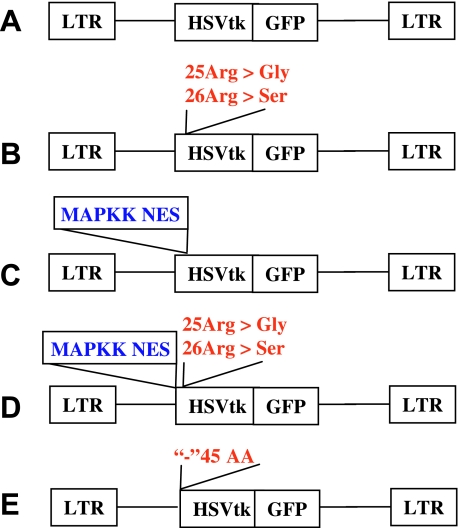
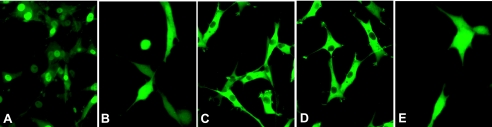
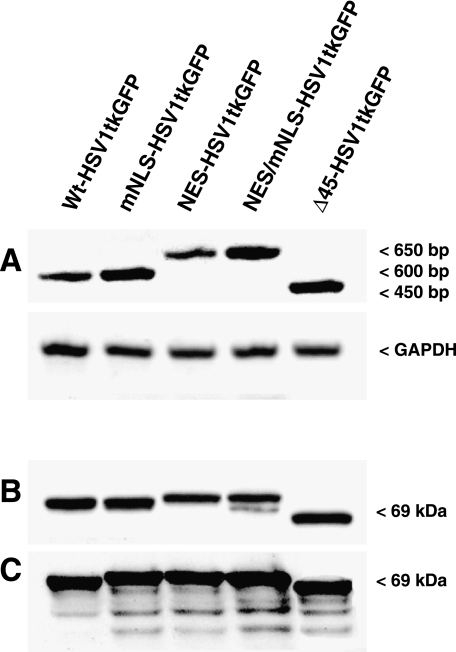
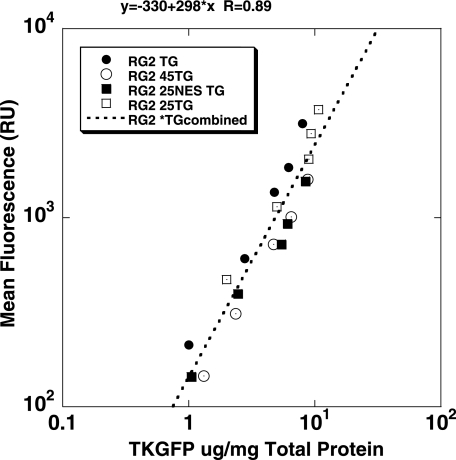
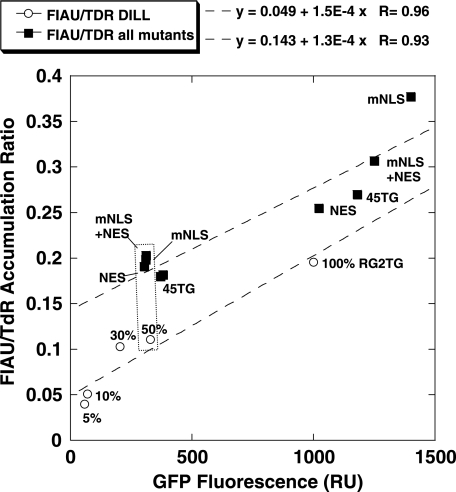
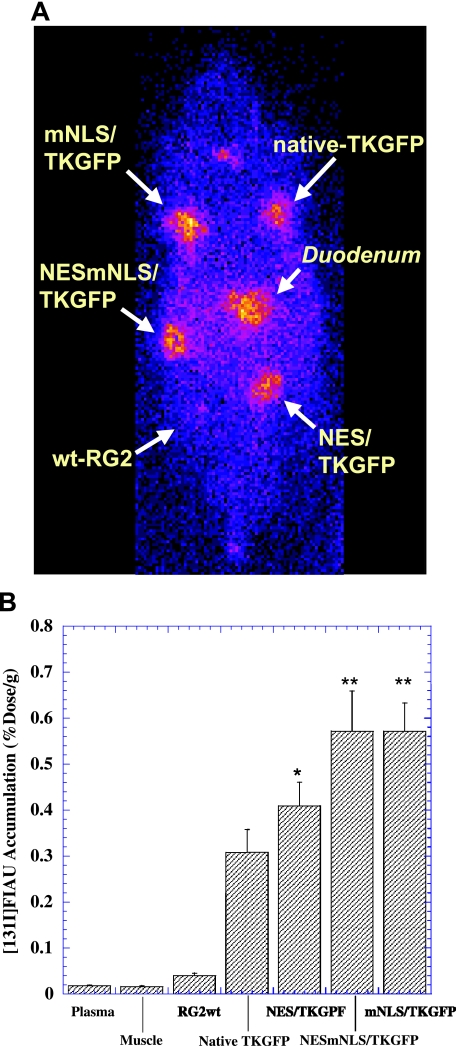
To optimize the sensitivity of imaging HSV1-tk/GFP reporter gene expression, a series of HSV1-tk/GFP mutants was developed with altered nuclear localization and better cellular enzymatic activity, compared to that of the native HSV1-tk/GFP fusion protein (HSV1-tk/GFP). Several modifications of HSV1-tk/GFP reporter gene were performed, including targeted inactivating mutations in the nuclear localization signal (NLS), the addition of a nuclear export signal (NES), a combination of both mutation types, and a truncation of the first 135 bp of the native hsv1-tk coding sequence containing a "cryptic" testicular promoter and the NLS. A recombinant HSV1-tk/GFP protein and a highly sensitive sandwich enzyme-linked immunosorbent assay for HSV1-tk/GFP were developed to quantitate the amount of reporter gene product in different assays to allow normalization of the data. These different mutations resulted in various degrees of nuclear clearance, predominant cytoplasmic distribution, and increased total cellular enzymatic activity of the HSV1-tk/GFP mutants, compared to native HSV1-tk/GFP when expressed at the same levels. This appears to be the result of improved metabolic bioavailability of cytoplasmically retargeted mutant HSV1-tk/GFP enzymes for reaction with the radiolabeled probe (e.g., FIAU). The analysis of enzymatic properties of different HSV1-tk/GFP mutants using FIAU as a substrate revealed no significant differences from that of the native HSV1-tk/GFP. Improved total cellular enzymatic activity of cytoplasmically retargeted HSV1-tk/GFP mutants observed in vitro was confirmed by noninvasive imaging of transduced subcutaneous tumor xenografts bearing these reporters using [(131)I]FIAU and a gamma-camera.
Figures
References
-
- Bengel FM, Anton M, Avril N, Brill T, Nguyen N, Haubner R, Gleiter E, Gansbacher B, Schwaiger M. Uptake of radiolabeled 2′-fluoro-2′-deoxy-5-iodo-1-beta-D-arabinofuranosyluracil in cardiac cells after adenoviral transfer of the herpesvirus thymidine kinase gene: the cellular basis for cardiac gene imaging. Circulation. 2000;102:948–950. - PubMed
-
- Black ME, Kokoris MS, Sabo P. Herpes simplex virus-1 thymidine kinase mutants created by semi-random sequence mutagenesis improve prodrug-mediated tumor cell killing. Cancer Res. 2001;61:3022–3026. - PubMed
-
- Black ME, Rechtin TM, Drake RR. Effect on substrate binding of an alteration at the conserved aspartic acid-162 in herpes simplex virus type 1 thymidine kinase. J Gen Virol. 1996;77(Pt 7):1521–1527. - PubMed
-
- Brown DG, Visse R, Sandhu G, Davies A, Rizkallah P, Melitz C, Summers W, Sanderson MR. Crystal structures of the thymidine kinase from herpes simplex virus type-1 in complex with deoxythymidine and ganciclovir. Nat Struct Biol. 1995;2:876–881. - PubMed
MeSH terms
Substances
LinkOut - more resources
Full Text Sources
Other Literature Sources
Medical
