. 2003 Aug 5;100(16):9608-13.
doi: 10.1073/pnas.1632587100. Epub 2003 Jul 17.

Prediction of clinical drug efficacy by classification of drug-induced genomic expression profiles in vitro

Affiliations

Prediction of clinical drug efficacy by classification of drug-induced genomic expression profiles in vitro

Erik C Gunther et al. Proc Natl Acad Sci U S A. .

Abstract

Assays of drug action typically evaluate biochemical activity. However, accurately matching therapeutic efficacy with biochemical activity is a challenge. High-content cellular assays seek to bridge this gap by capturing broad information about the cellular physiology of drug action. Here, we present a method of predicting the general therapeutic classes into which various psychoactive drugs fall, based on high-content statistical categorization of gene expression profiles induced by these drugs. When we used the classification tree and random forest supervised classification algorithms to analyze microarray data, we derived general "efficacy profiles" of biomarker gene expression that correlate with anti-depressant, antipsychotic and opioid drug action on primary human neurons in vitro. These profiles were used as predictive models to classify naïve in vitro drug treatments with 83.3% (random forest) and 88.9% (classification tree) accuracy. Thus, the detailed information contained in genomic expression data is sufficient to match the physiological effect of a novel drug at the cellular level with its clinical relevance. This capacity to identify therapeutic efficacy on the basis of gene expression signatures in vitro has potential utility in drug discovery and drug target validation.


Figures
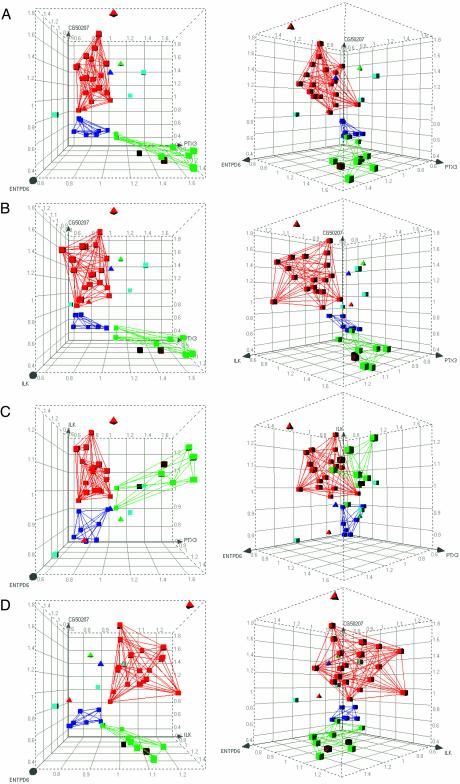
Fig. 1.
Fig. 1.
Three-dimensional representation of class discrimination on the basis of biomarker expression: classification tree. All possible three-way combinations of the four-gene marker set from CT iteration-one are displayed: (CG50207 vs. ENTPD6 vs. PTX3) (A), (CG50207 vs. ILK vs. PTX3) (B), (ILK vs. ENTPD6 vs. PTX3) (C), and (CG50207 vs. ENTPD6 vs. ILK) (D). Axes represent relative expression levels of marker genes, with means set to 1.0. Each graph is shown perpendicular to the XY plane (Left), and from 45° rotation around the y axis (Right). Red, antidepressant; dark blue, antipsychotic; green, opioid; brown, PCP; black, amphetamine; light blue, vehicle control; squares, correctly predicted treatments; triangles, misclassified treatments. Lines connecting correctly predicted treatments delineate the volume occupied by each accurately defined sample class. Note distinct class separation and placement of untreated control samples outside the treatment classes.
Fig. 2.
Fig. 2.
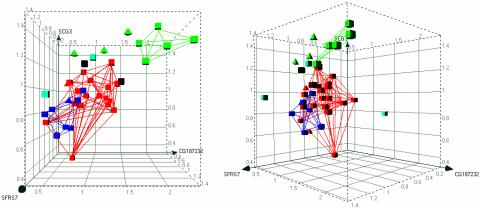
Three-dimensional representation of class discrimination on the basis of biomarker expression: random forest. The three biomarkers with importance measures >0.75 are depicted: (SFRS7 vs. SCG3 vs. CG187232–01). Axes represent relative expression levels of marker genes, with means set to 1.0. The graph is shown perpendicular to the XY plane (Left), and from 45° rotation around the y axis (Right). Red, antidepressant; dark blue, antipsychotic; green, opioid; brown, PCP; black, amphetamine; light blue, vehicle control; squares, correctly predicted treatments; triangles, misclassified treatments.

References

    1. Gasch, A. P., Spellman, P. T., Kao, C. M., Carmel-Harel, O., Eisen, M. B., Storz, G., Botstein, D. & Brown, P. O. (2000) Mol. Biol. Cell 11, 4241-4257. - PMC - PubMed
    1. Hughes, T. R., Marton, M. J., Jones, A. R., Roberts, C. J., Stoughton, R., Armour, C. D., Bennett, H. A., Coffey, E., Dai, H., He, Y. D., et al. (2000) Cell 102, 109-126. - PubMed
    1. Sørlie, T., Perou, C. M., Tibshirani, R., Aas, T., Geisler, S., Johnsen, H., Hastie, T., Eisen, M. B., van de Rijn, M., Jeffrey, S. S., et al. (2001) Proc. Natl. Acad. Sci. USA 98, 10869-10874. - PMC - PubMed
    1. Pomeroy, S. L., Tamayo, P., Gaasenbeek, M., Sturla, L. M., Angelo, M., McLaughlin, M. E., Kim, J. Y., Goumnerova, L. C., Black, P. M., Lau, C., et al. (2002) Nature 415, 436-442. - PubMed
    1. Perou, C. M., Jeffrey, S. S., van de Rijn, M., Rees, C. A., Eisen, M. B., Ross, D. T., Pergamenschikov, A., Williams, C. F., Zhu, S. X., Lee, J. C., et al. (1999) Proc. Natl. Acad. Sci. USA 96, 9212-9217. - PMC - PubMed

Substances