. 2003 Aug;9(8):931-6.
doi: 10.1261/rna.5660803.

Novel functional role of CA repeats and hnRNP L in RNA stability

Affiliations

Novel functional role of CA repeats and hnRNP L in RNA stability

Jingyi Hui et al. RNA. 2003 Aug.

Abstract

CA dinucleotide repeat sequences are very common in the human genome. We have recently demonstrated that the polymorphic CA repeats in intron 13 of the human endothelial nitric oxide synthase (eNOS) gene function as an unusual, length-dependent splicing enhancer. The CA repeat enhancer requires for its activity specific binding of hnRNP L. Here we show that in the absence of bound hnRNP L, the pre-mRNA is cleaved directly upstream of the CA repeats. The addition of recombinant hnRNP L restores RNA stability. CA repeats are both necessary and sufficient for this specific cleavage in the 5' adjacent RNA sequence. We conclude that-in addition to its role as a splicing activator-hnRNP L can act in vitro as a sequence-specific RNA protection factor. Based on the wide abundance of CA repetitive sequences in the human genome, this may represent a novel, generally important role of this abundant hnRNP protein.


Figures
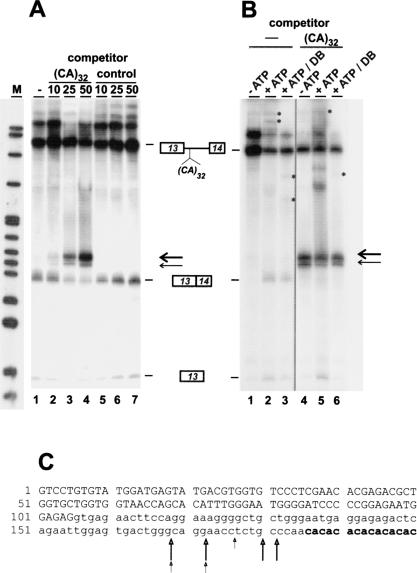
FIGURE 1.
FIGURE 1.
Competition by (CA)32 RNA destabilizes CA-repeat containing RNA. (A) 32P-labeled eNOS pre-mRNA with 32 CA repeats was incubated under splicing conditions for 90 min in the absence of competitor (lane 1) or with a 10-, 25-, or 50-fold molar excess of unlabeled (CA)32 RNA (lanes 24) or a 64-nt control RNA (lanes 57). After incubation, the RNAs were separated on an 8% denaturing polyacrylamide gel, followed by autoradiography. The positions of pre-mRNA, spliced product, and first exon are shown on the right (the strong band above the pre-mRNA appeared already without incubation and varied between different extract preparations). Thick and thin arrows mark the positions of the major and minor degradation products, respectively. (M) pBR322/HpaII marker fragments. (B) 32P-labeled eNOS pre-mRNA with 32 CA repeats was incubated for 90 min without (lanes 1,4) or with ATP (lanes 2,3,5,6), and without (lanes 13) or with a 50-fold molar excess of (CA)32 RNA (lanes 46). In addition, the RNAs shown in lanes 3 and 6 had been treated with HeLa cell S100 extract for debranching (DB). The putative lariat intermediate and excised lariat bands as well as their debranching products are indicated by asterisks. (C) The cleavage sites were precisely mapped within intron 13 of the eNOS gene, as described in Materials and Methods (eNOS exon 13 sequence in capital letters; intron 13 sequence in small letters; CA repeats in bold). Thick and thin arrows indicate cleavage sites derived from the major and minor degradation products, respectively.
FIGURE 2.
FIGURE 2.
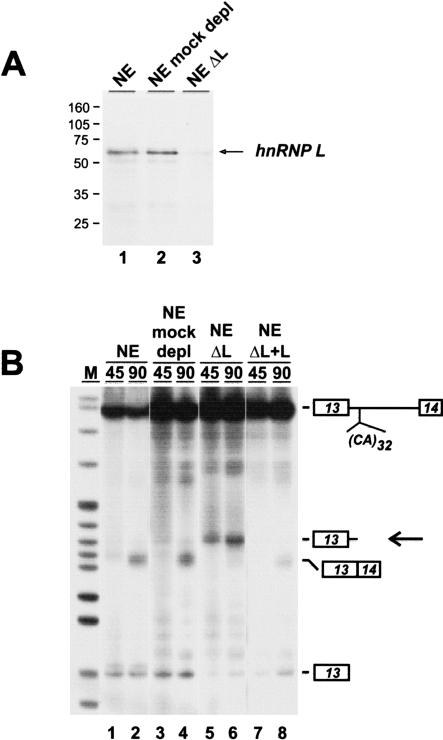
HnRNP L stabilizes CA-repeat containing RNA. (A) Western blot analysis of untreated nuclear extract (lane 1), mock-depleted nuclear extract (lane 2), and hnRNP L-depleted nuclear extract (lane 3). The sizes of marker proteins are given in kilodaltons. (B) 32P-labeled eNOS pre-mRNA with 32 CA repeats was incubated under splicing conditions for 45 and 90 min in untreated extract (lanes 1,2), mock-depleted extract (lanes 3,4), hnRNP L-depleted extract (lanes 5,6), and in depleted extract complemented with recombinant hnRNP L (600 ng per 25 μL reaction). RNAs were isolated and analyzed by denaturing polyacrylamide gel electrophoresis (8%) and autoradiography. The positions of pre-mRNA, spliced product, first exon, and the degradation product (arrow) are marked on the right. (M) pBR322/HpaII marker fragments.
FIGURE 3.
FIGURE 3.
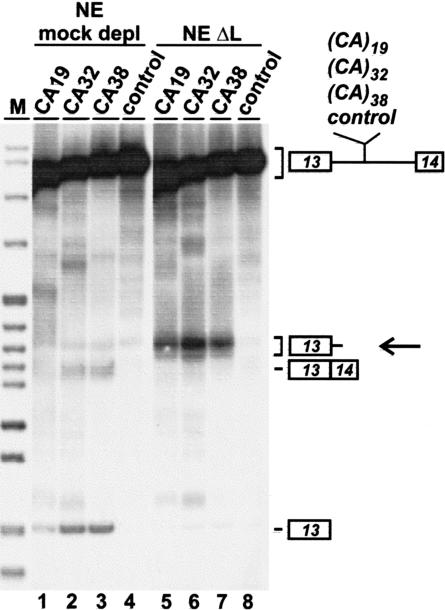
CA repeats are necessary for RNA destabilization. The following 32P-labeled eNOS pre-mRNAs were incubated under splicing conditions for 90 min in mock-depleted extract (lanes 14) and hnRNP L-depleted extract (lanes 58): eNOS with 19 CA repeats (CA19; lanes 1,5), 32 CA repeats (CA32; lanes 2,6), 38 CA repeats (CA38; lanes 3,7), and a 64-nt control sequence (control; lanes 4,8). RNAs were isolated and analyzed by denaturing polyacrylamide gel electrophoresis (8%) and autoradiography. The positions of pre-mRNA, spliced product, first exon, and the degradation products (arrow) are marked on the right. (M) pBR322/HpaII marker fragments.
FIGURE 4.
FIGURE 4.
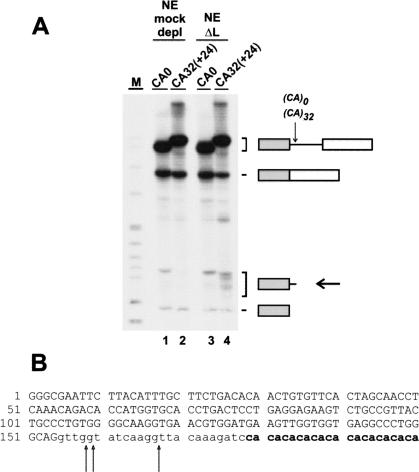
CA repeats are sufficient for RNA destabilization. (A) 32P-labeled β-globin pre-mRNAs without CA repeats (CA0; lanes 1,3) and with 32 CA repeats after position +24 in the intron [CA32(+24); lanes 2,4] were incubated under splicing conditions for 90 min in mock-depleted (lanes 1,2) or hnRNP L-depleted nuclear extract (lanes 3,4), followed by direct RNA analysis on an 8% denaturing polyacrylamide gel and autoradiography. The positions of pre-mRNA, spliced product, first exon, and the degradation products (arrow) are shown on the right. (M) pBR322/HpaII marker fragments. (B) The cleavage sites (arrows) were precisely mapped within the β-globin intron, as described in Materials and Methods (β-globin first exon sequence in capital letters; intron sequence in small letters; CA repeats in bold).

References

    1. Beelman, C.A. and Parker, R. 1995. Degradation of mRNA in eukaryotes. Cell 81: 179–183. - PubMed
    1. Bilbao, D. and Valcárcel, J. 2003. Getting to the heart of a splicing enhancer. Nat. Struct. Biol. 10: 6–7. - PubMed
    1. Ghetti, A., Piñol-Roma, S., Michael, W.M., Morandi, C., and Dreyfuss, G. 1992. hnRNP I, the polypyrimidine tract-binding protein: Distinct nuclear localization and association with hnRNAs. Nucleic Acids Res. 20: 3671–3678. - PMC - PubMed
    1. Hahm, B., Kim, Y.K., Kim, J.H., Kim, T.Y., and Jang, S.K. 1998. Heterogeneous nuclear ribonucleoprotein L interacts with the 3′ border of the internal ribosomal entry site of hepatitis C virus. J. Virol. 72: 8782–8788. - PMC - PubMed
    1. Hui, J., Stangl, K., Lane, W.S., and Bindereif, A. 2003. HnRNP L stimulates splicing of the eNOS gene by binding to variable-length CA repeats. Nat. Struct. Biol. 10: 33–37. - PubMed

Publication types

MeSH terms

Substances

LinkOut - more resources