. 2003 Aug 5;100(16):9156-61.
doi: 10.1073/pnas.1531993100. Epub 2003 Jul 18.

Pheromone gland-specific fatty-acyl reductase of the silkmoth, Bombyx mori

Affiliations

Pheromone gland-specific fatty-acyl reductase of the silkmoth, Bombyx mori

Ken'ichi Moto et al. Proc Natl Acad Sci U S A. .

Abstract

The C10-C18 unsaturated, acyclic, aliphatic compounds that contain an oxygenated functional group (alcohol, aldehyde, or acetate ester) are a major class of sex pheromones produced by female moths. In the biosynthesis of these pheromone components, the key enzyme required to produce the oxygenated functional groups is fatty-acyl reductase (FAR). This enzyme converts fatty-acyl pheromone precursors to their corresponding alcohols, which, depending on the moth species, can then be acetylated or oxidized to the corresponding aldehydes. Despite the significant role this enzyme has in generating the species-specific oxygenated constituents of lepidopteran sex pheromones, the enzyme has yet to be fully characterized and identified. In experiments designed to characterize a pheromone-gland-specific FAR in the silkmoth, Bombyx mori, we have isolated a cDNA clone encoding a protein homologous to a FAR from the desert shrub, Simmondsia chinensis, commonly known as jojoba. The deduced amino acid sequence of this clone predicts a 460-aa protein with a consensus NAD(P)H binding motif within the amino terminus. Northern blot analysis indicated that 2-kb transcripts of this gene were specifically expressed in the pheromone gland at 1 day before adult eclosion. Functional expression of this gene in the yeast Saccharomyces cerevisiae not only confirmed the long-chain FAR activity, but also indicated a distinct substrate specificity. Finally, the transformed yeast cells evoked typical mating behavior in male moths when cultured with the pheromone precursor fatty acid, (E,Z)-10,12-hexadecadienoic acid.


Figures
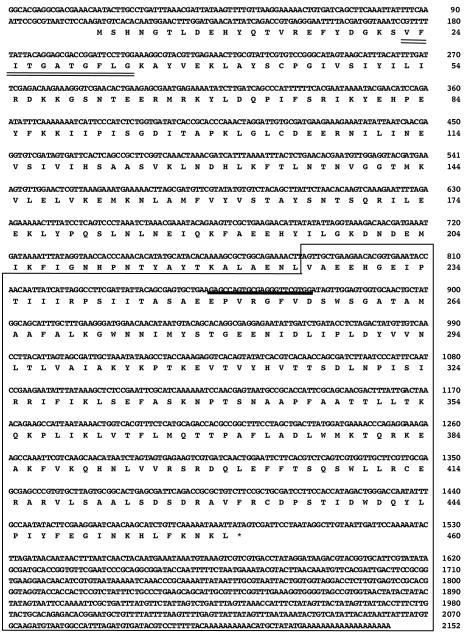
Fig. 1.
Fig. 1.
cDNA and deduced amino acid sequence of B. mori pgFAR. The region corresponding to the primer sequence used for 5′ RACE is underlined. The C-terminal part obtained by the first PCR is boxed. The proposed NAD(P)H binding motif is double underlined.
Fig. 2.
Fig. 2.
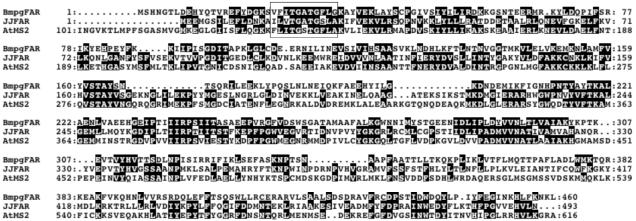
Multiple alignment of B. mori pgFAR and its related proteins. The identical residues are shaded black. The proposed NAD(P)H binding motif is boxed. BmpgFAR, B. mori pgFAR; AtMS2, A. thaliana male sterility 2 protein (GenBank accession no. X73652). JJFAR is from GenBank accession no. AF149917.
Fig. 3.
Fig. 3.
Northern blot analysis of B. mori pgFAR. (A) Expression in adult tissues. Lanes: 1, head; 2, fat body; 3, Malpighian tubule; 4, flight muscle; 5, ovary; 6, testis; 7, pheromone gland. Each tissue was dissected from a newly emerged female moth (day 0). Testis was dissected from a newly emerged male moth. (B) Expression in the pheromone gland. Pheromone glands dissected from females before and after adult eclosion were used for total RNA extraction. Day 0 corresponds to the day of eclosion. Ribosomal RNA band stained with ethidium bromide is shown as a loading control. The heterogeneity of the transcripts is caused by the differences in their 3′-untranslated regions (data not shown).
Fig. 4.
Fig. 4.
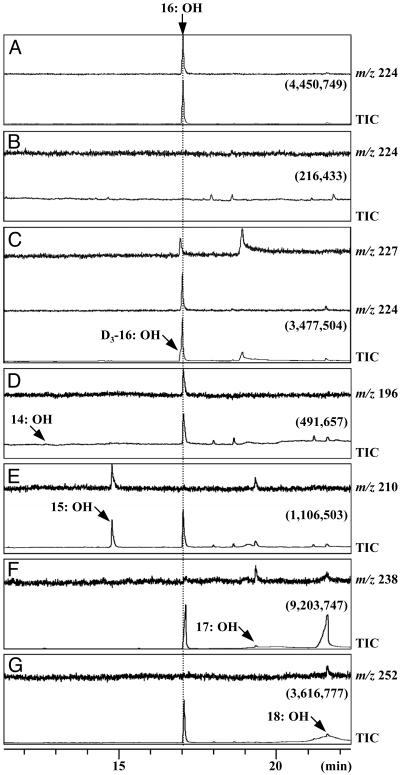
GC/MS analysis of fatty alcohols in the yeast-cell extracts by using total ion chromatograms (TICs) and mass chromatograms. (A) Yeast cells transformed with pESC-LEU-FAR. (B) Control yeast cells transformed with pESC-LEU. The fragment ion of m/z 224 corresponds to [M-18]+ of 16:OH. (CG) Yeast cells transformed with pESC-LEU-FAR were incubated in the presence of 0.5 mM saturated fatty acids. (C) D3-16:Acid. The m/z 227 corresponds to [M-18]+ of D3-16:OH. (D) 14:Acid. The m/z 196 corresponds to [M-18]+ of 14:OH. (E) 15:Acid. The m/z 210 corresponds to [M-18]+ of 15:OH. (F) 17:Acid. The m/z 238 corresponds to [M-18]+ of 17:OH. (G) 18:Acid. The m/z 252 corresponds to [M-18]+ of 18:OH. Fatty alcohols were extracted with n-hexane from lyophilized yeast cells. The value in parentheses indicates total peak abundance in each TIC.
Fig. 5.
Fig. 5.
GC/MS analysis of fatty alcohols in the yeast-cell extracts by using TICs and mass chromatograms. Yeast cells transformed with pESC-LEU-FAR were incubated in the presence of 0.5 mM monoene C16 fatty acids. (A) Z11–16:Acid. (B) E11–16:Acid. (C) Z9–16:Acid. (D) E9–16:Acid. The m/z 222 corresponds to [M-18]+ of monoene 16:OH. (EG) Conversion of E,Z10,12–16:Acid to E,Z10,12–16:OH (= bombykol). Yeast cells transformed with pESC-LEU-FAR were incubated in the presence of 0.5 mM E,Z10,12–16:Acid (E), 1:1 mixture of 0.25 mM E,Z10,12–16:Acid and E,E10,12–16:Acid (F), or 1:1 mixture of 0.5 mM E,Z10,12–16:Acid and Z11–16:Acid (G). The value in parentheses indicates total peak abundance in each TIC.
Fig. 6.
Fig. 6.
Mating behavior of the male B. mori moth evoked by yeast cells expressing B. mori pgFAR. Yeast cells were incubated in the presence of 0.5 mM E,Z10,12–16:Acid. (A) Before exposure to volatile contents of the vial containing transformed yeast cells. (BD) Sequential behavior of the male moth for the first 3 min after removal of the cap. This behavior was consistent with stereotypical male mating behavior, which is characterized by fluttering of the male's wings as he approaches the female and ultimately culminates copulation.

References

    1. Tamaki, Y. (1985) in Comprehensive Insect Physiology, Biochemistry, and Pharmacology, eds. Kerkut, G. A. & Gilbert, L. I. (Pergamon, New York), Vol. 9, pp. 145–191.
    1. Bjostad, L. B., Wolf, W. A. & Roelofs, W. L. (1987) in Pheromone Biochemistry, eds. Prestwich, G. D. & Blomquist, G. J. (Academic, Orlando, FL), pp. 77–120.
    1. Tillman, J. A., Seybold, S. J., Jurenka, R. A. & Blomquist, G. J. (1999) Insect Biochem. Mol. Biol. 29, 481–514. - PubMed
    1. Ando, T., Hase, R., Funayoshi, A., Arima, R. & Uchiyama, M. (1988) Agric. Biol. Chem. 52, 141–147.
    1. Fónagy, A., Yokoyama, N. & Matsumoto, S. (2001) Arthropod Struct. Dev. 30, 113–123. - PubMed

Publication types

MeSH terms

Associated data

LinkOut - more resources