


doi: 10.1093/aob/mcg139.
Effects of caffeine and chlorogenic acid on propidium iodide accessibility to DNA: consequences on genome size evaluation in coffee tree
Affiliations
- PMID: 12876189
- PMCID: PMC4243661
- DOI: 10.1093/aob/mcg139
Item in Clipboard
Effects of caffeine and chlorogenic acid on propidium iodide accessibility to DNA: consequences on genome size evaluation in coffee tree
Ann Bot.
2003 Aug.
Abstract
Estimates of genome size using flow cytometry can be biased by the presence of cytosolic compounds, leading to pseudo-intraspecific variation in genome size. Two important compounds present in coffee trees-caffeine and chlorogenic acid-modify accessibility of the dye propidium iodide to Petunia DNA, a species used as internal standard in our genome size evaluation. These compounds could be responsible for intraspecific variation in genome size since their contents vary between trees. They could also be implicated in environmental variations in genome size, such as those revealed when comparing the results of evaluations carried out on different dates on several genotypes.
Figures
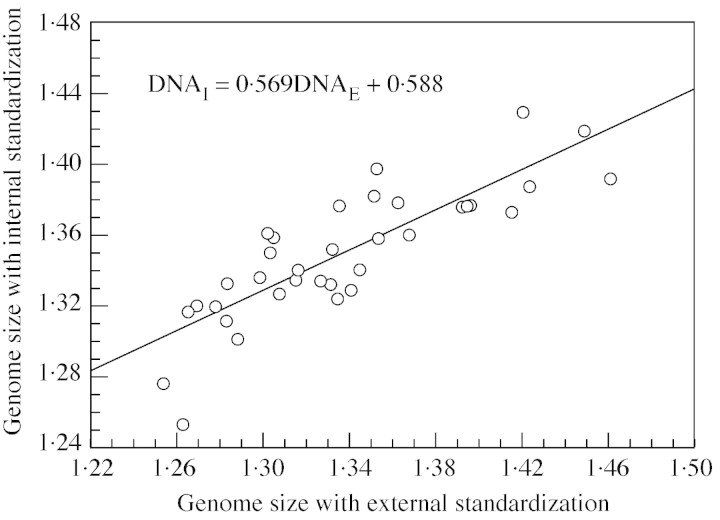
Fig. 1. Relationship between genome size evaluations using internal and external standardization. Petunia constituted the standard. Each point represents a backcross hybrid (target) between two species differing in their genome size. Segregation of the parental genome size in the second generation explains the range from F1 hybrids to the recurrent parent C. liberica var. dewevrei.
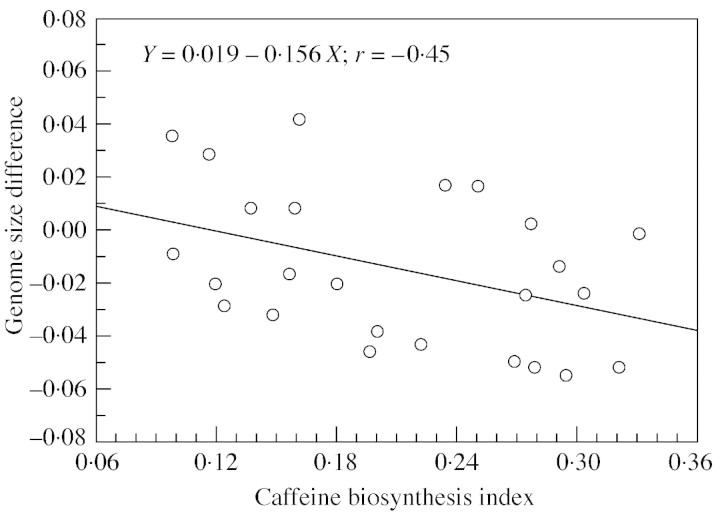
Fig. 2. Differences between two genome size evaluations (external vs. internal) in backcross hybrids is linearly related to their CAF : FT ratio (caffeine content per 100 d of fructification time) in mature beans.
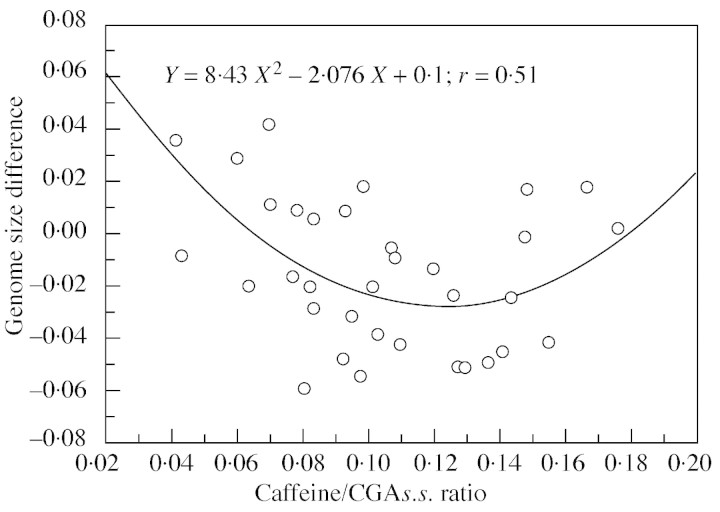
Fig. 3. Differences between two genome size evaluations (external vs. internal) in backcross hybrids are curvilinearly related to CAF : CGAs.s. (caffeine content : chlorogenic acids sensus stricto) in mature beans.
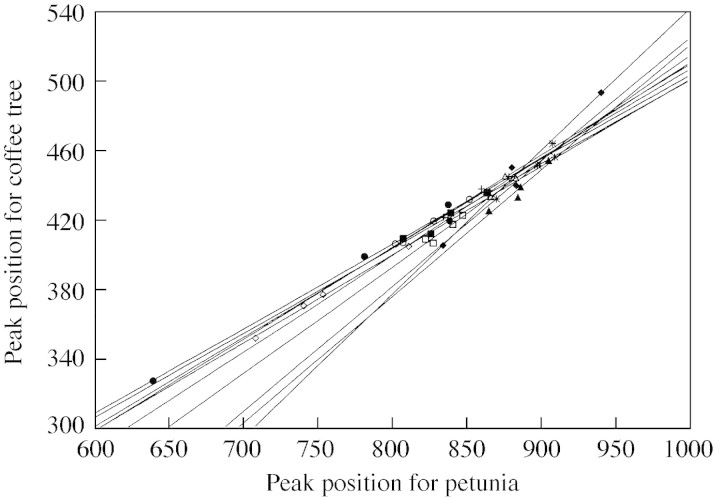
Fig. 4. Within‐tree relationships comparing the locations of the Petunia peak and the coffee peak. Each straight line represents a tree (from Noirot et al., 2002) and was estimated from four independent extracts per tree.
References
-
- AnthonyF, Clifford MN, Noirot M.1993. Biochemical diversity in the genus Coffea L.: chlorogenic acids, caffeine, and mozambioside contents. Genetic Resources and Crop Evolution 40: 61–70.
-
- BarreP, Noirot M, Louarn J, Duperray C, Hamon S.1996. Reliable flow cytometric estimation of nuclear DNA content in coffee trees. Cytometry 24: 32–38. - PubMed
-
- BarreP, Layssac M, D’Hont A, Louarn J, Charrier A, Hamon S, Noirot M.1998. Relationship between parental chromosomic contribution and nuclear DNA content in the coffee interspecific hybrid C. pseudozanguebariae × C. liberica var. dewevrei Theoretical Applied Genetics 96: 301–305.
-
- BaumannTW, Mösli SS, Schulthess BH, Aerts RJ.1993. Interdependence of caffeine and chlorogenic acid (5‐CQA) metabolism in coffee. Proceedings of the International Congress of ASIC 15: 134–140.
-
- CharrierA, Berthaud J.1975. Variation de la teneur en caféine dans le genre Coffea Café Cacao Thé 19: 251–264.
MeSH terms
Substances
LinkOut - more resources
Full Text Sources
Medical
