. 2003 Aug 5;100(16):9274-9.
doi: 10.1073/pnas.1233544100. Epub 2003 Jul 25.

Cell organization in soft media due to active mechanosensing

Affiliations

Cell organization in soft media due to active mechanosensing

I B Bischofs et al. Proc Natl Acad Sci U S A. .

Abstract

Adhering cells actively probe the mechanical properties of their environment and use the resulting information to position and orient themselves. We show that a large body of experimental observations can be consistently explained from one unifying principle, namely that cells strengthen contacts and cytoskeleton in the direction of large effective stiffness. Using linear elasticity theory to model the extracellular environment, we calculate optimal cell organization for several situations of interest and find excellent agreement with experiments for fibroblasts, both on elastic substrates and in collagen gels: cells orient in the direction of external tensile strain; they orient parallel and normal to free and clamped surfaces, respectively; and they interact elastically to form strings. Our method can be applied for rational design of tissue equivalents. Moreover, our results indicate that the concept of contact guidance has to be reevaluated. We also suggest that cell-matrix contacts are up-regulated by large effective stiffness in the environment because, in this way, build-up of force is more efficient.


Figures
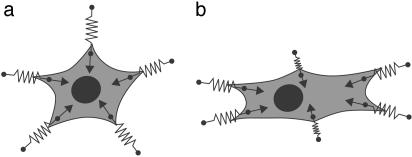
Fig. 1.
Fig. 1.
An adherent cell actively pulls on its soft environment through cell–matrix contacts. Experimentally, one finds that cells orient themselves in the direction of maximal stiffness of the environment. In this cartoon, we present one possible mechanism by which active mechanosensing in an elastically anisotropic medium might lead to cell orientation. The local elastic environment is represented by linear springs with different spring constants K, as indicated by differently sized springs. For up-regulation of a contact, the cell has to invest the work F2/2K. Therefore, up-regulation is more efficient for larger K. (a) In an isotropic environment, all spring constants are the same, growth at different contacts is similar, and the cell does not orient. (b) If spring constants are largest in one specific direction, the corresponding contacts outgrow the others and the cell orients in the direction of maximal stiffness of the environment. In this paper, we use the cellular preference for large effective stiffness and modeling of the extracellular environment by linear elasticity theory to predict cell positioning and orientation in soft media.
Fig. 2.
Fig. 2.
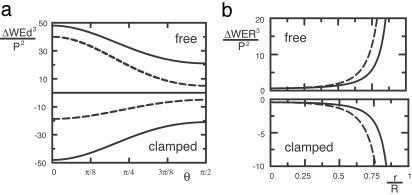
Adjusting cell position and orientation in such a way that the cell sensing maximal effective stiffness in its environment is equivalent to minimizing the quantity W, the amount of work the cell invests into the elastic surroundings in the presence of external strain. In the presence of mechanical activity, sample boundaries induce external strain that can result in different cell organization. (a) ΔW for a cell with dipole strength P that is a distance d away from the surface of an elastic halfspace with rigidity E, plotted in units of P2/Ed3 as a function of angle θ between cell orientation and surface normal (rescaled by 256π). Solid and dashed lines correspond to Poisson ratios ν = ½ and ν = 0, respectively. Irrespective of ν, the optimal orientations (minimal ΔW) are perpendicular (θ = 0) and parallel (θ = π/2) to the surface for clamped and free boundaries, respectively. Because |ΔW| increases if d decreases, the overall mechanical activity of a cell increases toward a clamped surface (ΔW < 0) but decreases toward a free surface (ΔW > 0). (b) ΔW for a cell in an elastic sphere of radius R, plotted in units of P/ER3 as a function of distance r to the sphere center in units of R for ν = ⅓ (rescaled by 15/8). Solid and dashed lines are parallel (θ = π/2) and perpendicular (θ = 0) orientations, respectively (all other orientations yield curves that lie in between the ones shown). As in an elastic halfspace, parallel and perpendicular orientations are favored (minimal ΔW) for free and clamped boundaries, respectively. For clamped boundaries, mechanical activity is favored (smaller ΔW) toward the surface. For free boundaries, mechanical activity is disfavored (larger ΔW) toward the surface.
Fig. 3.
Fig. 3.
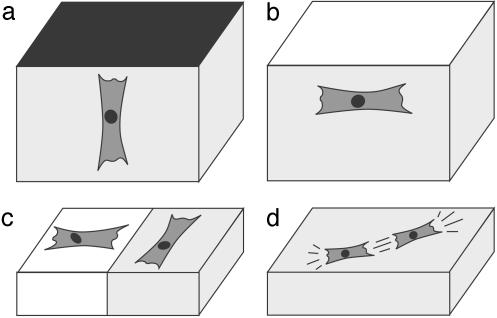
Predicted cell orientation in a hydrogel close to a surface (a and b) and on elastic substrates (c and d). (a) Cells prefer the direction of maximal effective stiffness. Thus, they orient perpendicular to a clamped surface. (b) For a free surface, this direction is parallel to the surface. (c) Cells close to a boundary between soft (left) and rigid (right) regions prefer analogous orientations as cells close to clamped and free surfaces in a hydrogel, respectively. (d) Cells interact elastically to form strings, because, in nose-to-tail alignment, the mechanical activity of one cell triggers the activity of the other cell, thereby forming a positive feedback loop.
Fig. 4.
Fig. 4.
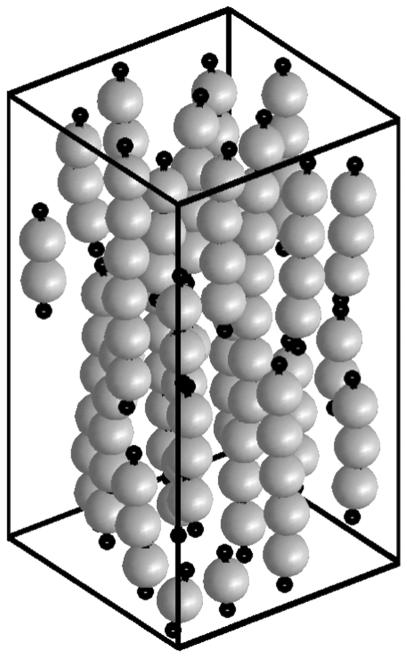
Monte Carlo simulations of elastically interacting cells in an external strain field. The temperature used in the simulation represents the stochastic element of the process of cell organization. Without external strain, cells form strings. In its presence, strings align in parallel.

References

    1. Galbraith, C. G. & Sheetz, M. (1998) Curr. Opin. Cell Biol. 10, 566–571. - PubMed
    1. Huang, S. & Ingber, D. E. (1999) Nat. Cell Biol. 1, E131–E138. - PubMed
    1. Geiger, B. & Bershadsky, A. (2002) Cell 110, 139–142. - PubMed
    1. Harris, A. K., Wild, P. & Stopak, D. (1980) Science 208, 177–179. - PubMed
    1. Pelham, R. J. & Wang, Y.-L. (1997) Proc. Natl. Acad. Sci. USA 94, 13661–13665. - PMC - PubMed

Publication types

Substances

LinkOut - more resources