


Information needs and information seeking in primary care: a study of nurse practitioners
- PMID: 12883577
- PMCID: PMC153161
Information needs and information seeking in primary care: a study of nurse practitioners
Abstract
Objective: The objective was to understand the information-related behavior of nurse practitioners (NPs), a population of clinicians responsible for an increasing proportion of primary care.
Methods: Two phases of data collection addressed seven research questions. The initial phase of data collection was a questionnaire sent to 300 NPs, who were asked to report their experiences of needing information as a result of patient encounters as well as their experiences of seeking information. The second phase of data collection entailed a series of interviews with twenty NPs following their encounters with patients to collect data on instances of information needs and information seeking.
Results: NPs most frequently needed information related to drug therapy and diagnosis. NPs with a master's degree were found to perceive information needs more frequently than their colleagues who had not received a master's degree. The information resources NPs used most frequently were consultations with colleagues, drug reference manuals, and textbooks and protocol manuals. NPs were more likely to pursue needs related to drug therapy with a print resource and needs related to diagnosis with a colleague. The generalizability of a need emerged as a negative predictor of information seeking.
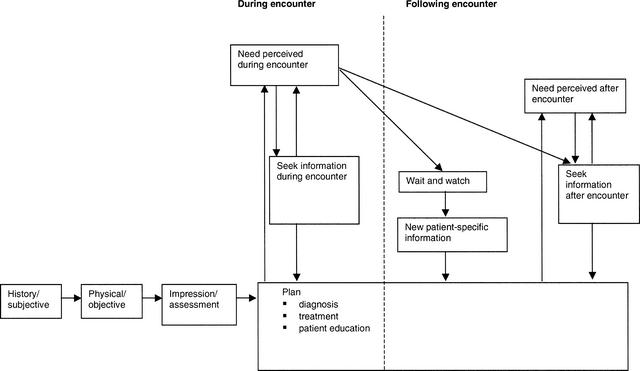
Conclusions: This study has addressed a number of questions about the information-related behavior of NPs in primary care practices and led to the development of a temporal model of information seeking in these settings. Results of this research underscore the importance of access to information resources in primary care practices. This study's findings also support the development of educational and outreach programs to promote evidence-based decision making among primary care clinicians.
Figures
References
-
- Dervin B, Nilan M.. Information needs and uses. Annu Rev Inform Sci. 1986;21:3–33.
-
- Hewins ET. Information need and use studies. Annu Rev Inform Sci 1990;25:145–72.
-
- Cogdill KW, Friedman CP, Jenkins CG, Mays BE, and Sharp MC. Information needs and information seeking in community medical education. Acad Med. 2000 May; 75(5):484–6. - PubMed
-
- Covell DG, Uman GC, and Manning PR. Information needs in office practice: are they being met? Ann Intern Med. 1985 Oct; 103(4):596–9. - PubMed
-
- Connelly DP, Rich EC, Curley SP, and Kelly JT. Knowledge resource preferences of family physicians. J Family Pract. 1990 Mar; 30(3):353–9. - PubMed
MeSH terms
LinkOut - more resources
Full Text Sources