


Adaptation of Puumala hantavirus to cell culture is associated with point mutations in the coding region of the L segment and in the noncoding regions of the S segment
- PMID: 12885898
- PMCID: PMC167242
- DOI: 10.1128/jvi.77.16.8793-8800.2003
Adaptation of Puumala hantavirus to cell culture is associated with point mutations in the coding region of the L segment and in the noncoding regions of the S segment
Abstract
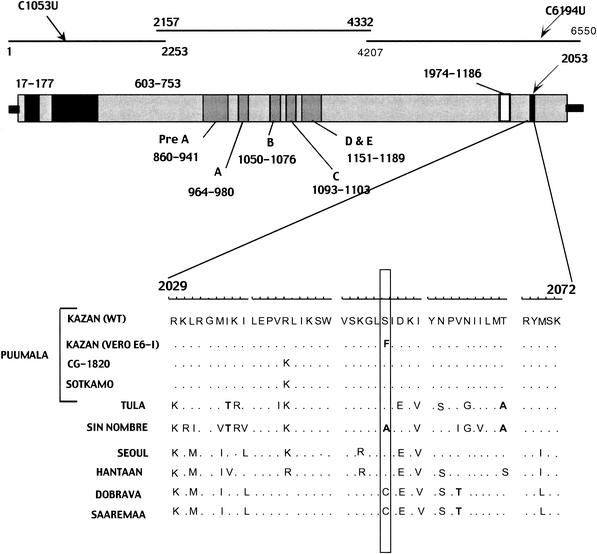
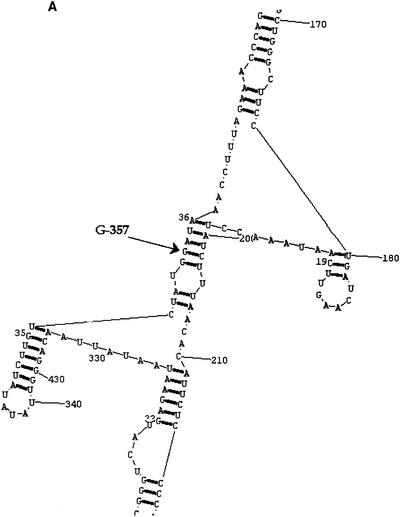
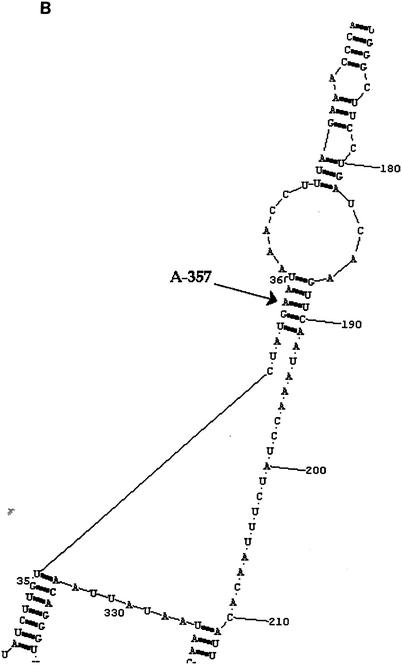
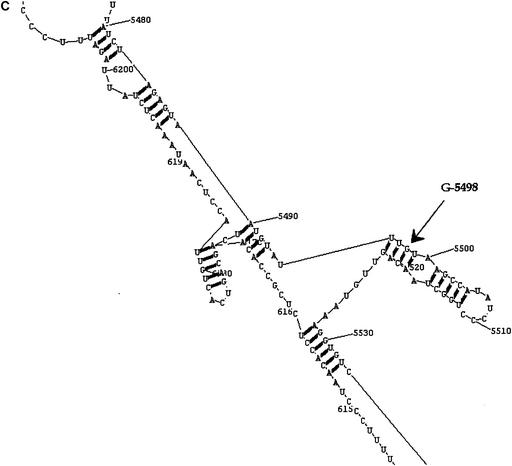
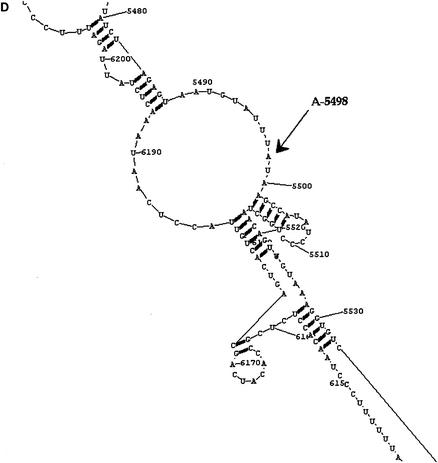
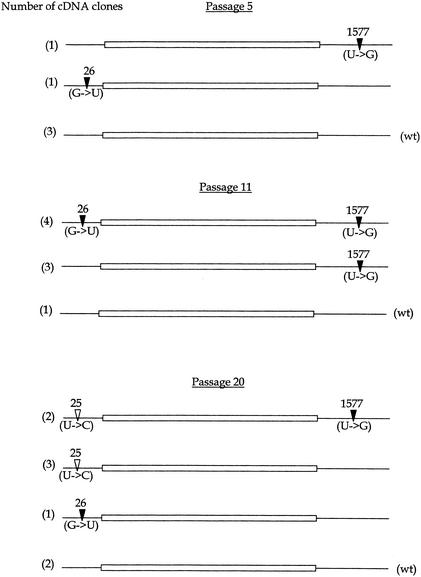
We previously developed a model for studies on hantavirus host adaptation and initiated genetic analysis of Puumala virus variants passaged in colonized bank voles and in cultured Vero E6 cells. With the data presented in this paper, the sequence comparison of the wild-type and Vero E6-adapted variants of Puumala virus, strain Kazan, has been completed. The only amino acid substitution that distinguished the two virus variants was found in the L protein, Ser versus Phe at position 2053. Another mutation found in the L segment, the silent transition C1053U, could result from the selection of a variant with altered L RNA folding. Nucleotide substitutions observed in individual L cDNA clones, most of them A-->G and U-->C transitions, suggested that the population of L RNA molecules is represented by quasispecies. The mutation frequency in the L segment quasispecies appeared to be similar to the corresponding values for the S and M quasispecies. Analysis of the cDNA clones with the complete S segment sequences from passage 20 confirmed our earlier conclusion that the cell-adapted genotype of the virus is represented mostly by variants with mutated S segment noncoding regions. However, the spectrum of the S segment quasispecies appeared to be changing, suggesting that, after the initial adaptation (passages 1 to 11), the viral population is still being driven by selection for variants with higher fitness.
Figures
Similar articles
-
Characterization of two substrains of Puumala virus that show phenotypes that are different from each other and from the original strain.J Virol. 2011 Feb;85(4):1747-56. doi: 10.1128/JVI.01428-10. Epub 2010 Nov 24. J Virol. 2011. PMID: 21106742 Free PMC article.
-
Cell culture adaptation of Puumala hantavirus changes the infectivity for its natural reservoir, Clethrionomys glareolus, and leads to accumulation of mutants with altered genomic RNA S segment.J Virol. 1997 Dec;71(12):9515-23. doi: 10.1128/JVI.71.12.9515-9523.1997. J Virol. 1997. PMID: 9371614 Free PMC article.
-
Accumulation of point mutations and reassortment of genomic RNA segments are involved in the microevolution of Puumala hantavirus in a bank vole (Myodes glareolus) population.J Gen Virol. 2008 Jul;89(Pt 7):1649-1660. doi: 10.1099/vir.0.2008/001248-0. J Gen Virol. 2008. PMID: 18559935
-
Resequencing of the Puumala virus strain Sotkamo from the WHO Arbovirus collection.Virus Genes. 2012 Oct;45(2):389-92. doi: 10.1007/s11262-012-0780-3. Epub 2012 Jul 15. Virus Genes. 2012. PMID: 22798055
-
Prediction of the Spatial Origin of Puumala Virus Infections Using L Segment Sequences Derived from a Generic Screening PCR.Viruses. 2019 Jul 30;11(8):694. doi: 10.3390/v11080694. Viruses. 2019. PMID: 31366168 Free PMC article.
Cited by
-
Effect of Puumala hantavirus infection on human umbilical vein endothelial cell hemostatic function: platelet interactions, increased tissue factor expression and fibrinolysis regulator release.Front Microbiol. 2015 Mar 24;6:220. doi: 10.3389/fmicb.2015.00220. eCollection 2015. Front Microbiol. 2015. PMID: 25852676 Free PMC article.
-
A model system for in vitro studies of bank vole borne viruses.PLoS One. 2011;6(12):e28992. doi: 10.1371/journal.pone.0028992. Epub 2011 Dec 16. PLoS One. 2011. PMID: 22194969 Free PMC article.
-
Characterization of two substrains of Puumala virus that show phenotypes that are different from each other and from the original strain.J Virol. 2011 Feb;85(4):1747-56. doi: 10.1128/JVI.01428-10. Epub 2010 Nov 24. J Virol. 2011. PMID: 21106742 Free PMC article.
-
Pathology of Puumala hantavirus infection in macaques.PLoS One. 2008 Aug 21;3(8):e3035. doi: 10.1371/journal.pone.0003035. PLoS One. 2008. PMID: 18716663 Free PMC article.
-
Emerging viral infections.Clin Lab Med. 2004 Sep;24(3):773-95, vii. doi: 10.1016/j.cll.2004.05.002. Clin Lab Med. 2004. PMID: 15325064 Free PMC article. Review.
References
-
- Andre, F. E. 1995. Approaches to a vaccine against hepatitis A: development and manufacture of an inactivated vaccine. J. Infect. Dis. 171(Suppl. 1):S33-S39. - PubMed
-
- Antic, D., B. U. Lim, and C. Y. Kang. 1991. Nucleotide sequence and coding capacity of the large (L) genomic RNA segment of Seoul 80-39 virus, a member of the hantavirus genus. Virus Res. 19:59-66. - PubMed
-
- Bijlenga, C., and E. M. Hernandez-Baumgarten. 1980. Adaptation, attenuation and plaque purification of a rabies virus isolate (V319) from a vampire bat (Desmodus rotundus). Cornell Vet. 70:290-299. - PubMed
-
- Chomczynski, P., and N. Sacchi. 1987. Single-step method of RNA isolation by acid guanidinium thiocyanate-phenol-chloroform extraction. Anal. Biochem. 162:156-159. - PubMed
Publication types
MeSH terms
Substances
LinkOut - more resources
Full Text Sources
