. 2003 Jul-Aug;10(4):275-84.
doi: 10.1101/lm.58503.

Sleep and the time course of motor skill learning

Affiliations

Sleep and the time course of motor skill learning

Matthew P Walker et al. Learn Mem. 2003 Jul-Aug.

Abstract

Growing evidence suggests that sleep plays an important role in the process of procedural learning. Most recently, sleep has been implicated in the continued development of motor-skill learning following initial acquisition. However, the temporal evolution of motor learning before and after sleep, the effects of different training regimens, and the long-term development of motor learning across multiple nights of sleep remain unknown. Here, we report data for subjects trained and retested on a sequential finger-tapping task across multiple days. The findings demonstrate firstly that following initial training, small practice-dependent improvements are possible before, but not following the large practice-independent gains that develop across a night of sleep. Secondly, doubling the quantity of initial training does not alter the amount of subsequent sleep-dependent learning that develops overnight. Thirdly, the amount of sleep-dependent learning does not correlate with the amount of practice-dependent learning achieved during training, suggesting the existence of two discrete motor-learning processes. Finally, whereas the majority of sleep-dependent motor-skill learning develops during the first night of sleep following training, additional nights of sleep still offer continued improvements.


Figures
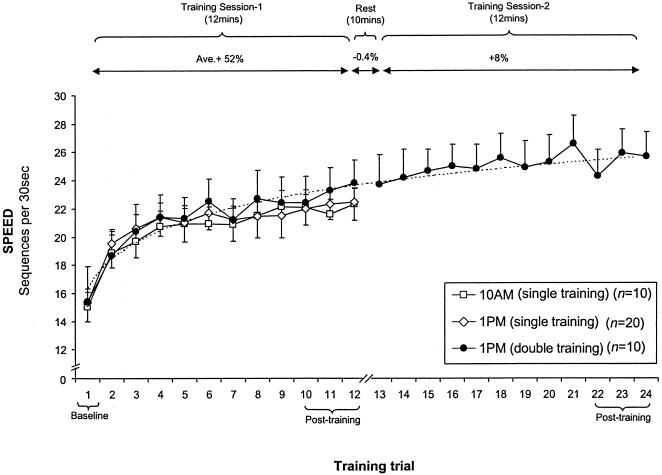
Figure 1
Figure 1
Improvement in performance speed across training. Improvement during training session 1 (trials 1–12) was similar for subjects trained at 10 AM (group 1, □) and 1 PM (groups 2 and 4, ⋄; and group 3, •). Subjects in group 3 performed a second successive training session (trials 13–24), demonstrating modest continued improvements, similar to the predicted improvement rate based on the logarithmic regression across the first 12 trials of training in Session 1 (broken line).
Figure 5
Figure 5
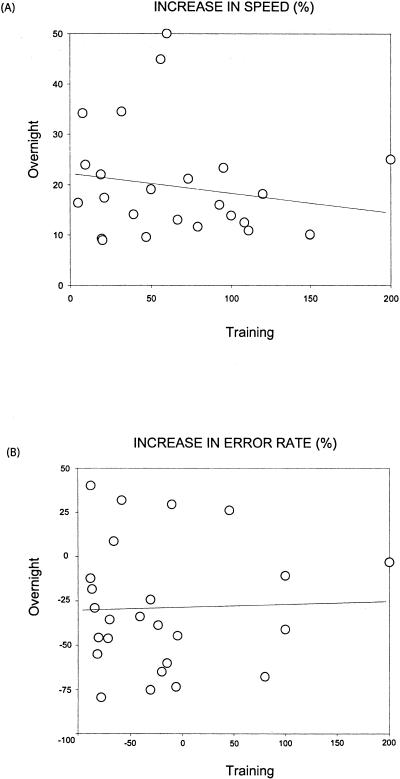
Training-dependent learning vs. sleep-dependent learning. Subjects were trained once and retested once after a single intervening night of sleep (n = 25; groups 2 and 5). (A) Speed: There was no relationship between the amount of improvement during training (difference between baseline and posttraining score) and the amount of subsequent overnight improvements (difference between posttraining and retest score). (B) Error rate: Similarly, there was no evidence of a correlation between practice-dependent changes in error rate during training, and the amount of continued performance improvements in error rate that developed overnight.
Figure 2
Figure 2
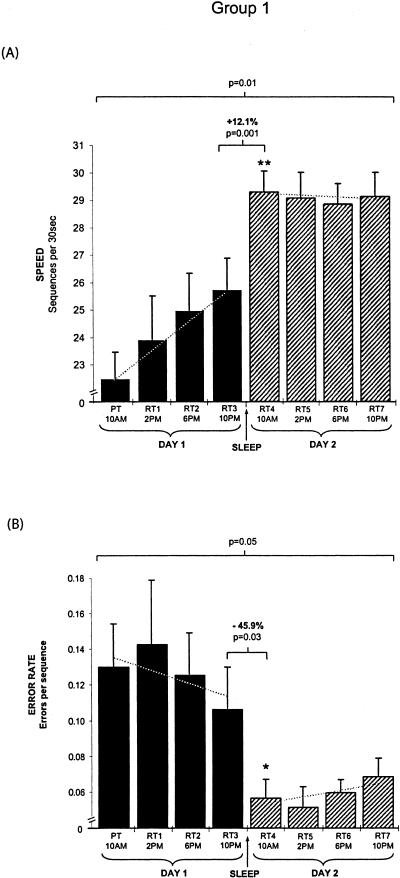
Differential motor skill learning across 36 h before and after sleep (Group 1). (A) Speed. Following training at 10 AM, subjects demonstrated modest, but significant continued gains in motor-skill speed with rehearsal on day 1 (solid black bars). The initial retest on day 2 (RT4) showed a large and significant overnight improvement. In contrast, continued retesting across day 2 (hatched bars) yielded no further increase in performance speed. The marked difference in learning profiles prior to sleep (day 1) and following sleep (day 2) are seen in the improvement slopes for each group (broken lines; day 1 slope [presleep] = 1.08 vs. day 2 slope [postsleep] = 0.14). (B) Error rate. In contrast, error rate did not significantly improve during daytime rehearsal on either day 1 (solid bars) or day 2 (hatched bars), with the only significant decrease in error rate occurring exclusively across the night of intervening sleep. This similarity is evident in the comparable learning profile slopes prior to sleep on day 1 and following sleep on day 2 (broken lines; day 1 slope [presleep] = 0.009 vs. day-2 slope [postsleep] = 0.001). (PT) Posttraining value (average of final three trials of training); (RT) retest value (average of three trials); Error bars, SEM; (Asterisks) significance (P) compared with previous time point at *<0.05; **<0.005
Figure 3
Figure 3
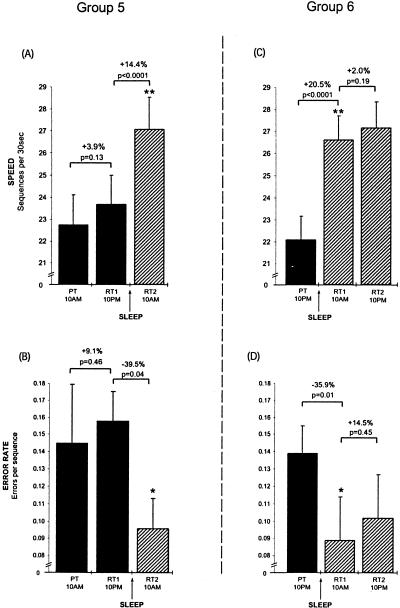
Continued motor-skill learning across 24 h with wake or sleep first (Groups 5 and 6, modified from Walker et al. 2002). (A,B) Group 5: Following a single training session in the morning, subjects demonstrated no significant change in speed or error rate following 12 h of wake (RT1; solid bars) relative to the end of training (posttraining; PT). However, following a night of sleep, a significant increase in speed and decrease in error rate had developed (RT2; hatched bar). (C,D) Group 6: Subjects were trained in the evening, and showed significant improvements in speed and error rate after only 12 h, following a night of sleep (RT1, solid bar), but displayed no further significant improvements in speed or error rate with an additional 12 h of wake (RT2, hatched bars). Error bars, SEM; (Asterisks) significance (P) compared with previous time point at *<0.05; **<0.005
Figure 4
Figure 4
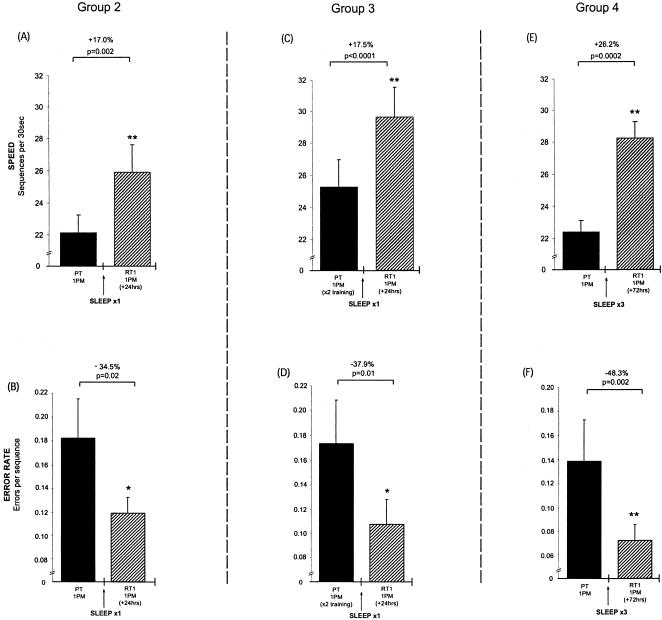
Continued motor-skill learning across 24–72 h with variable training and intervening nights of sleep (Groups 2–4). (A,B) Group 2: Subjects received a single training session on day 1 (1 PM), and demonstrated significant increases in speed (A) and decreases in error rate (B) relative to the end of training (PT) when retested 24 h later on day 2 (1 PM; RT1), similar to overnight values seen in our earlier findings (see Fig. 3). (C,D) Group 3: Subjects performed two consecutive training sessions on day 1 (1 PM). Although subjects attained different posttraining (PT) performance levels relative to subjects in group 2 due to this second training session, they displayed almost identical overnight percentage improvements in speed (C) and reductions in error rate (D) at retest on day 2 (RT1). (E,F) Group 4: Subjects received a single training session as in group 2, but were instead retested 72 h later after three intervening nights of sleep, and showed larger increases in performance speed (E) and greater reductions in error rate (F). Error bars, SEM; (Asterisks) significance (P) compared with previous time point at *<0.05; **<0.005.
Figure 6
Figure 6
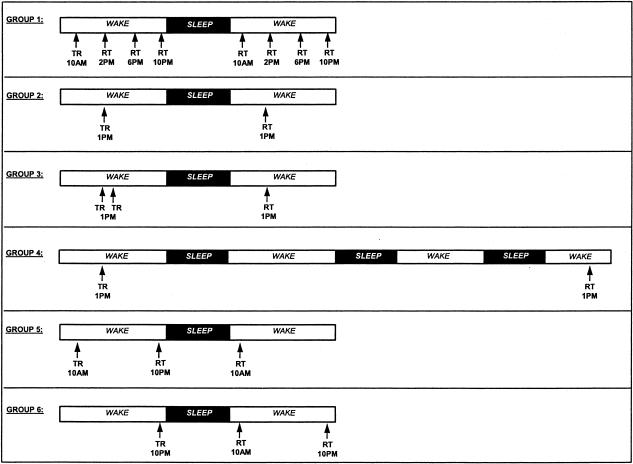
Experimental protocols. Forty subjects (groups 1–4) were trained at either 10 AM or 1 PM on day 1, and then retested across the following 24–72-h period in different experimental protocols. Thirty additional subjects (groups 5 and 6) were trained and retested in an earlier study (Walker et al. 2002) and are presented for comparison. (TR) Training; (RT) retest

References

    1. Abel, T. and Lattal, K.M. 2001. Molecular mechanisms of memory acquisition, consolidation and retrieval. Curr. Opin. Neurobiol. 11: 180–187. - PubMed
    1. Brashers-Krug, T., Shadmehr, R., and Bizzi, E. 1996. Consolidation in human motor memory. Nature 382: 252–255. - PubMed
    1. Butefisch, C.M., Davis, B.C., Wise, S.P., Sawaki, L., Kopylev, L., Classen, J., and Cohen, L.G. 2000. Mechanisms of use-dependent plasticity in the human motor cortex. Proc. Natl. Acad. Sci. 97: 3661–3665. - PMC - PubMed
    1. Fischer, S., Hallschmid, M., Elsner, A.L., and Born, J. 2002. Sleep forms memory for finger skills. Proc. Natl. Acad. Sci. 99: 11987–11991. - PMC - PubMed
    1. Gais, S., Plihal, W., Wagner, U., and Born, J. 2000. Early sleep triggers memory for early visual discrimination skills. Nat. Neurosci. 3: 1335–1339. - PubMed

Publication types

LinkOut - more resources