


Increased peripheral resistance in heart failure: new evidence suggests an alteration in vascular smooth muscle function
- PMID: 12890702
- PMCID: PMC1573961
- DOI: 10.1038/sj.bjp.0705366
Increased peripheral resistance in heart failure: new evidence suggests an alteration in vascular smooth muscle function
Abstract
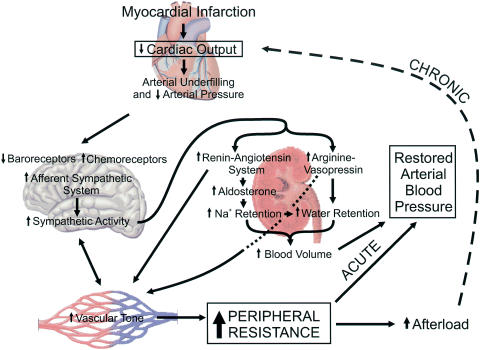
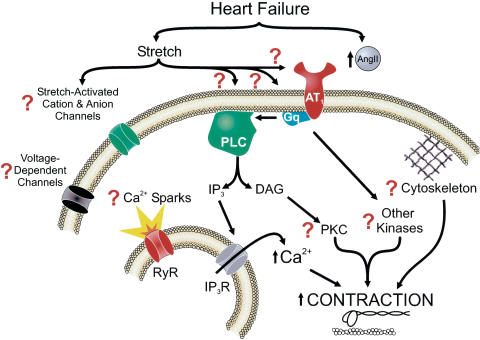
Increased peripheral resistance is a hallmark of chronic heart failure and has been primarily attributed to neurohumoral pathways involving both the renin-angiotensin and sympathetic nervous systems. The increased resistance is thought to serve as a compensatory mechanism to help maintain perfusion to the vital organs by sustaining blood pressure in the fate of a failing heart. Local mechanisms, and in particular endothelial dysfunction, have also been shown to be important contributors in regulating arterial resistance and vascular remodeling in this disease. In this issue of the British Journal of Pharmacology, Gschwend et al. (2003) present new data suggesting that in the absence of a functional endothelium, myogenic constriction of small pressurized mesenteric arteries, an intrinsic property of vascular smooth muscle cells, is enhanced in a coronary artery ligation-induced myocardial infarction model of congestive heart failure (CHF) in the rat. The increased myogenic tone appears to be tightly linked to angiotensin II type 1 receptors (AT(1)). The possibility that CHF-induced stimulation of myogenic constriction is due to the local release of preformed angiotensin II or constitutive upregulation of the AT(1) receptor signaling pathways are discussed along with other potential cellular and molecular mechanisms previously suggested to play a role in myogenic reactivity.
Figures
References
-
- BALMFORTH A.J., LEE A.J., WARBURTON P., DONNELLY D., BALL S.G. The conformational change responsible for AT1 receptor activation is dependent upon two juxtaposed asparagine residues on transmembrane helices III and VII. J. Biol. Chem. 1997;272:4245–4251. - PubMed
-
- DAVIS M.J., HILL M.A. Signaling mechanisms underlying the vascular myogenic response. Physiol. Rev. 1999;79:387–423. - PubMed
-
- FANG Z.Y., MARWICK T.H. Vascular dysfunction and heart failure: epiphenomenon or etiologic agent. Am. Heart J. 2002;143:383–390. - PubMed
-
- FELDER R.B., FRANCIS J., ZHANG Z.H., WEI S.G., WEISS R.M., JOHNSON A.K. Heart failure and the brain: new perspectives. Am. J. Physiol. Regul. Integr. Comp. Physiol. 2003;284:R259–R276. - PubMed
-
- GROBLEWSKI T., MAIGRET B., LARGUIER R., LOMBARD C., BONNAFOUS J.C., MARIE J. Mutation of Asn111 in the third transmembrane domain of the AT1A angiotensin II receptor induces its constitutive activation. J. Biol. Chem. 1997;272:1822–1826. - PubMed
Publication types
MeSH terms
Grants and funding
LinkOut - more resources
Full Text Sources
Medical
Research Materials
