


Myogenic constriction is increased in mesenteric resistance arteries from rats with chronic heart failure: instantaneous counteraction by acute AT1 receptor blockade
- PMID: 12890711
- PMCID: PMC1573962
- DOI: 10.1038/sj.bjp.0705367
Myogenic constriction is increased in mesenteric resistance arteries from rats with chronic heart failure: instantaneous counteraction by acute AT1 receptor blockade
Abstract
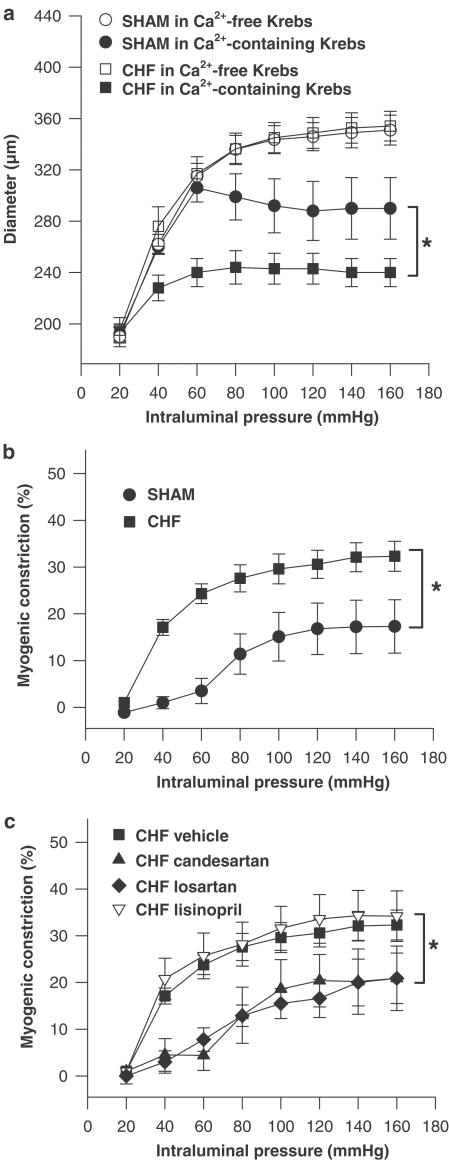
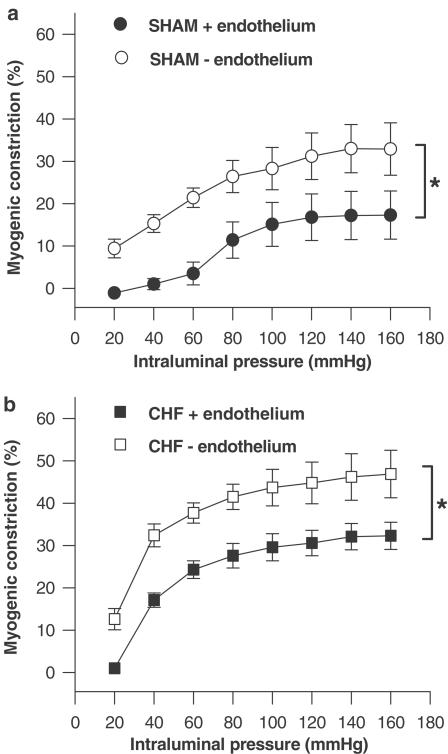
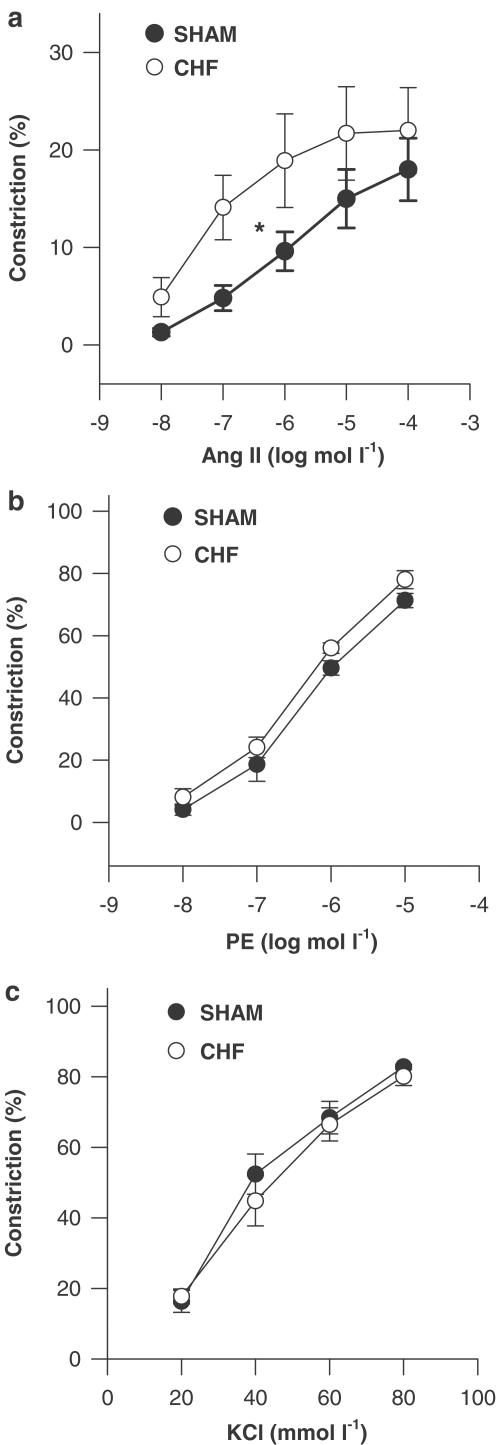
(1) Increased vascular resistance in chronic heart failure (CHF) has been attributed to stimulated neurohumoral systems. However, local mechanisms may also importantly contribute to set arterial tone. Our aim, therefore, was to test whether pressure-induced myogenic constriction of resistance arteries in vitro--devoid of acute effects of circulating factors--is increased in CHF and to explore underlying mechanisms. (2) At 12 weeks after coronary ligation-induced myocardial infarction or SHAM-operations in rats, we studied isolated mesenteric arteries for myogenic constriction, determined as the active constriction (% of passive diameter) in response to stepwise increase in intraluminal pressure (20 - 160 mmHg), in the absence and presence of inhibitors of potentially involved modulators of myogenic constriction. (3) We found that myogenic constriction in mesenteric arteries from CHF rats was markedly increased compared to SHAM over the whole pressure range, the difference being most pronounced at 60 mmHg (24+/-2 versus 4+/-3%, respectively, P<0.001). (4) Both removal of the endothelium as well as inhibition of NO production (L-N(G)-monomethylarginine, 100 micro M) significantly increased myogenic constriction (+16 and +25%, respectively), the increase being similar in CHF- and SHAM-arteries (P=NS). Neither endothelin type A (ET(A))-receptor blockade (BQ123, 1 micro M) nor inhibition of perivascular (sympathetic) nerve conduction (tetrodotoxin, 100 nM) affected the myogenic response in either group. (5) Interestingly, increased myogenic constriction in CHF was fully reversed after angiotensin II type I (AT(1))-receptor blockade (candesartan, 100 nM; losartan, 10 micro M), which was without effect in SHAM. In contrast, neither angiotensin-converting enzyme (ACE) inhibition (lisinopril, 1 micro M; captopril, 10 micro M) or AT(2)-receptor blockade (PD123319, 1 micro M), nor inhibition of superoxide production (superoxide dismutase, 50 U ml(-1)), TXA(2)-receptor blockade (SQ29,548, 1 micro M) or inhibition of cyclooxygenase-derived prostaglandins (indomethacin, 10 micro M) affected myogenic constriction. (6) Sensitivity of mesenteric arteries to angiotensin II (10 nM - 100 micro M) was increased (P<0.05) in CHF (pD(2) 7.1+/-0.4) compared to SHAM (pD(2) 6.2+/-0.3), while the sensitivity to KCl and phenylephrine was not different. (7) Our results demonstrate increased myogenic constriction in small mesenteric arteries of rats with CHF, potentially making it an important target for therapy in counteracting increased vascular resistance in CHF. Our results further suggest active and instantaneous participation of AT(1)-receptors in increased myogenic constriction in CHF, involving increased sensitivity of AT(1)-receptors rather than apparent ACE-mediated local angiotensin II production.
Figures
References
-
- BOULANGER C.M., VANHOUTTE P.M. The endothelium: a modulator of cardiovascular health and disease. Dialogues Cardiovasc. Med. 1998;3:187–200.
-
- CHRISTENSEN K.L., MULVANY M.J. Location of resistance arteries. J. Vasc. Res. 2001;38:1–12. - PubMed
-
- COCKCROFT J.R., O'KANE K.P.J., WEBB D.J. Tissue angiotensin generation and regulation of vascular tone. Pharmacol. Ther. 1995;65:193–213. - PubMed
-
- DAVIS M.J., HILL M.A. Signaling mechanisms underlying the vascular myogenic response. Physiol. Rev. 1999;79:387–423. - PubMed
-
- DIDION S.P., CARMINES P.K., IKENAGA H., MAYHAN W.G. Enhanced constrictor responses of skeletal muscle arterioles during chronic myocardial infarction. Am. J. Physiol. 1997;273:H1502–H1508. - PubMed
Publication types
MeSH terms
Substances
LinkOut - more resources
Full Text Sources
Other Literature Sources
Medical
Research Materials
Miscellaneous
