


Localization of a novel autosomal recessive non-syndromic hearing impairment locus (DFNB38) to 6q26-q27 in a consanguineous kindred from Pakistan
- PMID: 12890929
- PMCID: PMC2909108
- DOI: 10.1159/000071813
Localization of a novel autosomal recessive non-syndromic hearing impairment locus (DFNB38) to 6q26-q27 in a consanguineous kindred from Pakistan
Abstract
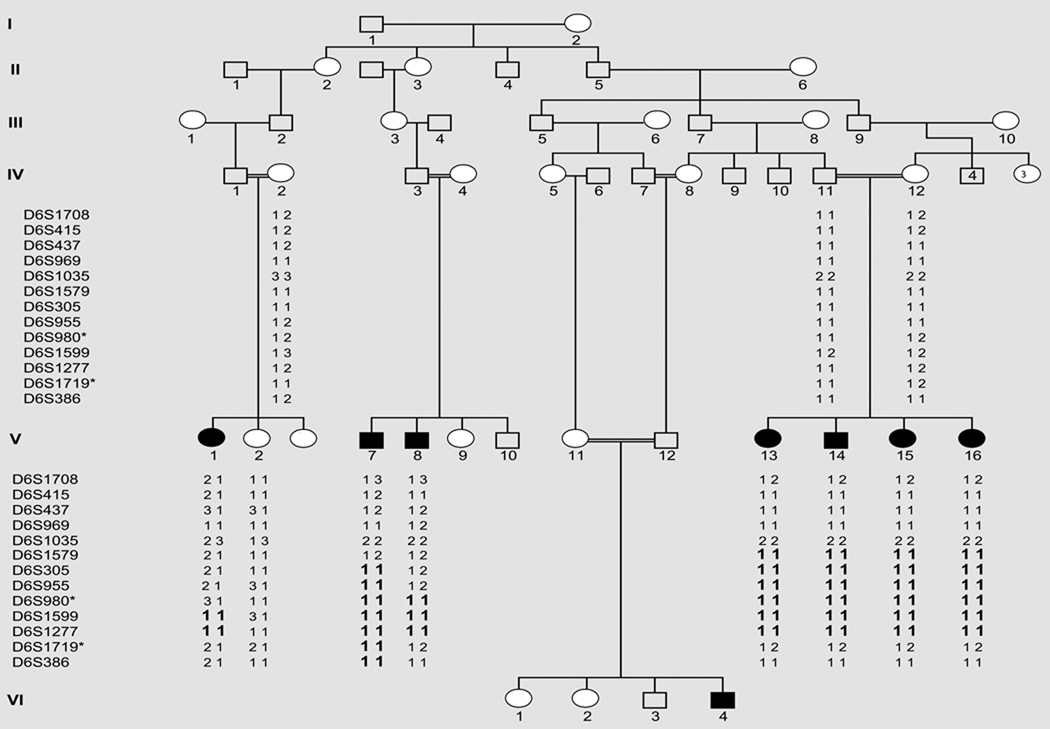
For autosomal recessive nonsyndromic hearing impairment over 30 loci have been mapped and 19 genes have been identified. DFNB38, a novel locus for autosomal recessive nonsyndromic hearing impairment, was localized in a consanguineous Pakistani kindred to 6q26-q27. The affected family members present with profound prelingual sensorineural hearing impairment and use sign language for communications. Linkage was established to microsatellite markers located on chromosome 6q26-q27 (Multipoint lod score 3.6). The genetic region for DFNB38 spans 10.1 cM according to the Marshfield genetic map and is bounded by markers D6S980 and D6S1719. This genetic region corresponds to 3.4 MB on the sequence-based physical map.
Copyright 2003 S. Karger AG, Basel
Figures
References
-
- Morton N. Genetic epidemiology of hearing impairment. Ann N Y Acad Sci. 1991;630:16–31. - PubMed
-
- Gorlin R, Toriello HV, Cohen MM. Hereditary hearing loss and its syndromes. Oxford: Oxford University press; 1995.
-
- Van Camp G, Smith RJH. Hereditary Hearing Loss Homepage. 2003. Apr, URL: http://dnalab-www.uia.ac.be/dnalab/hhh/
-
- Heller S, Hudspeth AJ. Two deaf mice, two deaf mice: murine candidate genes pinpoint the genetic bases of nonsyndromic hearing loss in humans. Nat Med. 1998;4:560–561. - PubMed
Publication types
MeSH terms
Substances
Associated data
- Actions
- Actions
- Actions
- Actions
Grants and funding
LinkOut - more resources
Full Text Sources
Medical
Molecular Biology Databases
Miscellaneous
