Enzyme potentiated desensitisation in treatment of seasonal allergic rhinitis: double blind randomised controlled study
- PMID: 12896934
- PMCID: PMC167158
- DOI: 10.1136/bmj.327.7409.251
Enzyme potentiated desensitisation in treatment of seasonal allergic rhinitis: double blind randomised controlled study
Abstract
Objective: To assess the efficacy of enzyme potentiated desensitisation in the treatment of severe summer hay fever poorly controlled by pharmacotherapy.
Design: Double blind randomised placebo controlled parallel group study.
Setting: Hospital in Hampshire.
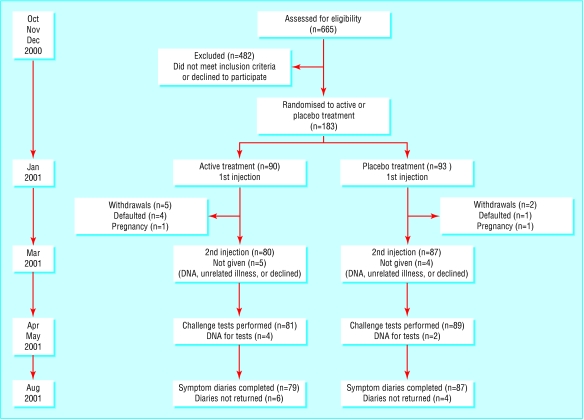
Participants: 183 participants aged between 18 and 64 with a history of severe summer hay fever for at least two years; all were skin prick test positive to timothy grass pollen. 90 randomised to active treatment; 93 randomised to placebo.
Interventions: Active treatment: two injections of enzyme potentiated desensitisation, given between eight and 11 weeks apart, each comprising 200 Fishman units of beta glucuronidase, 50 pg 1,3-cyclohexanediol, 50 ng protamine sulphate, and a mixed inhaled allergen extract (pollen mixes for trees, grasses, and weeds; allergenic fungal spores; cat and dog danders; dust and storage mites) in a total volume of 0.05 ml of buffered saline. Placebo: two injections of 0.05 ml buffered saline solution.
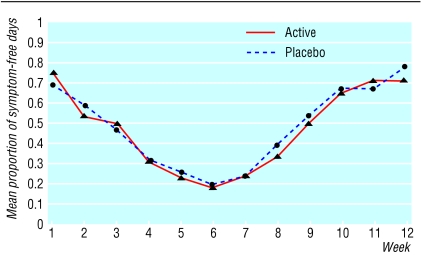
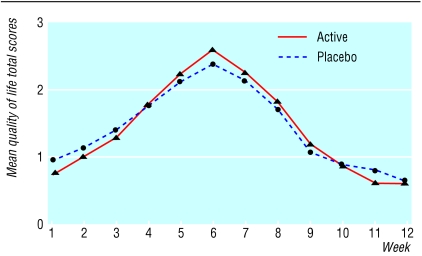
Main outcome measures: Proportion of problem-free days; global rhinoconjunctivitis quality of life scores assessed weekly during pollen season.
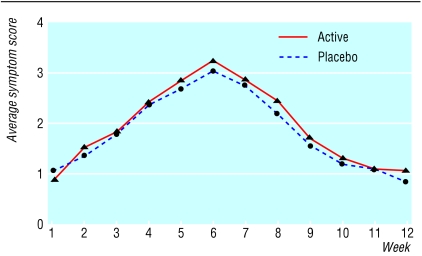
Results: The active treatment group and the placebo group did not differ in the proportion of problem-free days, quality of life scores, symptom severity scores, change in quantitative skin prick provocation threshold, or change in conjunctival provocation threshold. No clinically significant adverse reactions occurred.
Conclusions: Enzyme potentiated desensitisation showed no treatment effect in this study.
Figures
Comment in
-
Treatment of seasonal allergic rhinitis: desensitisation for hay fever works.BMJ. 2003 Nov 22;327(7425):1229. doi: 10.1136/bmj.327.7425.1229. BMJ. 2003. PMID: 14630778 Free PMC article. No abstract available.
-
Treatment of seasonal allergic rhinitis: useless versus helpful allergy therapy.BMJ. 2003 Nov 22;327(7425):1229. doi: 10.1136/bmj.327.7425.1229-a. BMJ. 2003. PMID: 14630781 Free PMC article. No abstract available.
References
-
- Bousquet J, Lockey RF, Malling H-J. Allergen immunotherapy: therapeutic vaccines for allergic diseases. Allergy 1998;53(suppl 44): 1-42. - PubMed
-
- Durham SR, Walker SM, Varga EM, Jacobsen MR, O'Brien F, Noble W, et al. Long-term clinical efficacy of grass-pollen immunotherapy. N Engl J Med 1999;341: 468-75. - PubMed
-
- Fell P, Brostoff J. Single dose desensitisation for summer hay fever. Eur J Clin Pharmacol 1990;38: 77-9. - PubMed
-
- McEwen LM. Enzyme-potentiated hyposensitization: effects of glucose, glucosamine, N-acetylamino-sugars and gelatin on the ability of β-glucuronidase to block the anamnestic response to antigen in mice. Ann Allergy 1973;31: 79-83. - PubMed
Publication types
MeSH terms
Substances
LinkOut - more resources
Full Text Sources
Medical
Miscellaneous