


Comment
doi: 10.1172/JCI19375.
Renal fibrosis: not just PAI-1 in the sky
Affiliations
- PMID: 12897200
- PMCID: PMC166301
- DOI: 10.1172/JCI19375
Item in Clipboard
Comment
Renal fibrosis: not just PAI-1 in the sky
J Clin Invest.
2003 Aug.
Abstract
A delicate balance exists between ECM synthesis and degradation such that interruption of the corresponding pathways results in increased plasminogen activator inhibitor-1 (PAI-1), pathological matrix accumulation, and glomerulosclerosis. A new study demonstrates that therapy with a mutant PAI-1 increases matrix turnover and reduces glomerulosclerosis by competing with endogenous PAI-1, suggesting therapeutic utility in the treatment of fibrotic renal disease.
Figures
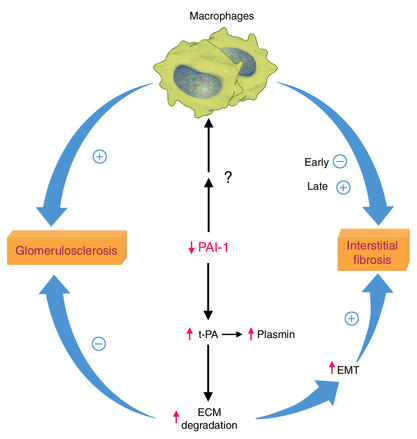
PAI-1 modulates scarring in a complex manner, including effects on cell migration, matrix turnover, and macrophage infiltration. Whereas increased t-PA promotes dissolution of matrix and subsequently lessens glomerulosclerosis, this matrix breakdown facilitates cell migration and epithelial-mesenchymal transition (EMT) and thus contributes to increased interstitial fibrosis. The effects of PAI-1 that facilitate enhanced macrophage infiltration in vivo are complex and have not yet been established. Macrophages have beneficial effects early in interstitial fibrosis and promote fibrosis later. The increased number of glomerular macrophages is linked to glomerulosclerosis. u-PA and its receptor and vitronectin also interact with PAI-1 and contribute to its final effects on fibrosis.
Comment on
-
A mutant, noninhibitory plasminogen activator inhibitor type 1 decreases matrix accumulation in experimental glomerulonephritis.J Clin Invest. 2003 Aug;112(3):379-88. doi: 10.1172/JCI18038. J Clin Invest. 2003. PMID: 12897205 Free PMC article.
References
-
- Ma L-J, Fogo AB. Angiotensin as inducer of plasminogen activator inhibitor-1 and fibrosis. Contrib. Nephrol. 2001;135:161–170. - PubMed
-
- Eddy AA. Plasminogen activator inhibitor-1 and the kidney. Am. J. Physiol. Renal Physiol. 2002;283:F209–F220. - PubMed
-
- Haraguchi M, Border WA, Huang Y, Noble NA. t-PA promotes glomerular plasmin generation and matrix degradation in experimental glomerulonephritis. Kidney Int. 2001;59:2146–2155. - PubMed
Publication types
MeSH terms
Substances
LinkOut - more resources
Full Text Sources
Other Literature Sources
Miscellaneous
