


Comment
doi: 10.1172/JCI19392.
IL-13 and adenosine: partners in a molecular dance?
Affiliations
- PMID: 12897201
- PMCID: PMC166304
- DOI: 10.1172/JCI19392
Item in Clipboard
Comment
IL-13 and adenosine: partners in a molecular dance?
J Clin Invest.
2003 Aug.
Abstract
Inflammation and airway remodeling are two responses readily apparent in asthma and other inflammatory disorders of the airway and lungs. Both adenosine and IL-13 play critical roles in contributing pathways. A new study reveals a previously unrecognized interaction between adenosine and IL-13 that indicates a mutual stimulation that may contribute to the nature and severity of airway inflammation and fibrosis.
Figures
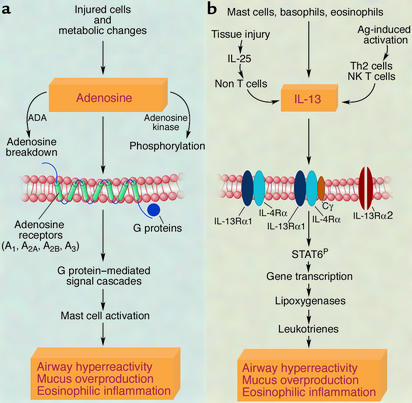
Adenosine and IL-13: sources, signaling, and effects in the lungs. (a) The adenosine-initiated cascade of molecular events is illustrated (2, 3, 10, 11). Overall adenosine levels reflect the balance between adenosine release by injured or metabolically stressed cells and adenosine metabolism by ADA or adenosine kinase. Adenosine receptors are G protein–linked. This linkage provides a multitude of opportunities for the fine-tuning of the adenosine receptors. Mast cells are thought to be the major mediators of the adenosine-induced asthma phenotype. (b) The IL-13–initiated cascade of molecular events is illustrated (–, –15). IL-13 is expressed upon recognition of antigen (such as allergen), or in response to inflammatory stimuli (e.g., IL-25). IL-13 signaling results in the phosphorylation of the signal transducer and activator of transcription-6 (STAT6P) molecule and alters the expression of a multitude of genes in the lungs including the upregulation of the expression of lipoxygenase genes. Leukotrienes, the products of lipoxygenases, are thought to be important mediators of the IL-13–induced asthma phenotype. The precise molecular interactions between adenosine and IL-13 are not yet known. As shown by Blackburn et al. in this issue of the JCI (1), positive feedback loops may involve IL-13–mediated regulation of ADA and adenosine receptors, and adenosine-mediated IL-13 release (1). A negative feedback loop may also exist. For example, toxic effects of high levels of adenosine on T cells (12) may dampen IL-13–mediated inflammation.
Comment on
-
Adenosine mediates IL-13-induced inflammation and remodeling in the lung and interacts in an IL-13-adenosine amplification pathway.J Clin Invest. 2003 Aug;112(3):332-44. doi: 10.1172/JCI16815. J Clin Invest. 2003. PMID: 12897202 Free PMC article.
References
-
- Van Den Berge M, et al. PC(20) adenosine 5′-monophosphate is more closely associated with airway inflammation in asthma than PC(20) methacholine. Am. J. Respir. Crit. Care Med. 2001;163:1546–1550. - PubMed
-
- Wills-Karp M, et al. Interleukin-13: central mediator of allergic asthma. Science. 1998;282:2258–2261. - PubMed
Publication types
MeSH terms
Substances
LinkOut - more resources
Full Text Sources
Other Literature Sources
Miscellaneous
