


The phosphatidylinositol (PI)-5-phosphate 4-kinase type II enzyme controls insulin signaling by regulating PI-3,4,5-trisphosphate degradation
- PMID: 12897244
- PMCID: PMC187868
- DOI: 10.1073/pnas.1734038100
The phosphatidylinositol (PI)-5-phosphate 4-kinase type II enzyme controls insulin signaling by regulating PI-3,4,5-trisphosphate degradation
Abstract
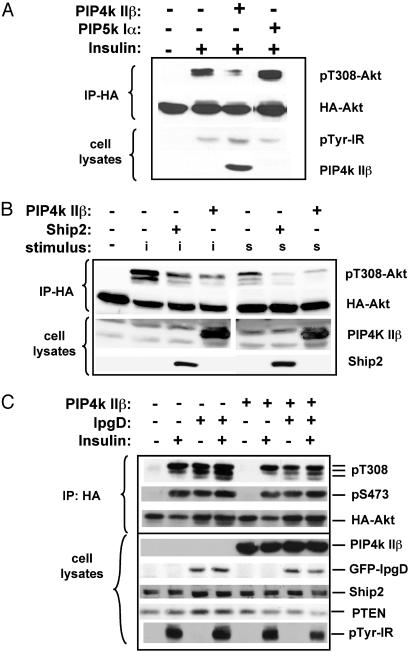
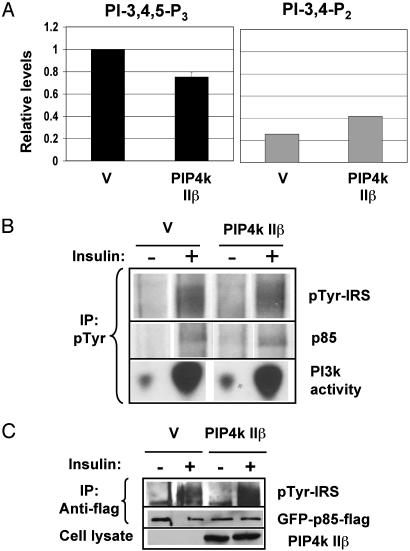
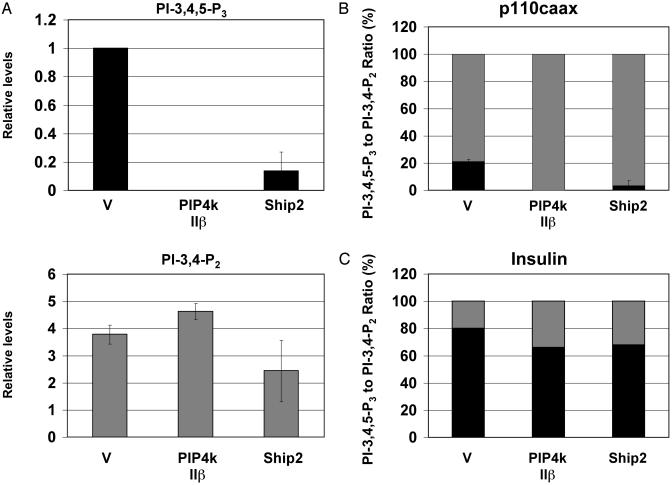
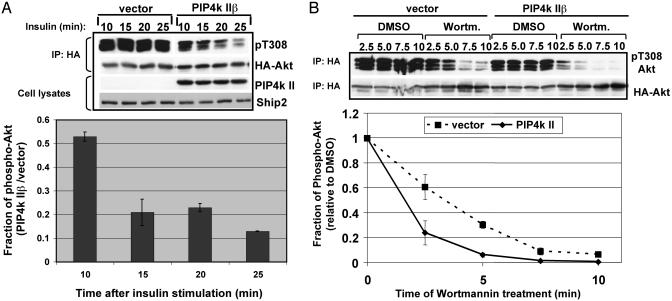
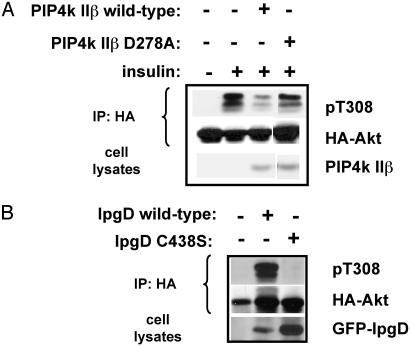
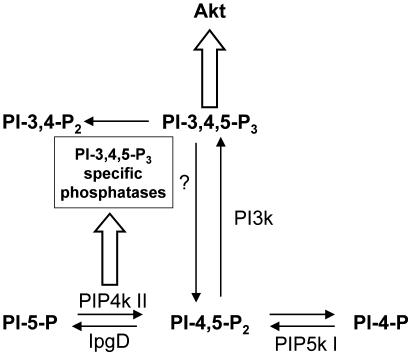
Phosphatidylinositol-5-phosphate (PI-5-P) is a newly identified phosphoinositide with characteristics of a signaling lipid but no known cellular function. PI-5-P levels are controlled by the type II PI-5-P 4-kinases (PIP4K IIs), a family of kinases that converts PI-5-P into phosphatidylinositol-4,5-bisphosphate (PI-4,5-P2). The PI-5-P pathway is an alternative route for PI-4,5-P2 synthesis as the bulk of this lipid is generated by the canonical pathway in which phosphatidylinositol-4-phosphate (PI-4-P) is the intermediate. Here we examined the effect of activation of the PI-5-P pathway on phosphoinositide 3-kinase (PI3K) signaling by expressing PIP4K II beta in cells that lack this enzyme. Although PIP4K II generates PI-4,5-P2, a substrate for PI3K, expression of this enzyme reduced rather than increased phosphatidylinositol-3,4,5-trisphosphate (PI-3,4,5-P3) levels in cells stimulated with insulin or cells expressing activated PI3K. This reduction in PI-3,4,5-P3 levels resulted in decreased activation of the downstream protein kinase, Akt/PKB. Consistent with these results, expression of IpgD, a bacterial phosphatase that converts PI-4,5-P2 to PI-5-P, resulted in Akt activation, and this effect was partially reversed by PIP4K II beta. PIP4K II beta expression did not impair insulin-dependent association of PI3K with insulin receptor substrate 1 (IRS1) but abbreviated Akt activation, indicating that PIP4K II regulates PI-3,4,5-P3 degradation rather than synthesis. These data support a model in which the PI-5-P pathway controls insulin signaling that leads to Akt activation by regulating a PI-3,4,5-P3 phosphatase.
Figures
References
-
- Tengholm, A. & Meyer, T. (2002) Curr. Biol. 12, 1871–1876. - PubMed
-
- Toker, A. (1998) Curr. Opin. Cell Biol. 10, 254–261. - PubMed
-
- Fruman, D. A., Meyers, R. E. & Cantley, L. C. (1998) Annu. Rev. Biochem. 67, 481–507. - PubMed
-
- Ishihara, H., Shibasaki, Y., Kizuki, N., Wada, T., Yazaki, Y., Asano, T. & Oka, Y. (1998) J. Biol. Chem. 273, 8741–8748. - PubMed
Publication types
MeSH terms
Substances
Grants and funding
LinkOut - more resources
Full Text Sources
Other Literature Sources
Medical
Molecular Biology Databases
Research Materials
Miscellaneous
