. 2003 Jul;9(7):800-9.
doi: 10.3201/eid0907.030038.

Emergence and global spread of a dengue serotype 3, subtype III virus

Affiliations

Emergence and global spread of a dengue serotype 3, subtype III virus

William B Messer et al. Emerg Infect Dis. 2003 Jul.

Abstract

Over the past two decades, dengue virus serotype 3 (DENV-3) has caused unexpected epidemics of dengue hemorrhagic fever (DHF) in Sri Lanka, East Africa, and Latin America. We used a phylogenetic approach to evaluate the roles of virus evolution and transport in the emergence of these outbreaks. Isolates from these geographically distant epidemics are closely related and belong to DENV-3, subtype III, which originated in the Indian subcontinent. The emergence of DHF in Sri Lanka in 1989 correlated with the appearance there of a new DENV-3, subtype III variant. This variant likely spread from the Indian subcontinent into Africa in the 1980s and from Africa into Latin America in the mid-1990s. DENV-3, subtype III isolates from mild and severe disease outbreaks formed genetically distinct groups, which suggests a role for viral genetics in DHF.


Figures
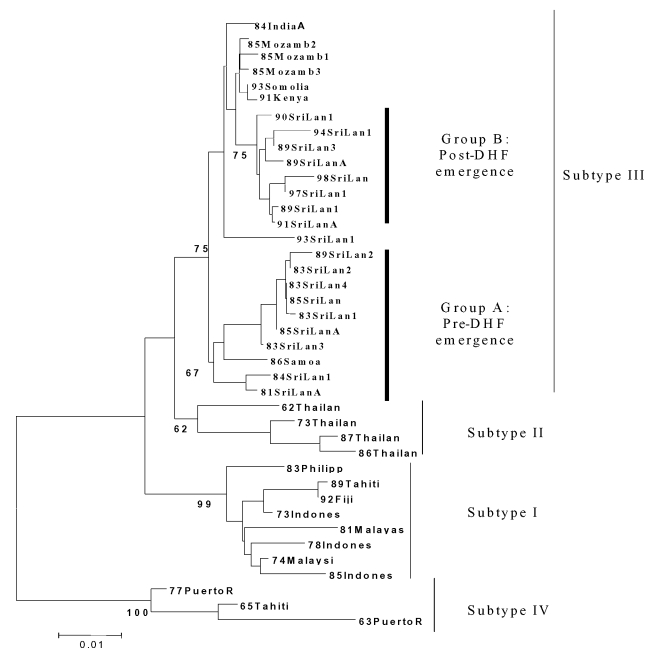
Figure 1
Figure 1
Phylogenetic tree of established dengue virus 3 subtypes (23) and the relationship of Sri Lanka pre– and post–dengue hemorrhagic fever dengue virus 3 (DENV-3) isolates to the established subtypes. This tree is based on a 708-base segment, positions 437 to 1145, spanning pre-M/M and a portion of the E gene. Scale bar shows number of substitutions per bases weighted by Tamura-Nei algorithm. Horizontal distances are equivalent to the distances between isolates. Numbers at nodes indicate bootstrap support values for the branch of the tree inferred at that node. The origin of the viruses and sequences used are listed in Table 1. The amino acid substitutions conserved within each DENV-3 subtype are listed in Table 2. DHF, dengue hemorrhagic fever.
Figure 2
Figure 2
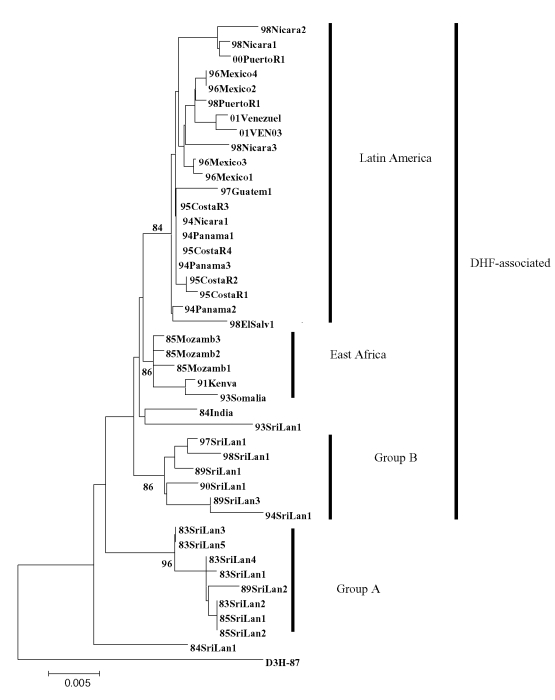
Phylogenetic tree of dengue virus 3, subtype III group A, group B, East Africa, and Latin America. Tree is based on 966-base region spanning positions 179–1,145 on the viral genome, capturing a portion of the C gene, all of pre-M/M gene and a portion of the E gene. Nucleotide substitutions conserved within each dengue virus 3, subtype III group (group A, B, East Africa, and Latin America) are listed in Table 3. DHF, dengue hemorrhagic fever.
Figure 3
Figure 3
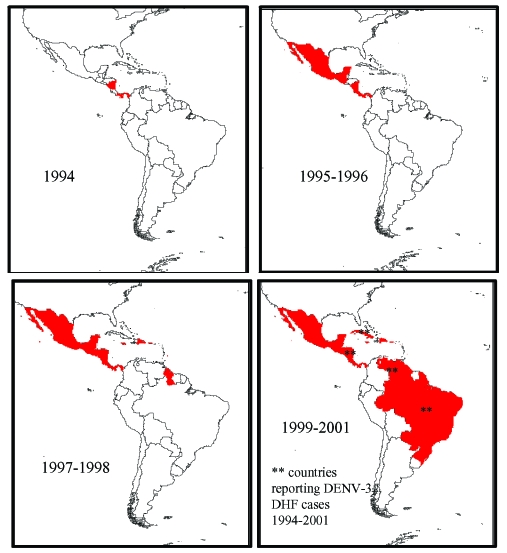
Map of the spread of dengue virus 3 (DENV-3), subtype III through Latin America and the Caribbean. The introduction of DENV-3, subtype III was first reported in November 1994 in Nicaragua and Panama. This virus strain has been isolated, identified, and reported in at least 16 other countries in the region. *Represents countries with dengue hemorrhagic fever (DHF) caused by DENV-3. These countries are Nicaragua in 1994 and 1998, Brazil and Venezuela in 2001 (Pan American Health Organization, unpub. data).
Figure 4
Figure 4
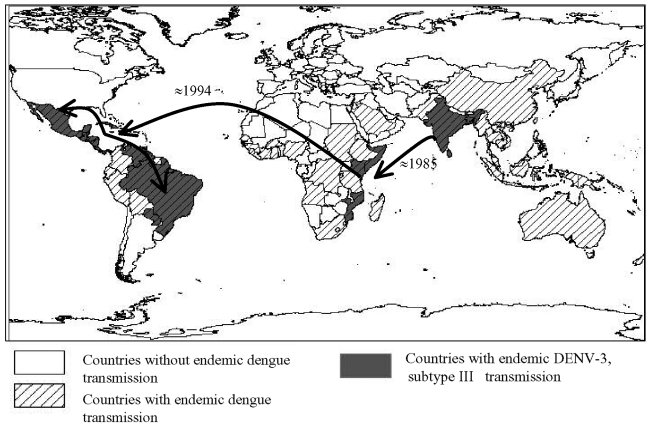
Global spread of dengue virus 3 (DENV-3), subtype III, which has been continuously circulating in the Indian subcontinent from the 1960s to the present. The virus was first isolated from East Africa in 1985 in Mozambique and subsequently from Kenya (1991) and Somalia (1993) (32,33). DENV-3 subtype III was first detected in the American continent in 1994 (Nicaragua and Panama) and the virus has subsequently spread through most of Latin America (13,14,16,29,30). The arrows depict the most likely directions of spread based on the phylogenetic relationships between the viruses (see text for details). The map also displays countries in which dengue is known to occur.

References

    1. Briese T, Jia XY, Huang C, Grady LJ, Lipkin WI. Identification of a Kunjin/West Nile–like flavivirus in brains of patients with New York encephalitis. Lancet. 1999;354:1261–2. 10.1016/S0140-6736(99)04576-6 - DOI - PubMed
    1. Lanciotti RS, Roehrig JT, Deubel V, Smith J, Parker M, Steele K, et al. Origin of the West Nile virus responsible for an outbreak of encephalitis in the northeastern United States. Science. 1999;286:2333–7. 10.1126/science.286.5448.2333 - DOI - PubMed
    1. Morse SS. Emerging viruses. New York: Oxford University Press; 1993.
    1. Halstead SB. Epidemiology of dengue and dengue hemorrhagic fever. In: Kuno DJGaG, editor. Dengue and dengue hemorrhagic fever. New York: CAB International; 1997. p. 23–44.
    1. Gubler DJ. Dengue and dengue hemorrhagic fever. Clin Microbiol Rev. 1998;11:480–96. - PMC - PubMed

Publication types

MeSH terms

LinkOut - more resources