


Effects of cultivation conditions on folate production by lactic acid bacteria
- PMID: 12902240
- PMCID: PMC169137
- DOI: 10.1128/AEM.69.8.4542-4548.2003
Effects of cultivation conditions on folate production by lactic acid bacteria
Abstract
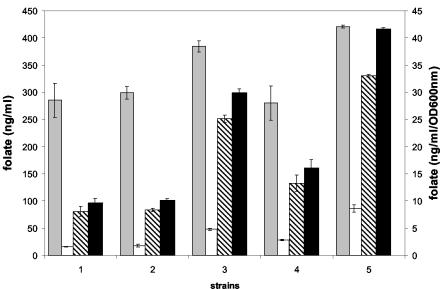
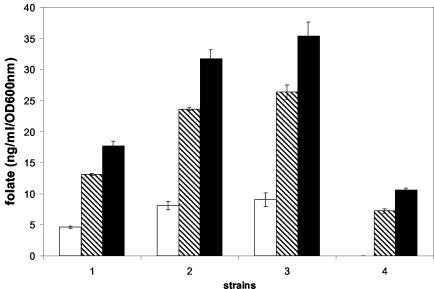
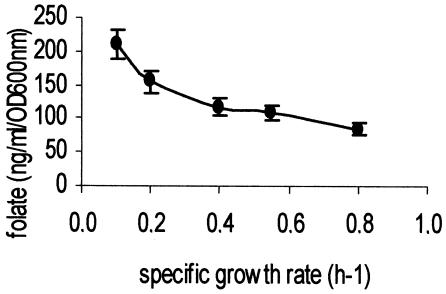
A variety of lactic acid bacteria were screened for their ability to produce folate intracellularly and/or extracellularly. Lactococcus lactis, Streptococcus thermophilus, and Leuconostoc spp. all produced folate, while most Lactobacillus spp., with the exception of Lactobacillus plantarum, were not able to produce folate. Folate production was further investigated in L. lactis as a model organism for metabolic engineering and in S. thermophilus for direct translation to (dairy) applications. For both these two lactic acid bacteria, an inverse relationship was observed between growth rate and folate production. When cultures were grown at inhibitory concentrations of antibiotics or salt or when the bacteria were subjected to low growth rates in chemostat cultures, folate levels in the cultures were increased relative to cell mass and (lactic) acid production. S. thermophilus excreted more folate than L. lactis, presumably as a result of differences in the number of glutamyl residues of the folate produced. In S. thermophilus 5,10-methenyl and 5-formyl tetrahydrofolate were detected as the major folate derivatives, both containing three glutamyl residues, while in L. lactis 5,10-methenyl and 10-formyl tetrahydrofolate were found, both with either four, five, or six glutamyl residues. Excretion of folate was stimulated at lower pH in S. thermophilus, but pH had no effect on folate excretion by L. lactis. Finally, several environmental parameters that influence folate production in these lactic acid bacteria were observed; high external pH increased folate production and the addition of p-aminobenzoic acid stimulated folate production, while high tyrosine concentrations led to decreased folate biosynthesis.
Figures

References
-
- Alm, L. 1980. Effect of fermentation on B-vitamin content of milk in Sweden. J. Dairy Sci. 65:353-359.
-
- Ames, B. N. 1999. Micronutrient deficiencies cause DNA damage and cancer. Food Sci. Agric. Chem. 1:1-15.
-
- Ayad, E. H. E., A. Verheul, C. de Jong, J. T. M. Wouters, and G. Smit. 1999. Flavour forming abilities and amino acid requirements of Lactococcus lactis strains isolated from artisanal and non-dairy origin. Int. Dairy J. 10:169-179.
-
- Ballantine, S. P., F. Volpe, and C. J. Delves. 1994. The hydroxymethyldihydropterin pyrophosphokinase domain of the multifunctional folic acid synthesis Fas protein of Pneumocystis carinii expressed as an independent enzyme in Escherichia coli: refolding and characterization of the recombinant enzyme. Protein Expr. Purif. 5:371-378. - PubMed
Publication types
MeSH terms
Substances
LinkOut - more resources
Full Text Sources
Other Literature Sources
Medical
Molecular Biology Databases
Miscellaneous
