


Detection and quantification of Plectosphaerella cucumerina, a potential biological control agent of potato cyst nematodes, by using conventional PCR, real-time PCR, selective media, and baiting
- PMID: 12902272
- PMCID: PMC169141
- DOI: 10.1128/AEM.69.8.4788-4793.2003
Detection and quantification of Plectosphaerella cucumerina, a potential biological control agent of potato cyst nematodes, by using conventional PCR, real-time PCR, selective media, and baiting
Abstract
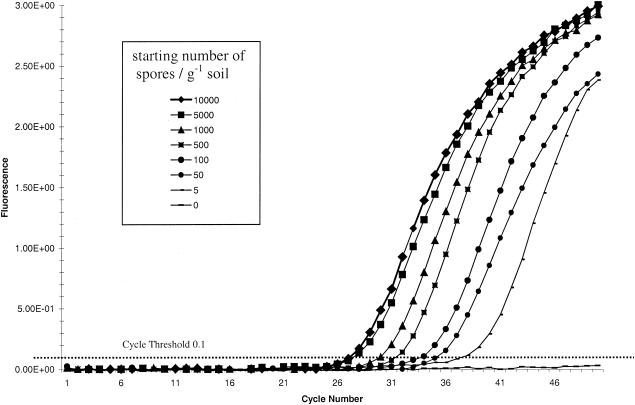
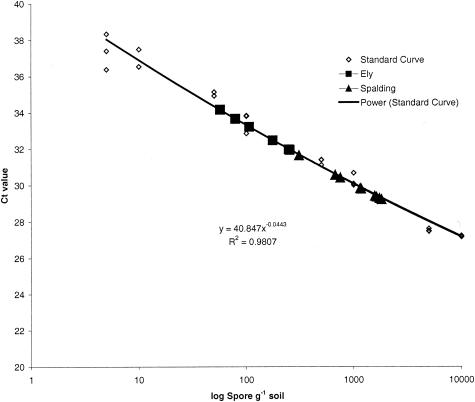
Potato cyst nematodes (PCN) are serious pests in commercial potato production, causing yield losses valued at approximately $300 million in the European Community. The nematophagous fungus Plectosphaerella cucumerina has demonstrated its potential as a biological control agent against PCN populations by reducing field populations by up to 60% in trials. The use of biological control agents in the field requires the development of specific techniques to monitor the release, population size, spread or decline, and pathogenicity against its host. A range of methods have therefore been developed to monitor P. cucumerina. A species-specific PCR primer set (PcCF1-PcCR1) was designed that was able to detect the presence of P. cucumerina in soil, root, and nematode samples. PCR was combined with a bait method to identify P. cucumerina from infected nematode eggs, confirming the parasitic ability of the fungus. A selective medium was adapted to isolate the fungus from root and soil samples and was used to quantify the fungus from field sites. A second P. cucumerina-specific primer set (PcRTF1-PcRTR1) and a Taqman probe (PcRTP1) were designed for real-time PCR quantification of the fungus and provided a very sensitive means of detecting the fungus from soil. PCR, bait, and culture methods were combined to investigate the presence and abundance of P. cucumerina from two field sites in the United Kingdom where PCN populations were naturally declining. All methods enabled differences in the activity of P. cucumerina to be detected, and the results demonstrated the importance of using a combination of methods to investigate population size and activity of fungi.
Figures
References
-
- Arora, D. K., Hirsch, P. R., Kerry, B. R. 1996. PCR-based molecular discrimination of Verticillium chlamydosporium isolates. Mycol. Res. 7:801-809.
-
- Atkins, S. D., D. Sosnowska, V. J. Evans, I. M. Clark, P. R. Hirsch, and B. R. Kerry. 2002. Investigation of three nematophagous fungi in two potato cyst nematode suppressive soils. IOBC/WPRS Bull., in press.
-
- Atkins, S. D., I. M. Clark, D. Sosnowska, and B. R. Kerry. 2002. Initial testing of potential fungal biological control agents of potato cyst nematodes, p. 79-84. British Crop Protection Council, Brighton, United Kingdom.
-
- Avis, T. J., R. C. Hamelin, and R. R. Belanger. 2001. Approaches to molecular characterization of fungal biocontrol agents: some case studies. Can. J. Plant Pathol. 23:8-12.
-
- Bates, J. A., E. J. A. Taylor, D. M. Kenyon, and J. E. Thomas. 2001. The application of real-time PCR to the identification, detection and quantification of Pyrenophora species in barley seed. Mol. Plant Pathol. 2:49-57. - PubMed
Publication types
MeSH terms
Substances
Grants and funding
LinkOut - more resources
Full Text Sources
Other Literature Sources
