Comparative Study
doi: 10.1101/gr.1113003.
Comparative DNA sequence analysis of wheat and rice genomes
Affiliations
- PMID: 12902377
- PMCID: PMC403773
- DOI: 10.1101/gr.1113003
Item in Clipboard
Comparative Study
Comparative DNA sequence analysis of wheat and rice genomes
Genome Res.
2003 Aug.
Abstract
The use of DNA sequence-based comparative genomics for evolutionary studies and for transferring information from model species to crop species has revolutionized molecular genetics and crop improvement strategies. This study compared 4485 expressed sequence tags (ESTs) that were physically mapped in wheat chromosome bins, to the public rice genome sequence data from 2251 ordered BAC/PAC clones using BLAST. A rice genome view of homologous wheat genome locations based on comparative sequence analysis revealed numerous chromosomal rearrangements that will significantly complicate the use of rice as a model for cross-species transfer of information in nonconserved regions.
Figures
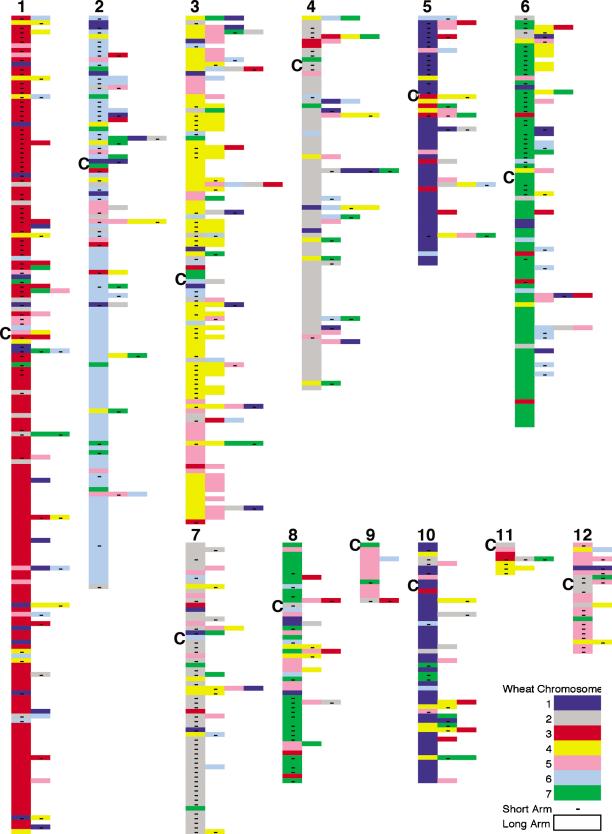
Rice–wheat genome relationships. Rice genome view showing the wheat
chromosome arm location for the most similar wheat gene sequences. Each
colored box represents a rice–wheat gene sequence match at ≥ 80%
identity. When the wheat EST mapped to more than one wheat chromosome, the
other color-coded locations are positioned adjacent to the first. Homologous
wheat chromosome locations are grouped together. Rice BAC/PAC sequences that
did not match any wheat sequence as well as redundant matches are omitted. The
rice centromere location is indicated by `C'.
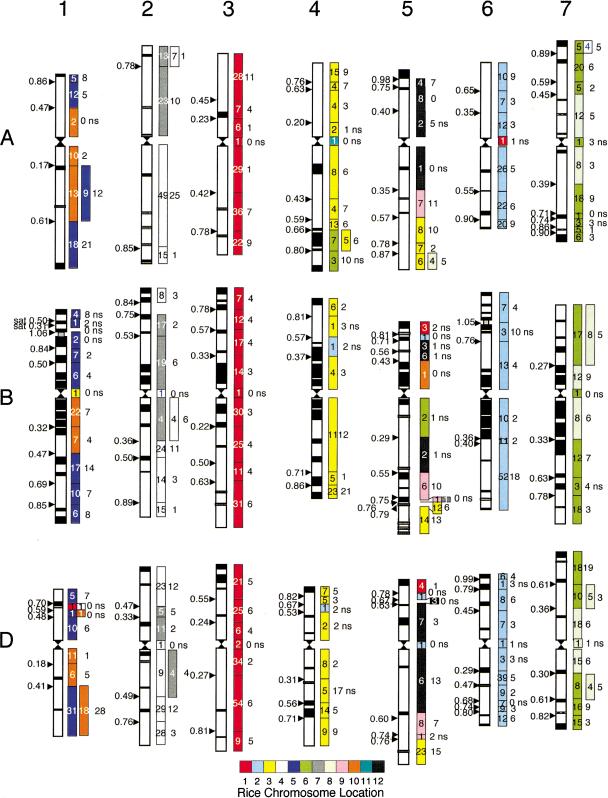
Wheat–rice genome relationships. (Left) The wheat C-banding
karyotype indicating the positions of deletion breakpoints. (Right)
Each deletion bin is color-coded according to the rice chromosome matching a
significant number (χ2 P < 0.01) of wheat ESTs
mapped to that bin. The number of those matches is indicated inside the
colored rectangle, and the number of matches to all other rice chromosomes is
adjacent. Nonsignificant association with a rice chromosome or insufficient
data is indicated by “ns” adjacent to the bin.
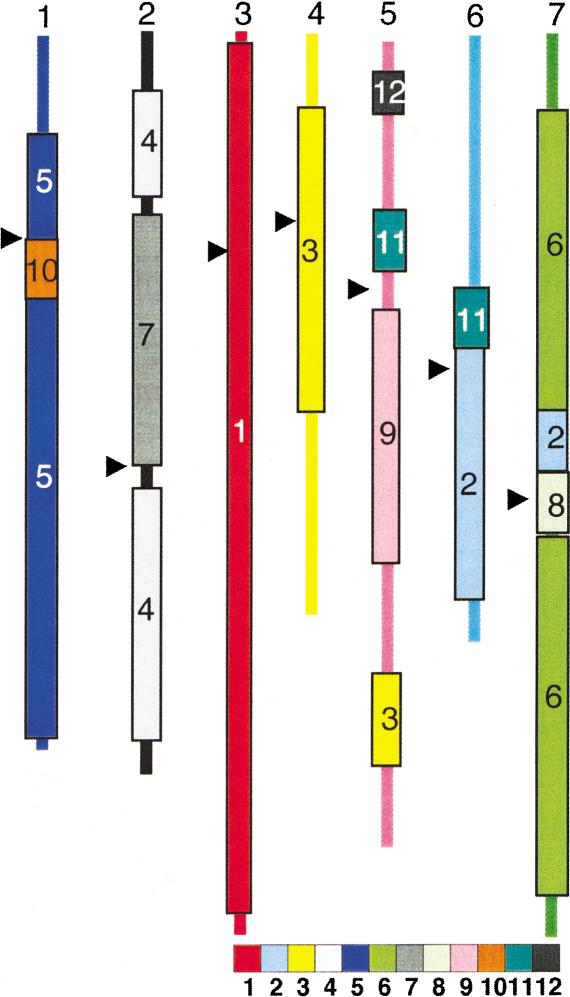
Diagrammatic representation of earlier RFLP-based comparative maps
(Kurata et al. 1994;
Van Deynze et al. 1995c;
Sarma et al. 2000) for the
rice and wheat genomes. The seven homologous wheat chromosome groups are
color-coded by wheat chromosome for comparison with
Fig. 1. The overlaid boxes
represent the predicted homologous rice chromosome region delineated by anchor
loci and are color-coded by rice chromosome for comparison with
Fig. 2.
References
-
- Ahn, S., Anderson, J.A., Sorrells, M.E., and Tanksley, S.D. 1993. Homoeologous relationships of rice, wheat and maize chromosomes. Mol. Gen. Genet. 241: 483-490. - PubMed
-
- Akhunov, E.D., Goodyear, J.A., Geng, S., Qi, L., Echalier, B., Gill, B.S., Lazo, G., Chao, S., Anderson, O.D., Linkiewicz, A.M., et al. 2003. The organization and rate of evolution of the wheat genomes are correlated with recombination rates along chromosome arms. Genome Res. 5: 753-763. - PMC - PubMed
-
- Anderson, J.A., Ogihara, Y., Sorrells, M.E., and Tanksley, S.D. 1992. Development of a chromosomal arm map for wheat based on RFLP markers. Theor. Appl. Genet. 83: 1035-1043. - PubMed
-
- Argumuganathan, K. and Earle, E.D. 1991. Nuclear DNA content of some important plant species. Plant Mol. Biol. Rep. 9: 208.
WEB SITE REFERENCES
-
- http://wheat.pw.usda.gov/pubs/2003/Sorrells/; Supplementary materials for this publication.
-
- http://wheat.pw.usda.gov/NSF/progress_mapping.html; U.S. National Science Foundation Wheat Genome Mapping Progress.
-
- http://wheat.pw.usda.gov/; GrainGenes home page.
-
- http://wheat.pw.usda.gov/NSF/curator/assembly.html; NSF Wheat Genome Project—Description of unigene assembly protocol.
-
- http://www.gramene.org/; Gramene home page.
Publication types
MeSH terms
Substances
LinkOut - more resources
Full Text Sources
Other Literature Sources
Research Materials