


Prescribing patterns of antibiotics and sensitivity patterns of common microorganisms in the Internal Medicine ward of a teaching hospital in Western Nepal: a prospective study
- PMID: 12904265
- PMCID: PMC179888
- DOI: 10.1186/1476-0711-2-7
Prescribing patterns of antibiotics and sensitivity patterns of common microorganisms in the Internal Medicine ward of a teaching hospital in Western Nepal: a prospective study
Abstract
Background: Information about antibiotic use and resistance patterns of common microorganisms are lacking in hospitals in Western Nepal. Excessive and inappropriate use of antibiotics contributes to the development of bacterial resistance. The parameter: Defined daily dose/100 bed-days, provides an estimate of consumption of drugs among hospital in-patients. This study was carried out to collect relevant demographic information, antibiotic prescribing patterns and the common organisms isolated including their antibiotic sensitivity patterns.
Methods: The study was carried out over a 3-month period (01.04.2002 to 30.06.2002) at the Manipal Teaching Hospital, Western Nepal. The median number of days of hospitalization and mean +/- SD cost of antibiotics prescribed during hospital stay were calculated. The use of antibiotics was classified for prophylaxis, bacteriologically proven infection or non-bacteriologically proven infection. Sensitivity patterns of the common organisms were determined. Defined daily dose/100 bed-days of the ten most commonly prescribed antibiotics were calculated.
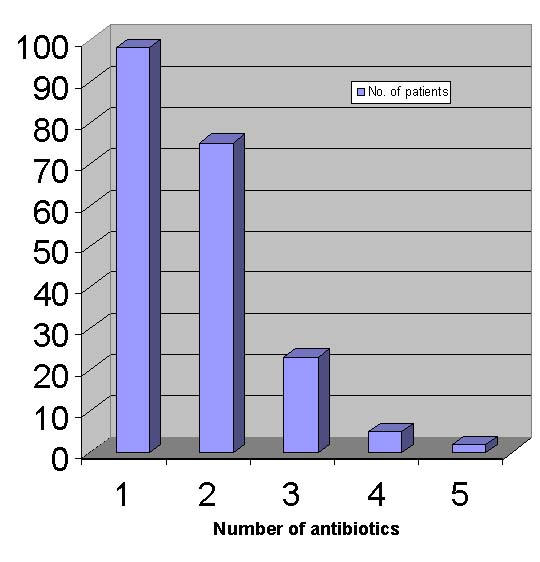
Results: 203 patients were prescribed antibiotics; 112 were male. Median duration of hospitalization was 5 days. 347 antibiotics were prescribed. The most common were ampicillin, amoxicillin, metronidazole, ciprofloxacin and benzylpenicillin. Mean +/- SD cost of antibiotics was 16.5 +/-13.4 US dollars. Culture and sensitivity testing was carried out in 141 patients. The common organisms isolated were H. influenzae, E. coli, K. pneumoniae and S. aureus.
Conclusions: Antibiotic resistance is becoming a problem in the Internal Medicine ward. Formulation of a policy for hospital antibiotic use and an educational programme especially for junior doctors is required.
Figures
References
-
- Srishyla MV, Naga Rani MA, Venkataraman BV. Drug utilization of antimicrobials in the in-patient setting of a tertiary hospital. Indian J Pharmacol. 1994;26:282–287.
-
- Kuruvilla A, George K, Rajaratnam A, John KR. Prescription patterns and cost analysis of drugs in a base hospital in South India. Natl Med J India. 1994;7:167–168. - PubMed
-
- Uppal R, Khanna S, Sharma SK, Sharma PL. Antimicrobial drug use in urology. Int J Clin Pharmacol Ther Toxicol. 1991;9:366–368. - PubMed
-
- Sharma D, Reeta Kh, Badyal DK, Garg SK, Bhargava VK. Antimicrobial prescribing pattern in an Indian tertiary hospital. Indian J Physiol Pharmacol. 1998;42:533–537. - PubMed
LinkOut - more resources
Full Text Sources
