


Evaluation of the MagNA pure LC instrument for extraction of hepatitis C virus RNA for the COBAS AMPLICOR Hepatitis C Virus Test, version 2.0
- PMID: 12904346
- PMCID: PMC179864
- DOI: 10.1128/JCM.41.8.3503-3508.2003
Evaluation of the MagNA pure LC instrument for extraction of hepatitis C virus RNA for the COBAS AMPLICOR Hepatitis C Virus Test, version 2.0
Abstract
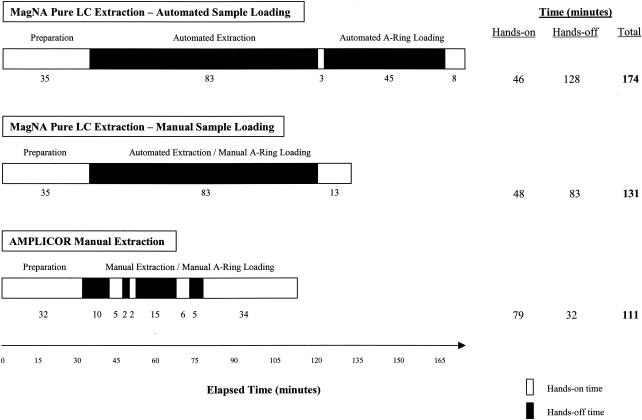
The COBAS AMPLICOR system has played a major role in the transition of molecular diagnostics from research to routine clinical laboratory use by automating the nucleic acid amplification and detection processes. However, sample preparation remains a labor-intensive portion of the procedure. In this study, we evaluated the performance of the COBAS AMPLICOR Hepatitis C Virus Test, version 2.0 (Roche Molecular Systems, Branchburg, N.J.) following manual hepatitis C virus (HCV) RNA extraction versus automated extraction with the MagNA Pure LC instrument (Roche Applied Science, Indianapolis, Ind.). Parallel replicate testing was performed with standard dilutions of 100, 75, 60, and 0 HCV IU/ml and 153 clinical specimens. An analytical sensitivity of 75 IU/ml was achieved with either the manual or the standard-volume (200 microl) automated extraction methodologies (25 of 26 [96.2%]; 95% confidence interval [95% CI], 80.4 to 99.9), whereas the clinical sensitivity and specificity were both 100% with either extraction method. A large-volume (1 ml) automated extraction method was also evaluated with standard dilutions of 40, 25, 10, and 0 IU/ml and the same 153 clinical specimens. The analytical sensitivity of the COBAS AMPLICOR assay with the large-volume extraction method was 25 HCV IU/ml (26 of 26 [100%]; 95% CI, 86.8 to 100), whereas the clinical sensitivity and specificity were both 100%. The MagNA Pure LC instrument is a versatile, labor-saving platform capable of integration with minimal modification of the existing assay procedure. The increased sensitivity of the COBAS AMPLICOR Hepatitis C Virus Test, version 2.0 performed in conjunction with large-volume HCV RNA extraction may be important in HCV diagnostic testing as new therapeutic strategies evolve.
Figures
References
-
- Comanor, L., F. Anderson, M. Ghany, R. Perrillo, E. J. Heathcote, C. Sherlock, I. Zitron, D. Hendricks, and S. C. Gordon. 2001. Transcription-mediated amplification is more sensitive than conventional PCR-based assays for detecting residual serum HCV RNA at end of treatment. Am. J. Gastroenterol. 96:2968-2972. - PubMed
-
- DiDomenico, N., H. Link, R. Knobel, T. Caratsch, W. Weschler, Z. G. Loewy, and M. Rosenstraus. 1996. COBAS AMPLICOR: fully automated RNA and DNA amplification and detection system for routine diagnostic PCR. Clin. Chem. 42:1915-1923. - PubMed
-
- Espy, M. J., P. N. Rys, A. D. Wold, J. R. Uhl, L. M. Sloan, G. D. Jenkins, D. M. Ilstrup, F. R. Cockerill III, R. Patel, J. E. Rosenblatt, and T. F. Smith. 2001. Detection of herpes simplex virus DNA in genital and dermal specimens by LightCycler PCR after extraction using the IsoQuick, MagNA Pure, and BioRobot 9604 methods. J. Clin. Microbiol. 39:2233-2236. - PMC - PubMed
-
- Fiebelkorn, K. R., B. G. Lee, C. E. Hill, A. M. Caliendo, and F. S. Nolte. 2002. Clinical evaluation of an automated nucleic acid isolation system. Clin. Chem. 48:1613-1615. - PubMed
-
- Jungkind, D. 2001. Automation of laboratory testing for infectious diseases using the polymerase chain reaction: our past, our present, our future. J. Clin. Virol. 20:1-6. - PubMed
Publication types
MeSH terms
Substances
LinkOut - more resources
Full Text Sources
Medical
