. 2003 Aug;41(8):3737-43.
doi: 10.1128/JCM.41.8.3737-3743.2003.

Virulence genes and neutral DNA markers of Helicobacter pylori isolates from different ethnic communities of West Bengal, India

Affiliations

Virulence genes and neutral DNA markers of Helicobacter pylori isolates from different ethnic communities of West Bengal, India

Simanti Datta et al. J Clin Microbiol. 2003 Aug.

Abstract

Virulence-associated genes and neutral DNA markers of Helicobacter pylori strains from the Santhal and Oroan ethnic minorities of West Bengal, India, were studied. These people have traditionally been quite separate from other Indians and differ culturally, genetically, and linguistically from mainstream Bengalis, whose H. pylori strains have been characterized previously. H. pylori was found in each of 49 study participants, although none had peptic ulcer disease, and was cultured from 31 of them. All strains carried the cag pathogenicity island and potentially toxigenic s1 alleles of vacuolating cytotoxin gene (vacA) and were resistant to at least 8 micro g of metronidazole per ml. DNA sequence motifs in vacA mid-region m1 alleles, cagA, and an informative insertion or deletion motif next to cagA from these strains were similar to those of strains from ethnic Bengalis. Three mobile elements, IS605, IS607, and ISHp608, were present in 29, 19, and 10%, respectively, of Santhal and Oroan strains, which is similar to their prevalence in Bengali H. pylori. Thus, there is no evidence that the gene pools of H. pylori of these ethnic minorities differ from those of Bengalis from the same region. This relatedness of strains from persons of different ethnicities bears on our understanding of H. pylori transmission between communities and genome evolution.


Figures
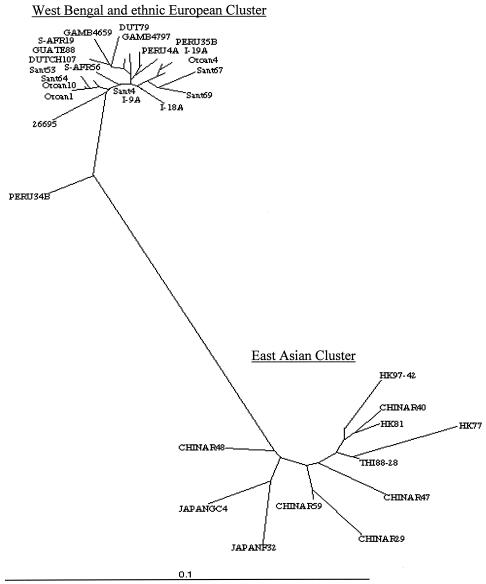
FIG. 1.
FIG. 1.
Phylogenetic tree based on an informative 220-bp segment at the 5′ end of cagA of H. pylori strains. The tree was generated using PHYLIP (Phylogeny Inference Package), version 3.5c, of J. Felsenstein. The strains used are as follows (GenBank accession numbers are in parentheses): 26695 (AE000569); I-18 (Calcutta, India) (AF202224); I-9 (Calcutta, India) (AF202221); I-19 (Calcutta, India) (AF202225), Peru4A (AF198477), Peru34B (AF198475), Peru35B (AF198476), DUT79 (Dutch) (AJ252970), GAMB4659 (Gambia) (AF198468), GAMB4797 (Gambia) (AF198469), GUATE88 (Guatemala) (AF198472), S-AFR19 (South Africa) (AF198470), DUTCH107 (AJ252963), HK77 (Hong Kong) (AF198485), THI88 to 28 (Thailand) (AJ239722), HK97 to 42 (Hong Kong) (AJ239733), HK81 (Hong Kong) (AF198486), CHINAR47 (AJ252985), CHINAR40 (AJ252982), CHINAR59 (AJ252986), CHINAR29 (AJ252980), JAPANF32 (AJ239726), JAPANGC4 (AF198484), CHINAR48 (AJ252983), Sant 4 (Santhal) (AY162446), Sant 53 (Santhal) (AY162447), Sant 64 (Santhal) (AY162448), Sant 67 (Santhal) (AY162449), Sant 69 (Santhal) (AY162450), Oroan 1 (AY162451), Oroan 4 (AY162453), Oroan 10 (AY162452), and S-AFR56 (South Africa) (AF198471).
FIG. 2.
FIG. 2.
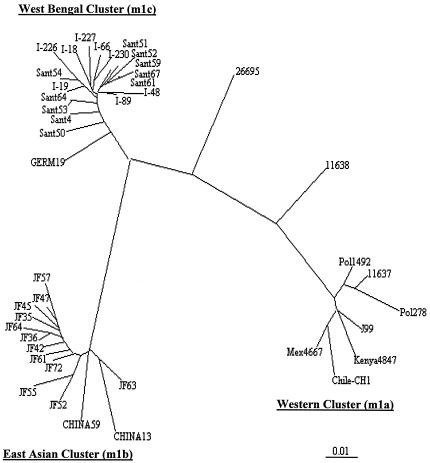
Phylogenetic tree based on an informative 650-bp segment of vacA gene containing vacAm1 alleles of H. pylori strains. The tree was generated using PHYLIP (Phylogeny Inference Package), version 3.5c, of J. Felsenstein. The strains used are as follows (GenBank accession numbers are in parentheses): I-19 (Calcutta, India) (AF220111), I-226 (Calcutta, India) (AF220115), I-89 (Calcutta, India) (AF220114), I-48 (Calcutta, India) (AF220112), I-18 (Calcutta, India) (AF220110), I-230 (Calcutta, India) (AF220117), GERM19 (Germany) (AJ006967), I-66 (Calcutta, India) (AF220113), I-227 (Calcutta, India) (AF220116), JF52 (Japan) (AF049631), JF55 (Japan) (AF049632), CHINAR59 (AF035611), JF63 (Japan) (AF049635), CHINAR13 (AF035610), JF42 (Japan) (AF049626), JF72 (Japan) (AF049651), JF45 (Japan) (AF049628), JF47 (Japan) (AF049629), JF57 (Japan) (AF049634), JF35 (Japan) (AF049625), JF61 (Japan) (AF049645), JF36 (Japan) (AF049462), JF64 (Japan) (AF049647), JF45 (Japan) (AF0496628), Pol1492 (Poland) (AF097570), Pol278 (Poland) (AF097571), NCTC11637 (AF049653), J99 (AE001511), NCTC11638 (U07145), 26695 (AE000598), Kenya AFN4847 (AF191644), Chile-CH1 (AF479031),and Mex 4467 9 (Mexico) (AF159855).

References

    1. Achtman, M., T. Azuma, D. E. Berg, Y. Ito, G. Morelli, Z. J. Pan, S. Suerbaum, S. A. Thompson, A. van der Ende, and L. J. van Doorn. 1999. Recombination and clonal groupings within Helicobacter pylori from different geographical regions. Mol. Microbiol. 32:459-470. - PubMed
    1. Akopyanz, N., N. O. Bukanov, T. U. Westblom, S. Kresovich, and D. E. Berg. 1992. DNA diversity among clinical isolates of Helicobacter pylori detected by PCR-based RAPD fingerprinting. Nucleic Acids Res. 20:5137-5142. - PMC - PubMed
    1. Akopyants, N. S., S. W. Clifton, D. Kersulyte, J. E. Crabtree, B. E. Youree, C. A. Reece, N. O. Bukanov, E. S. Drazek, B. A. Roe, and D. E. Berg. 1998. Analyses of the cag pathogenicity island of Helicobacter pylori. Mol. Microbiol. 28:37-54. - PubMed
    1. Anonymous. 1986. Rapid identification of pyloric Campylobacter in Peruvians with gastritis. Dig. Dis. Sci. 31:1089-1094. - PubMed
    1. Blaser, M. J. 1998. Helicobacters are indigenous to the human stomach: duodenal ulceration is due to changes in gastric microecology in the modern era. Gut 43:721-727. - PMC - PubMed

Publication types