


Enzootic transmission of Anaplasma bovis in Nantucket cottontail rabbits
- PMID: 12904385
- PMCID: PMC179860
- DOI: 10.1128/JCM.41.8.3744-3747.2003
Enzootic transmission of Anaplasma bovis in Nantucket cottontail rabbits
Abstract
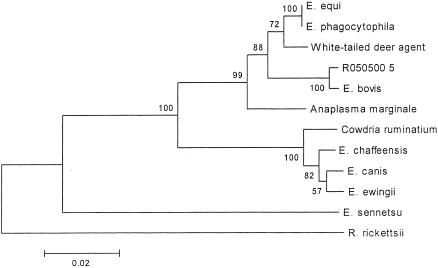
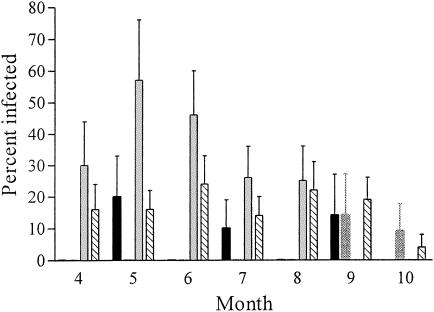
Serological studies of cottontail rabbits sampled from Nantucket Island, Mass., have suggested exposure to at least two ehrlichiae. The agent of human granulocytic ehrlichiosis (Anaplasma phagocytophilum) is intensely enzootic in rabbits there, but the identity of the other ehrlichial infection remains undescribed. We sampled rabbits over five transmission seasons and tested their blood and tissues for evidence of infection using PCR targeting an Ehrlichia genus-wide 16S rDNA target. Sequence analysis of positive amplicons revealed the presence of Anaplasma bovis, an agent not known to be present in North America. The average annual prevalence of A. bovis within rabbits, as determined by PCR of blood samples, was 18%. Haemaphysalis leporispalustris appears to serve as vector. The public health (human or veterinary) significance of this finding remains speculative.
Figures
References
-
- Ayes, J. C., and R. Feemster. 1948. Epidemiology of tularemia in Massachusetts with a review of the literature. N. Engl. J. Med. 238:187-194. - PubMed
-
- Belding, D. L., and B. Merrill. 1941. Tularemia in imported rabbits in Massachusetts. N. Engl. J. Med. 224:1085-1087.
-
- Dawson, J. E., D. E. Stallknecht, E. W. Howerth, C. Warner, K. Biggie, W. R. Davidson, J. M. Lockhart, V. F. Nettles, J. G. Olson, and J. E. Childs. 1994. Susceptibility of white-tailed deer (Odocoileus virginianus) to infection with Ehrlichia chaffeensis, the etiologic agent of human ehrlichiosis. J. Clin. Microbiol. 32:2725-2728. - PMC - PubMed
MeSH terms
LinkOut - more resources
Full Text Sources
Molecular Biology Databases
