


Dendrimeric coating of glass slides for sensitive DNA microarrays analysis
- PMID: 12907740
- PMCID: PMC169980
- DOI: 10.1093/nar/gng088
Dendrimeric coating of glass slides for sensitive DNA microarrays analysis
Abstract
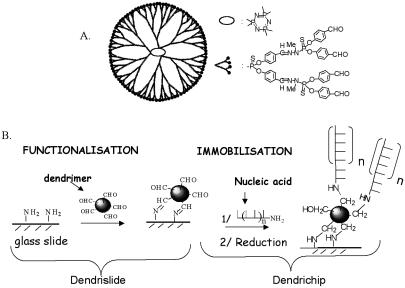
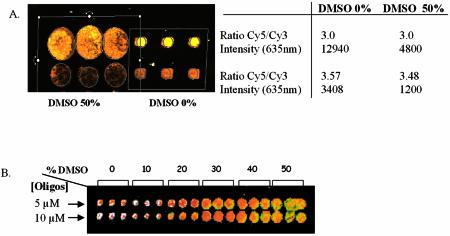
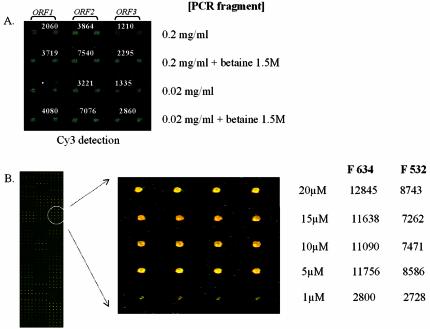
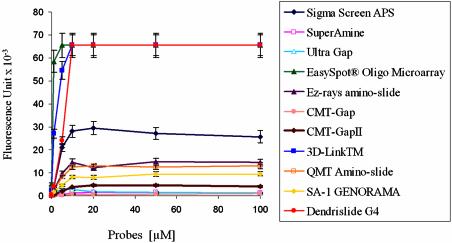
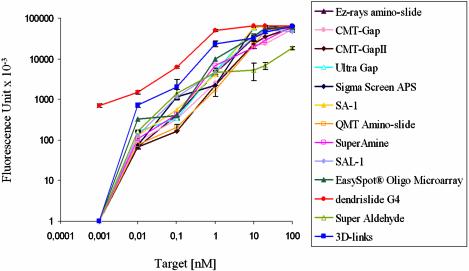
Successful use and reliability of microarray technology is highly dependent on several factors, including surface chemistry parameters and accessibility of cDNA targets to the DNA probes fixed onto the surface. Here, we show that functionalisation of glass slides with homemade dendrimers allow production of more sensitive and reliable DNA microarrays. The dendrimers are nanometric structures of size-controlled diameter with aldehyde function at their periphery. Covalent attachment of these spherical reactive chemical structures on amino-silanised glass slides generates a reactive approximately 100 A layer onto which amino-modified DNA probes are covalently bound. This new grafting chemistry leads to the formation of uniform and homogenous spots. More over, probe concentration before spotting could be reduced from 0.2 to 0.02 mg/ml with PCR products and from 20 to 5 micro M with 70mer oligonucleotides without affecting signal intensities after hybridisation with Cy3- and Cy5-labelled targets. More interestingly, while the binding capacity of captured probes on dendrimer-activated glass surface (named dendrislides) is roughly similar to other functionalised glass slides from commercial sources, detection sensitivity was 2-fold higher than with other available DNA microarrays. This detection limit was estimated to 0.1 pM of cDNA targets. Altogether, these features make dendrimer-activated slides ideal for manufacturing cost-effective DNA arrays applicable for gene expression and detection of mutations.
Figures
References
-
- Lipshutz R.J., Fodor,S.P.A., Gingeras,T.R. and Lockhart,D.J. (1999) High density synthetic oligonucleotide arrays. Nature Genet., 14, 1675–1680. - PubMed
-
- Hughes T.R., Mao,L.M., Jones,A.R., Burchard,J., Marton,M.J., Shannon,K.W. et al. (2001) Expression profiling using microarrays fabricated by an ink-jet oligonucleotide synthesizer. Nat. Biotechnol., 19, 342–347. - PubMed
-
- Cheung V.G., Morley,M., Auilar,F., Massimi,A., Kucherlapati,R. and Childs,G. (1999) Making and reading microarrays. Nature Genet., 21, (suppl.), 15–19. - PubMed
-
- MacBeath G., Koehler,A.N. and Schreiber,S.L.(1999) Printing small molecules as microarrays and detecting protein-ligand interactions en masse. J. Am. Chem. Soc., 121, 7967–7968.
-
- Mac Beath G. and Schreiber,S.L. (2000) Printing proteins as microarrays for high-throughput function determination. Science, 289, 1760–1762. - PubMed
Publication types
MeSH terms
Substances
LinkOut - more resources
Full Text Sources
Other Literature Sources
