


Description, nomenclature, and mapping of a novel cerebello-renal syndrome with the molar tooth malformation
- PMID: 12908130
- PMCID: PMC1180692
- DOI: 10.1086/378241
Description, nomenclature, and mapping of a novel cerebello-renal syndrome with the molar tooth malformation
Abstract
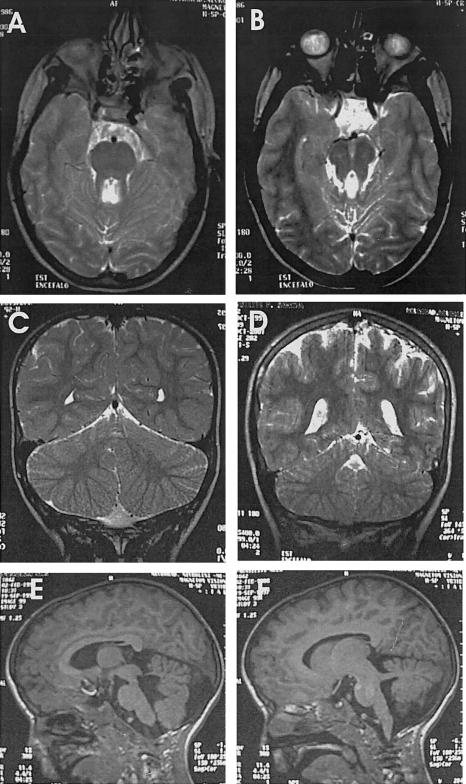
Cerebello-oculo-renal syndromes (CORSs) and Joubert syndrome (JS) are clinically and genetically heterogeneous autosomal recessive syndromes that share a complex neuroradiological malformation resembling a molar tooth on brain axial images, a condition referred to as "molar tooth on imaging" (MTI) or the "molar tooth sign." The current literature on these syndromes is complex, with overlapping and incomplete phenotypes that complicate the selection of clinically homogeneous cases for genetic purposes. So far, only one locus (JBTS1 on 9q34) has been mapped, in two families with JS. Here, we describe a large consanguineous family with JS and nephronophthisis, representing a novel cerebello-renal phenotype. We have mapped this condition to the pericentromeric region of chromosome 11 and have named the locus "CORS2." The acronym "CORS" is proposed for all loci associated with JS, CORSs, and related phenotypes sharing the MTI, because this neuroradiological sign seems to be the unifying feature of these clinically heterogeneous syndromes.
Figures

References
Electronic-Database Information
-
- Center for Medical Genetics, Marshfield Medical Research Foundation, http://research.marshfieldclinic.org/genetics/ (for chromosome 11 genetic map)
-
- Online Mendelian Inheritance in Man (OMIM), http://www.ncbi.nlm.nih.gov/Omim/ (for COGAN syndrome, JS, and Senior-Löken syndrome)
-
- UCSC Genome Bioinformatics, http://genome.cse.ucsc.edu/ (for chromosome 11 physical map; November 2002)
References
-
- Betz R, Rensing C, Otto E, Mincheva A, Zehnder D, Lichter P, Hildebrandt F (2000) Children with ocular motor apraxia type COGAN carry deletions in the gene (NPHP1) for juvenile nephronophthisis. J Pediatr 136:828–831 - PubMed
-
- Blair IP, Gibson RR, Bennett CL, Chance PF (2002) Search for genes involved in Joubert syndrome: evidence that one or more major loci are yet to be identified and exclusion of candidate genes EN1, EN2, FGF8 and BARHL1. Am J Med Genet 107:190–196 - PubMed
-
- Caridi G, Murer L, Bellantuono R, Sorino P, Caringella DA, Gusmano R, Ghiggeri GM (1998) Renal-retinal syndromes: association of retinal anomalies and recessive nephronophthisis in patients with homozygous deletions of the NPH1 locus. Am J Kidney Dis 32:1059–1062 - PubMed
-
- Chance PF, Cavalier L, Satran D, Pellegrino JE, Koenig M, Dobyns WB (1999) Clinical nosologic and genetic aspects of Joubert and related syndromes. J Child Neurol 14:660–666 - PubMed
Publication types
MeSH terms
LinkOut - more resources
Full Text Sources
Medical
Molecular Biology Databases
