. 2003;2(3):20.
doi: 10.1186/1475-4924-2-20. Epub 2003 Aug 7.

The Drosophila forkhead transcription factor FOXO mediates the reduction in cell number associated with reduced insulin signaling

Affiliations

The Drosophila forkhead transcription factor FOXO mediates the reduction in cell number associated with reduced insulin signaling

Martin A Jünger et al. J Biol. 2003.

Abstract

Background: Forkhead transcription factors belonging to the FOXO subfamily are negatively regulated by protein kinase B (PKB) in response to signaling by insulin and insulin-like growth factor in Caenorhabditis elegans and mammals. In Drosophila, the insulin-signaling pathway regulates the size of cells, organs, and the entire body in response to nutrient availability, by controlling both cell size and cell number. In this study, we present a genetic characterization of dFOXO, the only Drosophila FOXO ortholog.

Results: Ectopic expression of dFOXO and human FOXO3a induced organ-size reduction and cell death in a manner dependent on phosphoinositide (PI) 3-kinase and nutrient levels. Surprisingly, flies homozygous for dFOXO null alleles are viable and of normal size. They are, however, more sensitive to oxidative stress. Furthermore, dFOXO function is required for growth inhibition associated with reduced insulin signaling. Loss of dFOXO suppresses the reduction in cell number but not the cell-size reduction elicited by mutations in the insulin-signaling pathway. By microarray analysis and subsequent genetic validation, we have identified d4E-BP, which encodes a translation inhibitor, as a relevant dFOXO target gene.

Conclusion: Our results show that dFOXO is a crucial mediator of insulin signaling in Drosophila, mediating the reduction in cell number in insulin-signaling mutants. We propose that in response to cellular stresses, such as nutrient deprivation or increased levels of reactive oxygen species, dFOXO is activated and inhibits growth through the action of target genes such as d4E-BP.


Figures
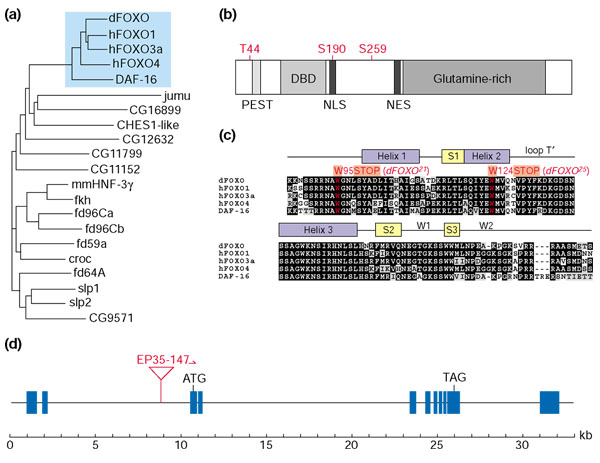
Figure 1
Figure 1
dFOXO is the only Drosophila FOXO/DAF-16 homolog. A TBLASTN search of the Drosophila genome for known and predicted genes encoding forkhead transcription factors retrieved 16 genes. (a) A phylogenetic tree calculated from a multiple sequence alignment of the forkhead domains of these 16 proteins and of the human FOXO proteins FOXO1 (FKHR), FOXO3a (FKHRL1) and FOXO4 (AFX), the C. elegans DAF-16 and mouse Foxa3 (HNF-3γ; protein names on the figure are from GenBank). The similarity of dFOXO to FOXO proteins is highlighted in blue. (b) dFOXO has three PKB phosphorylation sites in the same orientation as those of mammalian FOXO proteins. The sites are indicated above the protein; PEST (destruction), nuclear localization (NLS), nuclear export (NES) and DNA-binding sequences are also shown. (c) A multiple amino-acid sequence alignment of the dFOXO, human FOXO and DAF-16 forkhead domains illustrates the high degree of sequence conservation especially within the DNA-binding domain. The secondary structure is indicated above the alignment. Similar and identical amino-acid residues are shaded in gray and black, respectively. The region encoding helix 3 of the forkhead domain, which is the DNA-recognition helix contacting the major groove of the DNA double helix, is identical in the five proteins. Given the high structural similarity between the DNA-binding domains of FOXO4 (AFX) and HNF-3γ [85], it is likely that FOXO proteins contact insulin response elements through helix 3. Two EMS-induced point mutations described in this study are shown in red. (d) The dFOXO gene spans a genomic region of 31 kilobases (kb) and contains 11 exons (blue bars). The EP35-147 transposable element is inserted in the second intron upstream of the open reading frame, allowing GAL4-induced expression of endogenous dFOXO.
Figure 2
Figure 2
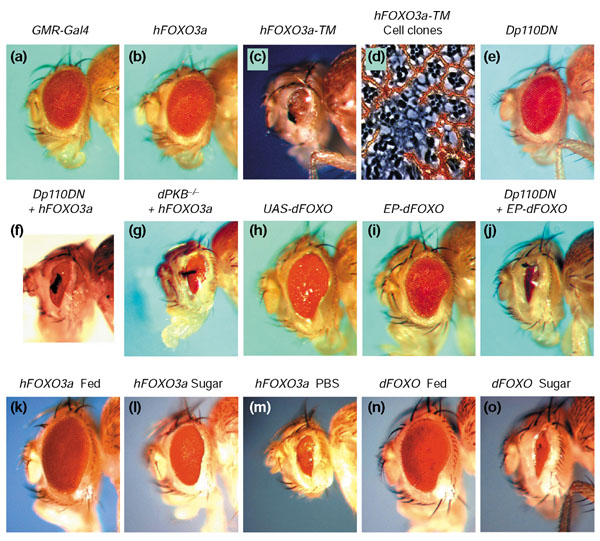
Targeted hFOXO3a and dFOXO expression in the developing Drosophila eye induces organ-size reduction and cell death, and the phenotypes are sensitive to insulin signaling and nutrient levels. (a) GMR-Gal4- expressing control fly. (b) No discernible phenotype results from hFOXO3a expression. (c) Expression of hFOXO3a-TM in the eye disc leads to pupal lethality; escapers at 18°C show a necrotic phenotype and severely disrupted cell specification. (d) Expression in w--marked clones of cells induces a similar phenotype at 25°C. (e) Dp110DN expression slightly reduces eye size, and (f) co-expression of wild-type hFOXO3a partially mimicks the hFOXO3a-TM escaper phenotype. (g) The same enhancement of hFOXO3a activity was observed in a dPKB-/- background. (h,i) Expression of transgenic or endogenous dFOXO results in a small-eye phenotype, which is also dramatically enhanced by (j) Dp110DN. (k-o) hFOXO3a and dFOXO phenotypes are progressively exacerbated by protein deprivation ('sugar') and complete starvation ('PBS'). Flies like the one shown in (m) die within one day, and complete starvation of dFOXO-expressing flies resulted in pupal lethality (not shown). Genotypes are: (a) y w; GMR-Gal4/+; (b) y w; GMR-Gal4/+; UAS-hFOXO3a/+; (c) y w; GMR-Gal4/+; UAS-hFOXO3a-TM/+; (d) y w hs-flp/y w; GMR >FRT-w+ STOP - FRT >Gal-4/+; UAS-hFOXO3a-TM/+; (e) y w; GMR-Gal4 UAS-Dp110DN/+; (f) y w; GMR-Gal4 UAS-Dp110DN/+; UAS-hFOXO3a/+; (g) y w; UAS-hFOXO3a/GMR-Gal4; dPKB3/dPKB1; (h) y w; UAS-dFOXO/GMR-Gal4; (i) y w; GMR-Gal4/+; EP-dFOXO/+; (j) y w; GMR-Gal4 UAS-Dp110DN/+; EP-dFOXO/+; (k-m) y w; GMR-Gal4/+; UAS-hFOXO3a/+; (n,o) y w; GMR-Gal4/+; EP-dFOXO/+.
Figure 3
Figure 3
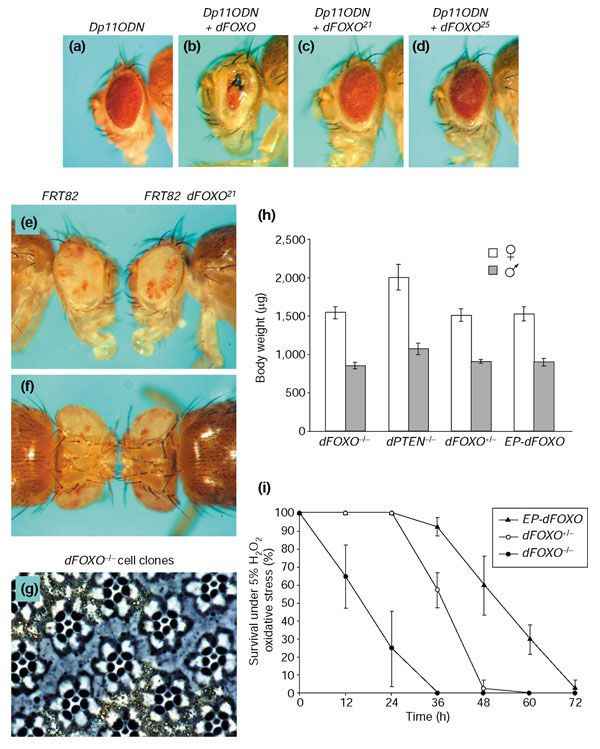
Null dFOXO mutants are viable, have no overgrowth phenotype and are hypersensitive to oxidative stress. (a) Dp110DN expressing control fly. (b) EP-driven coexpression of dFOXO elicits a necrotic eye phenotype. (c,d) EMS-induced mutations in dFOXO lead to a reversion of the overexpression phenotype. (e,f) Selective removal of dFOXO from the head (right) does not lead to an organ-size alteration compared to a control fly (left). (g) w--marked dFOXO-deficient photoreceptor cells are the same size as wild-type cells. (h) In contrast to dPTEN, dFOXO null mutants have no organismal growth phenotype. For each genotype, the left bar indicates the body weight of females and the right bar the weight of males. Values are shown ± standard deviation (SD). (i) dFOXO mutants are hypersensitive to oxidative stress. The graph shows a survival curve of male adult flies on PBS/sucrose gel containing 5% hydrogen peroxide. The observed hypersensitivity is more pronounced in males, but is also observed in females (not shown). The increased resistance of homozygous EP-dFOXO flies might be caused by low basal dFOXO overexpression from the EP element, which occurs due to leakiness of UAS enhancers in the absence of Gal4. Control flies placed on PBS/sucrose without oxidant survived during the time window shown. Genotypes are: (a) y w; GMR-Gal4 UAS-Dp110DN/+; (b) y w; GMR-Gal4 UAS-Dp110DN/+; EP-dFOXO/+; (c) y w; GMR-Gal4 UAS-Dp110DN/+; EP-dFOXO21/+; (d) y w; GMR-Gal4 UAS-Dp110DN/+; EP-dFOXO25/+; (e,f) y w ey-flp/y w; FRT82/FRT82 cl3R3 w+ (left); y w ey-flp/y w; FRT82 EP-dFOXO21/FRT82 cl3R3 w+ (right); (g) y w hs-flp/y w; FRT82 EP-dFOXO21/FRT82 w+.
Figure 4
Figure 4
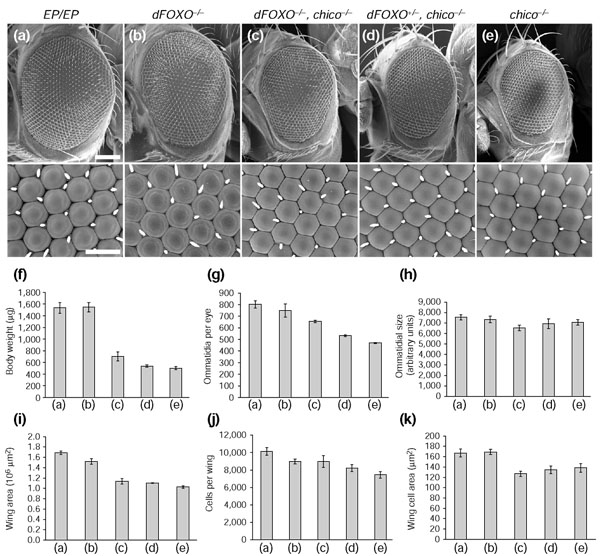
Loss of dFOXO suppresses the cell-number reduction in chico mutants. (a-e) Partial rescue of the chico phenotype by mutations in dFOXO. Bar sizes are 100 μm (low magnification) and 20 μm (high magnification). Each graph displays the variation of a single parameter between the five genotypes shown in (a-e): (f) body weight, (g) cell number in the eye, (h) cell size in the eye, (i) wing area, (j) cell number in the wing, and (k) cell size in the wing. (f) dFOXO-/-partially suppresses the low-body-weight phenotype of chico-/-. The suppression is less pronounced in the wing (i), because dFOXO-null mutants have significantly smaller wings than control flies, although their body weight is the same. In a chico-/- background, loss of dFOXO leads to increased cell numbers in the eye (g) and in the wing (j) compared to the chico single mutant. Although organ and tissue size is increased, cell size significantly decreases in the chico-dFOXO double mutant both in the eye (h) and in the wing (k). It seems that loss of dFOXO in a chico-/- background leads to increased proliferation rates. All values are shown ± SD. Genotypes are: (a) y w;; EP-dFOXO/EP-dFOXO; (b) y w;; EP-dFOXO21/EP-dFOXO25; (c) y w; chico1/chico2; EP-dFOXO21/+; (d) y w; chico1/chico2; EP-dFOXO21/ EP-dFOXO25; (e) y w; chico1/chico2.
Figure 5
Figure 5
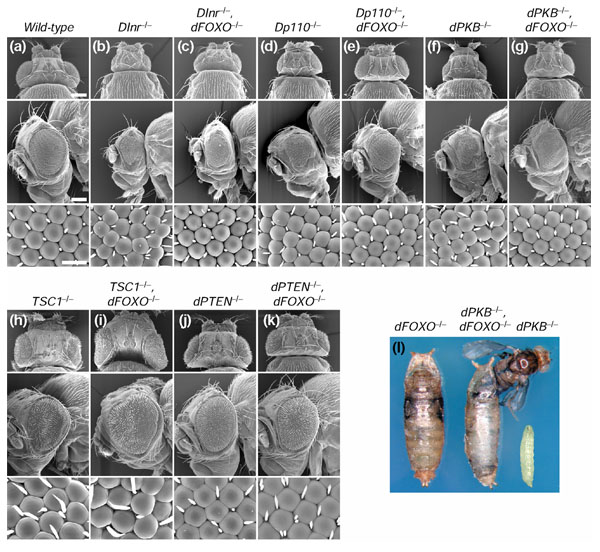
Growth-deficient phenotypes of DInr, Dp110 and dPKB mutants are suppressed by loss of dFOXO. (a) Control fly. (b) Selective removal of DInr from the head leads to a pinhead phenotype, which is partially suppressed by the loss of dFOXO (c). The same suppression is observed in Dp110-, and dPKB-pinheads (d-g). The TSC1-/- bighead phenotype (h) is enhanced by mutations in dFOXO (i), but the dPTEN-/- bighead (j) is slightly suppressed (k). (l) Living without PKB. In contrast to the larval lethality of dPKB null mutants, dPKB-dFOXO double mutants develop into small pharate adults, most of which fail to eclose. Bar sizes are 200 μm (low magnification) and 20 μm (high magnification). Genotypes are: (a) y w ey-flp/y w; FRT82/FRT82 cl3R3 w+; (b) y w ey-flp/y w; FRT82 DInr304/FRT82 cl3R3 w+; (c) y w ey-flp/y w; FRT82 DInr304 EP-dFOXO25/FRT82 cl3R3 w+; (d) y w ey-flp/y w; FRT82 Dp1105W3/FRT82 cl3R3 w+; (e) y w ey-flp/y w; FRT82 Dp1105W3 EP-dFOXO25/FRT82 cl3R3 w+; (f) y w ey-flp/y w; FRT82 dPKB1/FRT82 cl3R3 w+; (g) y w ey-flp/y w; FRT82 dPKB1EP-dFOXO25/FRT82 cl3R3 w+; (h) y w ey-flp/y w; FRT82 dTSC1Q87X/FRT82 cl3R3 w+; (i) y w ey-flp/y w; FRT82 dTSC1Q87X EP-dFOXO25/FRT82 cl3R3 w+; (j) y w ey-flp/y w; FRT40 dPTEN117-4/FRT40 cl2L3 w+; (k) y w ey-flp/y w; FRT40 dPTEN117-4/FRT40 cl2L3 w+; FRT82 EP-dFOXO25/FRT82 cl3R3 w+; (l) y w;; EP-dFOXO21/EPdFOXO25 (left), y w;; dPKB1EP-dFOXO21/dPKB1EP-dFOXO25 (middle), dPKB1/dPKB1 (right).
Figure 6
Figure 6
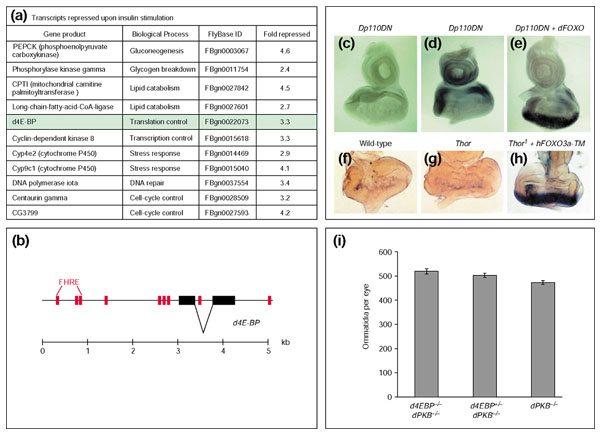
dFOXO regulates transcription of the d4E-BP gene. (a) A selection of microarray-identified genes that are transcriptionally downregulated after 2 h of insulin stimulation in Kc167 cells and contain forkhead response elements (FHREs) in their genomic upstream or intronic sequences. (b) FHREs (red) at the d4E-BP locus; black boxes are exons. (c,d) Overexpression of Dp110DN alone does not induce transcription of d4E-BP in imaginal discs, but (e) coexpression of dFOXO strongly upregulates the gene. (f-h) Expression of human FOXO3a-TM induces expression of the d4E-BP enhancer trap line Thor1. (i) d4E-BP and dPKB interact genetically. The Thor1 mutation increases the ommatidial number in dPKB-mutants by 9% without affecting cell size. Values are shown ± SD. Genotypes are: (c) y w; GMR-Gal4 UAS-Dp110DN/+; (d) y w; GMR-Gal4 UAS-Dp110DN/+; (e) y w; GMR-Gal4 UAS-Dp110DN/+; EP-dFOXO/+; (f) y w; (g) y w; Thor1/+; (h) y w; Thor1/GMR-Gal4; UAS-hFOXO3a-TM/+; (i) from right to left: y w;; dPKB3/dPKB1, y w; Thor1/+; dPKB3/dPKB1, y w; Thor1/Thor1; dPKB3/dPKB1.
Figure 7
Figure 7
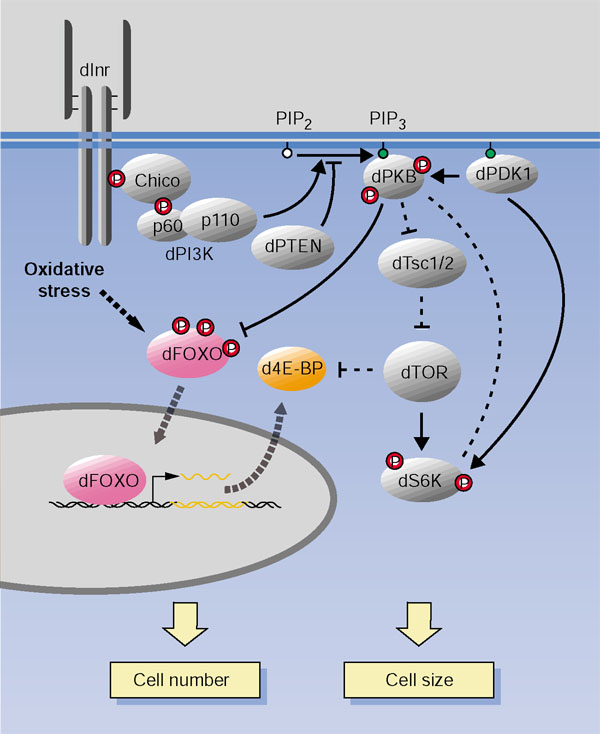
dFOXO may be an integrator of cellular stress. We propose a model in which dFOXO senses different forms of cellular stress (that is, nutrient deprivation or reactive oxygen species) and induces cellular responses, such as proliferation arrest, in part by repressing translation via upregulation of d4E-BP. The various signaling proteins shown in the figure are discussed in the text.

References

    1. Takahashi Y, Kadowaki H, Momomura K, Fukushima Y, Orban T, Okai T, Taketani Y, Akanuma Y, Yazaki Y, Kadowaki T. A homozygous kinase-defective mutation in the insulin receptor gene in a patient with leprechaunism. Diabetologia. 1997;40:412–420. - PubMed
    1. Baker J, Liu JP, Robertson EJ, Efstratiadis A. Role of insulin-like growth factors in embryonic and postnatal growth. Cell. 1993;75:73–82. - PubMed
    1. Holzenberger M, Dupont J, Ducos B, Leneuve P, Geloen A, Even PC, Cervera P, Le Bouc Y. IGF-1 receptor regulates lifespan and resistance to oxidative stress in mice. Nature. 2003;421:182–187. - PubMed
    1. Kimura KD, Tissenbaum HA, Liu Y, Ruvkun G. daf-2, an insulin receptor-like gene that regulates longevity and diapause in Caenorhabditis elegans. Science. 1997;277:942–946. - PubMed
    1. Brogiolo W, Stocker H, Ikeya T, Rintelen F, Fernandez R, Hafen E. An evolutionarily conserved function of the Drosophila insulin receptor and insulin-like peptides in growth control. Curr Biol. 2001;11:213–221. - PubMed

Publication types

MeSH terms

Substances