


Measurement of voluntary activation of fresh and fatigued human muscles using transcranial magnetic stimulation
- PMID: 12909682
- PMCID: PMC2343213
- DOI: 10.1113/jphysiol.2003.044099
Measurement of voluntary activation of fresh and fatigued human muscles using transcranial magnetic stimulation
Abstract
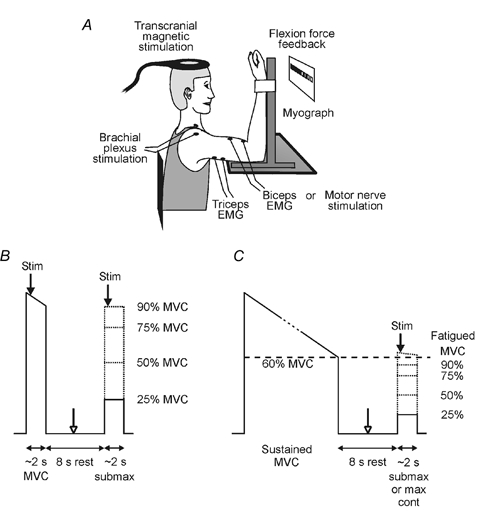
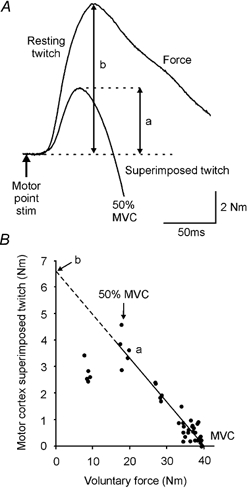
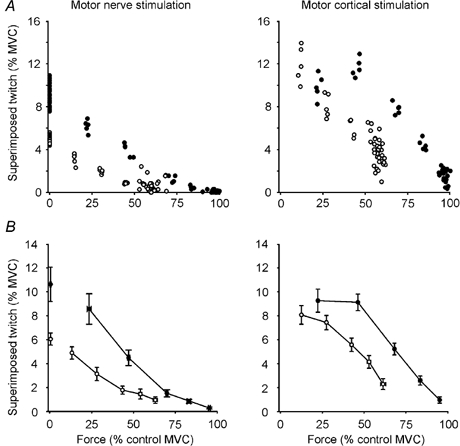
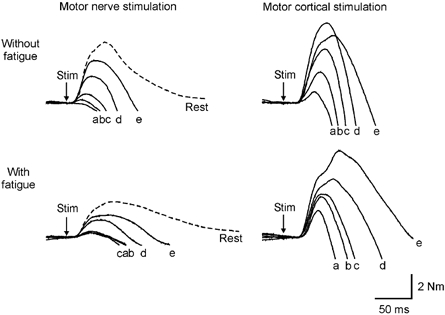
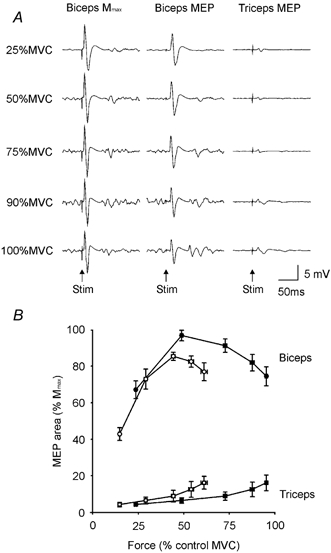
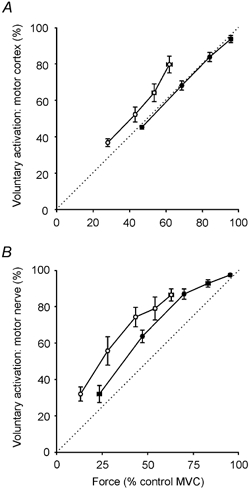
Recently, transcranial magnetic stimulation of the motor cortex (TMS) revealed impaired voluntary activation of muscles during maximal efforts. Hence, we evaluated its use as a measure of voluntary activation over a range of contraction strengths in both fresh and fatigued muscles, and compared it with standard twitch interpolation using nerve stimulation. Subjects contracted the elbow flexors isometrically while force and EMG from biceps and triceps were recorded. In one study, eight subjects made submaximal and maximal test contractions with rests to minimise fatigue. In the second study, eight subjects made sustained maximal contractions to reduce force to 60 % of the initial value, followed by brief test contractions. Force responses were recorded following TMS or electrical stimulation of the biceps motor nerve. In other contractions, EMG responses to TMS (motor evoked potentials, MEPs) or to stimulation at the brachial plexus (maximal M waves, Mmax) were recorded. During contractions of 50 % maximum, TMS elicited large MEPs in biceps (> 90 % Mmax) which decreased in size (to approximately 70 % Mmax) with maximal efforts. This suggests that faster firing rates made some motor units effectively refractory. With fatigue, MEPs were also smaller but remained > 70 % Mmax for contractions of 50-100 % maximum. For fresh and fatigued muscle, the superimposed twitch evoked by motor nerve and motor cortex stimulation decreased with increasing contraction strength. For nerve stimulation the relation was curvilinear, and for TMS it was linear for contractions of 50-100 % maximum (r2 = 1.00). Voluntary activation was derived using the expression: (1 - superimposed twitch/resting twitch) x 100. The resting twitch was measured directly for nerve stimulation and for TMS, it was estimated by extrapolation of the linear regression between the twitch and voluntary force. For cortical stimulation, this resulted in a highly linear relation between voluntary activation and force. Furthermore, the estimated activation corresponded well with contraction strength. Using TMS or nerve stimulation, voluntary activation was high during maximal efforts of fresh muscle. With fatigue, both measures revealed reduced voluntary activation (i.e. central fatigue) during maximal efforts. Measured with TMS, this central fatigue accounted for one-quarter of the fall in maximal voluntary force. We conclude that TMS can quantify voluntary activation for fresh or fatigued muscles at forces of 50-100 % maximum. Unlike standard twitch interpolation of the elbow flexors, voluntary activation measured with TMS varies in proportion to voluntary force, it reveals when extra output is available from the motor cortex to increase force, and it elicits force from all relevant synergist muscles.
Figures
References
-
- Allen GE, McKenzie DK, Gandevia SC. Twitch interpolation of the elbow flexor muscles at high forces. Muscle Nerve. 1998;21:318–328. - PubMed
-
- Awiszus F, Wahl B, Meinecke I. Influence of stimulus cross talk on results of the twitch-interpolation technique at the biceps brachii muscle. Muscle Nerve. 1997;20:1187–1190. - PubMed
-
- Behm DG, Whittle J, Button D, Power K. Intermuscle differences in activation. Muscle Nerve. 2002;25:236–243. - PubMed
-
- Belanger AY, McComas AJ. Extent of motor unit activation during effort. J Appl Physiol. 1981;51:1131–1135. - PubMed
-
- Bigland-Ritchie B, Jones DA, Hosking GP, Edwards RHT. Central and peripheral fatigue in sustained maximum voluntary contractions of human quadriceps muscle. Clin Sci Mol Med. 1978;54:609–614. - PubMed
Publication types
MeSH terms
LinkOut - more resources
Full Text Sources
Medical
