Intestinal absorption of the bile acid analogue 75Se-homocholic acid-taurine is increased in primary biliary cirrhosis, and reverts to normal during ursodeoxycholic acid administration
- PMID: 12912872
- PMCID: PMC1773789
- DOI: 10.1136/gut.52.9.1371
Intestinal absorption of the bile acid analogue 75Se-homocholic acid-taurine is increased in primary biliary cirrhosis, and reverts to normal during ursodeoxycholic acid administration
Abstract
Background: Whether ileal absorption of bile acid is up or downregulated in chronic cholestasis is still debated, and most evidence has come from animal studies.
Aims: To compare ileal bile acid absorption in patients with primary biliary cirrhosis (PBC) and in healthy control subjects, and to assess the effect of ursodeoxycholic acid (UDCA).
Patients: We studied 14 PBC patients before and during (n=11) UDCA administration, 14 healthy control subjects, and 14 Crohn's disease patients (as disease controls).
Methods: We used cholescintigraphy to measure retention in the enterohepatic circulation over five successive days of the bile acid analogue (75)Se-homocholic acid-taurine ((75)SeHCAT) as an index of ileal bile acid absorption. Results were expressed as (75)SeHCAT fractional turnover rate (FTR) and t(1/2)12.
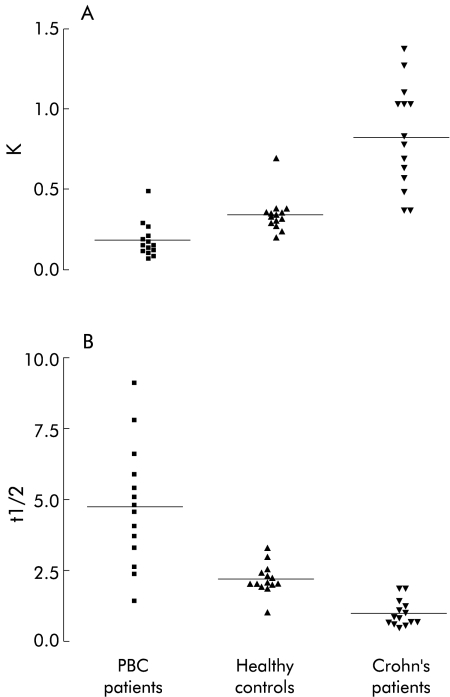
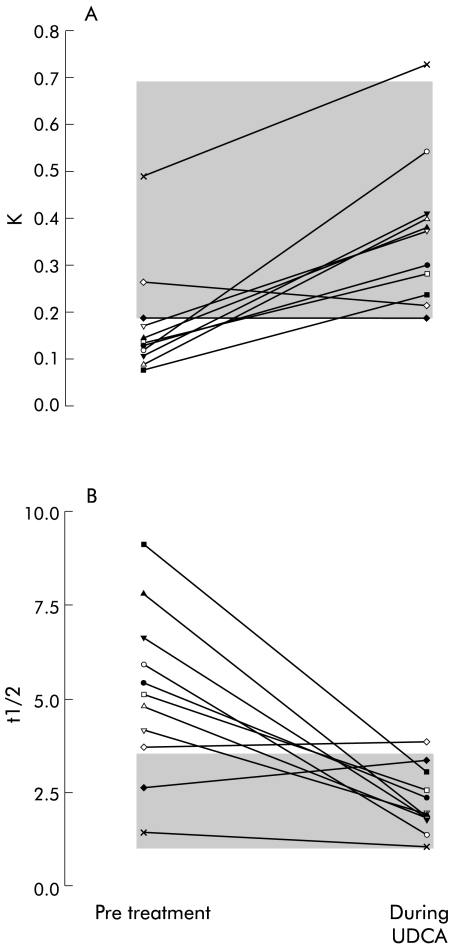
Results: (75)SeHCAT FTR was 0.19 (0.11)/day, 0.34 (0.11)/day (p<0.001), and 0.83 (0.32)/day in PBC patients, healthy controls (p<0.0001), and Crohn's patients (p<0.001), respectively, which increased to 0.36 (0.16)/day in PBC patients during UDCA treatment (p<0.005). (75)SeHCAT t(1/2)12 was 4.8 (2.1) days in PBC patients, 2.2 (0.5) days (p<0.001) in healthy controls, and 1.0 (0.5) days (p<0.001) in Crohn's disease patients. (75)SeHCAT t(1/2)12 decreased to 2.2 (0.93) days (p< 0.001) in PBC patients during UDCA treatment.
Conclusions: Our results support the concept that ileal bile acid absorption is upregulated in PBC patients, and that this effect may contribute towards damaging the cholestatic liver. This upregulation of bile acid absorption is abolished by UDCA.
Figures
Comment in
-
Inappropriate ileal conservation of bile acids in cholestatic liver disease: homeostasis gone awry.Gut. 2003 Sep;52(9):1239-41. doi: 10.1136/gut.52.9.1239. Gut. 2003. PMID: 12912852 Free PMC article. No abstract available.
References
-
- Metcalf JV, Mitchison HC, Palmer JM, et al. Natural history of early primary biliary cirrhosis. Lancet 1996;348:1399–402. - PubMed
-
- Zollner G, Fickert P, Zenz R, et al. Hepatobiliary transporter expression in percutaneous liver biopsies of patients with cholestatic liver diseases. Hepatology 2001;33:633–46. - PubMed
-
- Grober J, Zaghini I, Fujii H, et al. Identification of a bile acid-responsive element in the human ileal bile acid-binding protein gene. Involvement of the farnesoid X receptor/9-cis-retinoic acid receptor heterodimer. J Biol Chem 1999;274:29749–54. - PubMed
-
- Hofmann AF. Regulation of ileal bile acid transport: desirability of measuring transport function as well as transporter activity. Hepatology 1999;29:1335–7. - PubMed
-
- Rodrigues CM, Steer CJ. Mitochondrial membrane perturbations in cholestasis. J Hepatol 2000;32:135–41. - PubMed
MeSH terms
Substances
LinkOut - more resources
Full Text Sources
Other Literature Sources