. 2003 Aug;132(4):1901-12.
doi: 10.1104/pp.103.022731.

Overexpression of the disease resistance gene Pto in tomato induces gene expression changes similar to immune responses in human and fruitfly

Affiliations

Overexpression of the disease resistance gene Pto in tomato induces gene expression changes similar to immune responses in human and fruitfly

Kirankumar S Mysore et al. Plant Physiol. 2003 Aug.

Abstract

The Pto gene encodes a serine/threonine protein kinase that confers resistance in tomato (Lycopersicon esculentum) to Pseudomonas syringae pv tomato strains that express the type III effector protein AvrPto. Constitutive overexpression of Pto in tomato, in the absence of AvrPto, activates defense responses and confers resistance to several diverse bacterial and fungal plant pathogens. We have used a series of gene discovery and expression profiling methods to examine the effect of Pto overexpression in tomato leaves. Analysis of the tomato expressed sequence tag database and suppression subtractive hybridization identified 600 genes that were potentially differentially expressed in Pto-overexpressing tomato plants compared with a sibling line lacking Pto. By using cDNA microarrays, we verified changes in expression of many of these genes at various time points after inoculation with P. syringae pv tomato (avrPto) of the resistant Pto-overexpressing line and the susceptible sibling line. The combination of these three approaches led to the identification of 223 POR (Pto overexpression responsive) genes. Strikingly, 40% of the genes induced in the Pto-overexpressing plants previously have been shown to be differentially expressed during the human (Homo sapiens) and/or fruitfly (Drosophila melanogaster) immune responses.


Figures
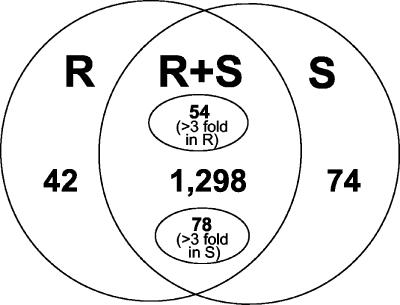
Figure 1.
Figure 1.
Identification of differentially expressed genes by in silico EST subtraction. ESTs derived from the R11-12 (R) and the R11-13 (S) libraries were assembled into contigs. Within each contig, the number of ESTs derived from the R or S libraries was then calculated. Those contigs (with at least three ESTs) with ESTs from only the R library are shown on the left, and those with ESTs from only the S library are shown on the right. Contigs that contained mixtures of ESTs from both libraries are shown in the middle. Fifty-four of these contigs contained 3-fold or more ESTs from the R than S library, whereas 78 contigs contained 3-fold or more ESTs from the S than the R library. The remainder of the contigs (1,298) contained mixtures of ESTs from both libraries but in less than 3-fold ratios.
Figure 2.
Figure 2.
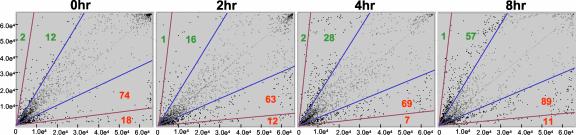
Scatter plots showing distribution of POR gene expression ratios at different time points after inoculation. Each cDNA insert was replicated three times on the microarray slides (see “Materials and Methods”). The dots (>2-fold induction/repression) and white circles (<2-fold induction/repression) correspond to the signal intensity ratios (R11-12:R11-13) of the individual cDNA spots. The x axis represents the spot intensity of Cy3 (R11-12 RNA; experiment), and the y axis represents the spot intensity of Cy5 (R11-13 RNA; control). Diagonal blue and brown lines represent >2-fold and >10-fold induction:repression ratio cutoffs, respectively, relative to the best fit line through the normalized data (middle black line). Number of cDNA clones that are >2-fold or >10-fold induced (red)/repressed (green) is shown.
Figure 3.
Figure 3.
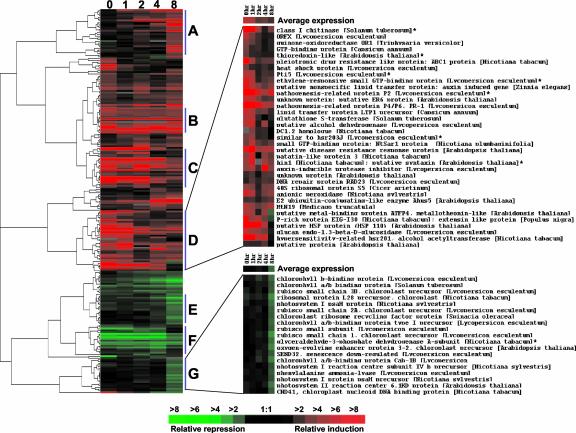
A hierarchical cluster of gene expression of the 223 POR genes over a time course after inoculation by P. syringae pv tomato expressing avrPto. Each gene is represented by a single row of colored bars, and the columns represent the time points. Colored bars (red, increased transcript abundance; green, decreased transcript abundance; gray, missing or incomplete data; and black, no difference in transcript abundance) represent the ratio of hybridization measurements between corresponding time points in the R11-12 and R11-13 (treated with avirulent P. syringae pv tomato) samples. The cluster tree (left) illustrates the nodes of coregulation of gene expression. The clusters A through G are discussed in the text. Average differential expression and the list of genes in clusters D and G are shown. Genes with asterisks are previously known plant defense-related genes that were deliberately included during microarray experiments.
Figure 4.
Figure 4.
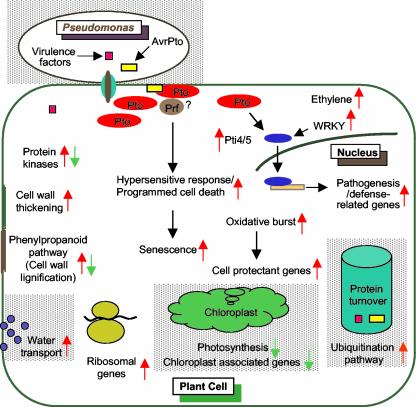
A summary of the plant responses to overexpression of Pto and P. syringae pv tomato infection. Red arrows indicate genes that were induced and green arrows indicate genes that were suppressed due to Pto overexpression. Black arrows indicate either possible steps in signal transduction pathways or host responses that might directly impact other responses. Classes of genes shaded in gray are also responsive to P. syringae pv tomato infection.

References

    1. Austin MJ, Muskett P, Kahn K, Feys BJ, Jones JDG, Parker JE (2002) Regulatory role of SGT1 in Early R gene-mediated plant defenses. Science 295: 2077–2080 - PubMed
    1. Axelrod AE (1981) Role of the B vitamins in the immune response. Adv Exp Med Biol 135: 93–106 - PubMed
    1. Azevedo C, Sadanandom A, Kitagawa K, Freialdenhoven A, Shirasu K, Schulze-Lefert P (2002) The RAR1 interactor SGT1, an essential component of R gene-triggered disease resistance. Science 295: 2073–2076 - PubMed
    1. Beck MA (2001) Antioxidants and viral infections: host immune response and viral pathogenicity. J Am Coll Nutr 20: 384S–388S - PubMed
    1. Ben-Neriah Y (2002) Regulatory functions of ubiquitination in the immune system. Nat Immunol 3: 20–26 - PubMed

Publication types

MeSH terms

Substances

LinkOut - more resources