


Angiotensin-I-converting enzyme and its relatives
- PMID: 12914653
- PMCID: PMC193637
- DOI: 10.1186/gb-2003-4-8-225
Angiotensin-I-converting enzyme and its relatives
Abstract
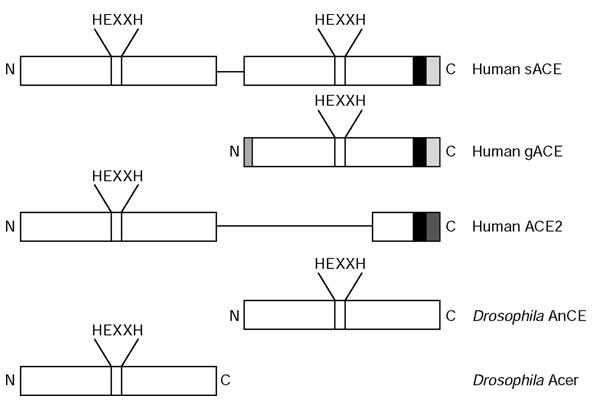
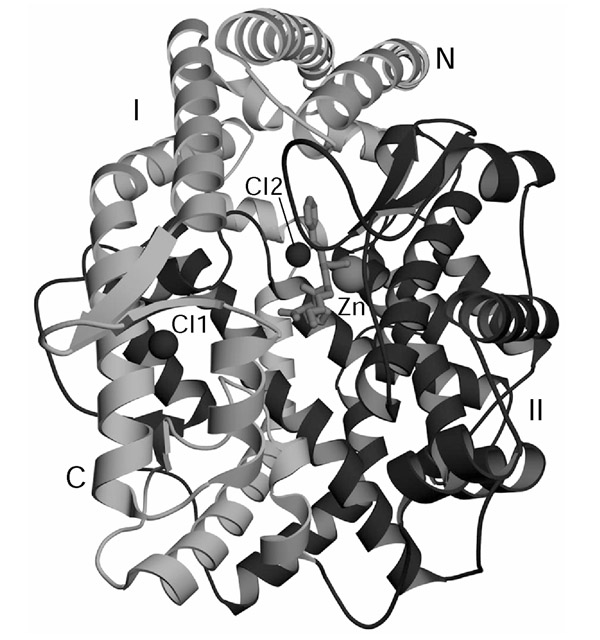
Angiotensin-I-converting enzyme (ACE) is a monomeric, membrane-bound, zinc- and chloride-dependent peptidyl dipeptidase that catalyzes the conversion of the decapeptide angiotensin I to the octapeptide angiotensin II, by removing a carboxy-terminal dipeptide. ACE has long been known to be a key part of the renin angiotensin system that regulates blood pressure, and ACE inhibitors are important for the treatment of hypertension. There are two forms of the enzyme in humans, the ubiquitous somatic ACE and the sperm-specific germinal ACE, both encoded by the same gene through transcription from alternative promoters. Somatic ACE has two tandem active sites with distinct catalytic properties, whereas germinal ACE, the function of which is largely unknown, has just a single active site. Recently, an ACE homolog, ACE2, has been identified in humans that differs from ACE in being a carboxypeptidase that preferentially removes carboxy-terminal hydrophobic or basic amino acids; it appears to be important in cardiac function. ACE homologs (also known as members of the M2 gluzincin family) have been found in a wide variety of species, even in those that neither have a cardiovascular system nor synthesize angiotensin. X-ray structures of a truncated, deglycosylated form of germinal ACE and a related enzyme from Drosophila have been reported, and these show that the active site is deep within a central cavity. Structure-based drug design targeting the individual active sites of somatic ACE may lead to a new generation of ACE inhibitors, with fewer side-effects than currently available inhibitors.
Figures
References
-
- Hubert C, Houot AM, Corvol P, Soubrier F. Structure of the angiotensin I-converting enzyme gene. Two alternate promoters correspond to evolutionary steps of a duplicated gene. J Biol Chem. 1991;266:15377–15383. The complete description of the gene structure of sACE and evidence for alternative promoters for the expression of the mRNAs for somatic and germinal ACE. - PubMed
-
- Corvol P, Williams TA. Peptidyl-dipeptidase A/angiotensin 1-converting enzyme. In: Barrett AJ, Rawlings ND, Woessner JF, editor. In Handbook of Proteolytic Enzymes. San Diego: Academic Press; 1998. pp. 1066–1076. An excellent summary of ACE, including sequence data bank codes and a thorough analysis of the chemical and biological properties of ACE.
-
- Williams TA, Michaud A, Houard X, Chauvet M-T, Soubrier F, Corvol P. Drosophila melanogaster angiotensin I-converting enzyme expressed in Pichia pastoris resembles the C domain of the mammalian homologue and does not require glycosylation for secretion and enzymatic activity. Biochem J. 1996;318:125–131. This paper shows that AnCE has catalytic properties that resemble those of human C-domain ACE. - PMC - PubMed
-
- Cornell MJ, Williams TA, Lamango NS, Coates D, Corvol P, Soubrier F, Hoheisel J, Lehrach H, Isaac RE. Cloning and expression of an evolutionary conserved single-domain angiotensin converting enzyme from Drosophila melanogaster. J Biol Chem. 1995;270:13613–13619. doi: 10.1074/jbc.270.29.17627. This paper presents an interesting analysis of the evolution of the ACE gene and its duplication. - DOI - PubMed
Publication types
MeSH terms
Substances
Grants and funding
LinkOut - more resources
Full Text Sources
Miscellaneous
