


Identification of a mutation in editing of defective Newcastle disease virus recombinants that modulates P-gene mRNA editing and restores virus replication and pathogenicity in chicken embryos
- PMID: 12915541
- PMCID: PMC187413
- DOI: 10.1128/jvi.77.17.9259-9265.2003
Identification of a mutation in editing of defective Newcastle disease virus recombinants that modulates P-gene mRNA editing and restores virus replication and pathogenicity in chicken embryos
Erratum in
- J Virol. 2003 Oct;77(20):11299
Abstract
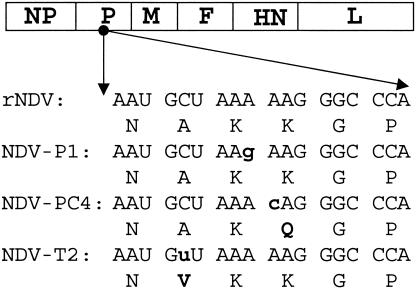
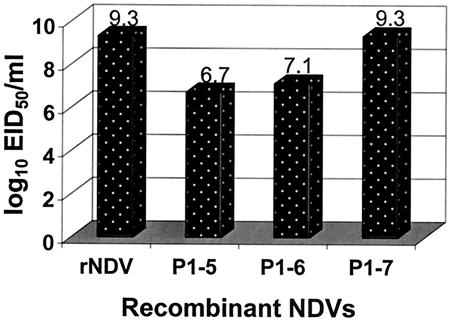
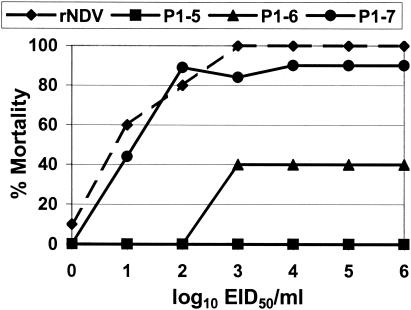
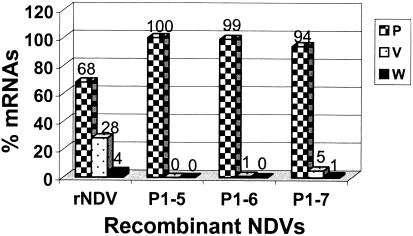
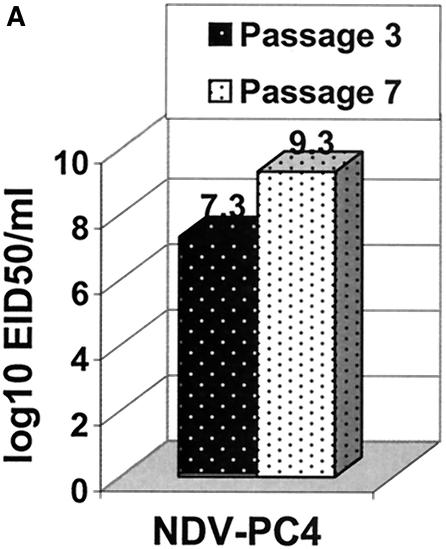
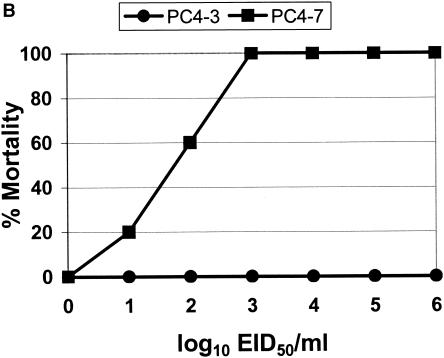
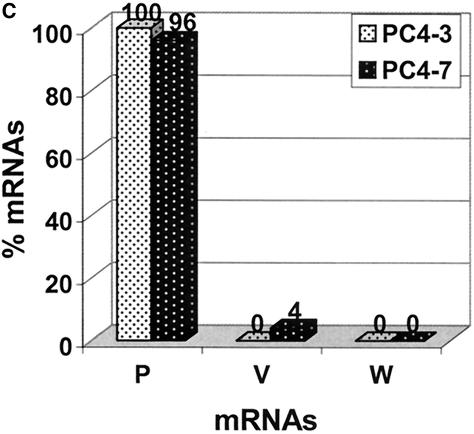
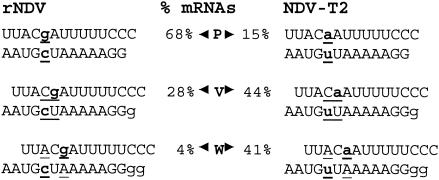
Editing of P-gene mRNA of Newcastle disease virus (NDV) enables the formation of two additional proteins (V and W) by inserting one or two nontemplated G residues at a conserved editing site (5'-AAAAAGGG). The V protein of NDV plays an important role in virus replication and is also a virulence factor presumably due to its ability to counteract the antiviral effects of interferon. A recombinant virus possessing a nucleotide substitution within the A-stretch (5'-AAgAAGGG) produced 20-fold-less V protein and, in consequence, was impaired in replication capacity and completely attenuated in pathogenicity for chicken embryos. However, in a total of seven serial passages, restoration of replication and pathogenic capacity in 9- to 11-day-old chicken embryos was noticed. Determining the sequence around the editing site of the virus at passage 7 revealed a C-to-U mutation at the second nucleotide immediately upstream of the 5'-A(5) stretch (5'-GuUAAgAAGGG). The V mRNA increased from an undetectable level at passage 5 to ca. 1 and 5% at passages 6 and 7, respectively. In addition, similar defects in another mutant possessing a different substitution mutation (5'-AAAcAGGG) were restored in an identical manner within a total of seven serial passages. Introduction of the above C-to-U mutation into the parent virus (5'-GuUAAAAAGGG) altered the frequency of P, V, and W mRNAs from 68, 28, and 4% to 15, 44, and 41%, respectively, demonstrating that the U at this position is a key determinant in modulating P-gene mRNA editing. The results indicate that this second-site mutation is required to compensate for the drop in edited mRNAs and consequently to restore the replication capacity, as well as the pathogenic potential, of editing-defective NDV recombinants.
Figures
References
-
- Beard, C. W., and R. P. Hanson. 1984. Newcastle disease, p. 452-470. In M. S. Hofstad, H. J. Barnes, B. W. Calnek, W. M. Reid, and H. W. Yoder (ed.), Diseases of poultry. Iowa State University Press, Ames.
-
- Buchholz, U. J., S. Finke, and K.-K. Conzelmann. 1999. Generation of bovine respiratory syncytial virus (BRSV) from cDNA: BRSV NS2 is not essential for virus replication in tissue culture, and the human RSV leader region acts as a functional BRSV genome promoter. J. Virol. 73:251-259. - PMC - PubMed
-
- Delenda, C., S. Hausmann, D. Garcin, and D. Kolakofsky. 1997. Normal cellular replication of Sendai virus without the trans-frame, nonstructural V protein. Virology 228:55-62. - PubMed
-
- Delenda, C., G. Taylor, S. Hausmann, D. Garcin, and D. Kolakofsky. 1998. Sendai viruses with altered P, V, and W protein expression. Virology 242:327-337. - PubMed
MeSH terms
Substances
LinkOut - more resources
Full Text Sources
