. 2003 Sep;77(17):9463-73.
doi: 10.1128/jvi.77.17.9463-9473.2003.

Identification of novel immunodominant CD4+ Th1-type T-cell peptide epitopes from herpes simplex virus glycoprotein D that confer protective immunity

Affiliations

Identification of novel immunodominant CD4+ Th1-type T-cell peptide epitopes from herpes simplex virus glycoprotein D that confer protective immunity

Lbachir BenMohamed et al. J Virol. 2003 Sep.

Abstract

The molecular characterization of the epitope repertoire on herpes simplex virus (HSV) antigens would greatly expand our knowledge of HSV immunity and improve immune interventions against herpesvirus infections. HSV glycoprotein D (gD) is an immunodominant viral coat protein and is considered an excellent vaccine candidate antigen. By using the TEPITOPE prediction algorithm, we have identified and characterized a total of 12 regions within the HSV type 1 (HSV-1) gD bearing potential CD4(+) T-cell epitopes, each 27 to 34 amino acids in length. Immunogenicity studies of the corresponding medium-sized peptides confirmed all previously known gD epitopes and additionally revealed four new immunodominant regions (gD(49-82), gD(146-179), gD(228-257), and gD(332-358)), each containing naturally processed epitopes. These epitopes elicited potent T-cell responses in mice of diverse major histocompatibility complex backgrounds. Each of the four new immunodominant peptide epitopes generated strong CD4(+) Th1 T cells that were biologically active against HSV-1-infected bone marrow-derived dendritic cells. Importantly, immunization of H-2(d) mice with the four newly identified CD4(+) Th1 peptide epitopes but not with four CD4(+) Th2 peptide epitopes induced a robust protective immunity against lethal ocular HSV-1 challenge. These peptide epitopes may prove to be important components of an effective immunoprophylactic strategy against herpes.


Figures
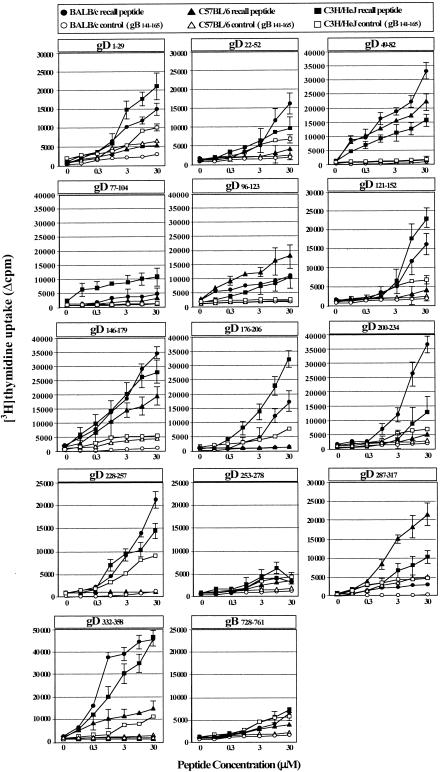
FIG. 1.
FIG. 1.
Ag-specific T-cell proliferation induced in BALB/c (H-2d), C57BL/6 (H-2b), and C3H/HeJ (H-2k) mice following immunization with TEPITOPE-selected gD peptides. Mice were immunized with the peptide indicated at the top of each panel, and peptide-specific T-cell responses were determined following in vitro stimulation of spleen T cells with the recall peptide (solid symbols) or the irrelevant control peptide gB141-165 (open symbols). The spleen T cells were obtained from H-2d (circles), H-2b (triangles), and H-2k (squares) mice 14 days after the second (final) immunization. The means ± standard deviations from two separate experiments (five mice/group/experiment) are shown.
FIG. 2.
FIG. 2.
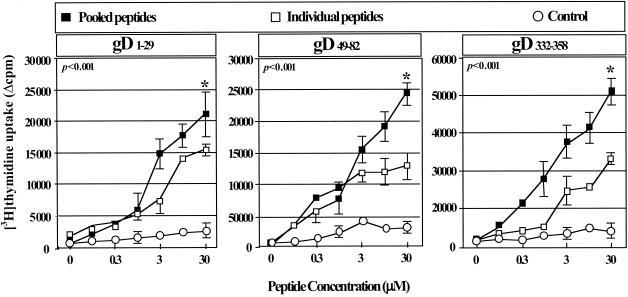
Simultaneous induction of multiple Ag-specific T cells to pools of gD-derived peptides. H-2d mice were immunized with a pool of gD1-29, gD49-82, and gD332-358 or with the individual peptides. The peptides indicated above each panel were used for in vitro stimulation of spleen T cells from mice immunized with the pooled peptides (solid squares), mice immunized with individual peptide (open squares), or control mice injected with adjuvant alone (open circles). The results shown are representative of three separate experiments. The P values shown are for pooled versus single peptide.
FIG. 3.
FIG. 3.
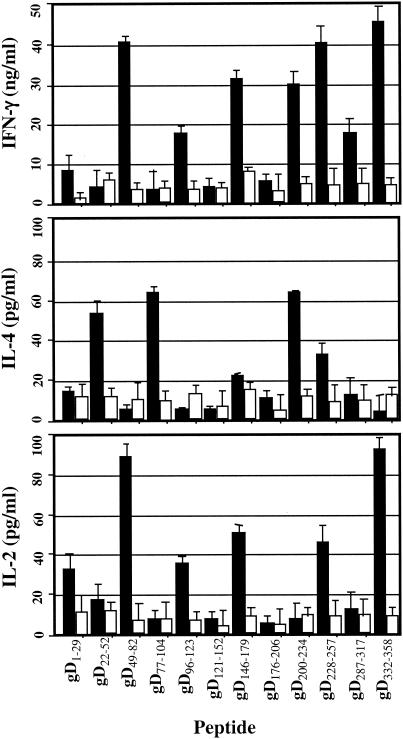
Induction of IL-2, IL-4, and IFN-γ by gD peptides emulsified in M-ISA720 adjuvant. H-2d mice were immunized with individual peptides as described. Splenic T cells were stimulated with the immunizing peptide (solid bars) or the control irrelevant peptide gB141-165 (open bars). IL-2, IL-4, and IFN-γ secreted into the culture media were quantified by a specific sandwich enzyme-linked immunosorbent assay, as described in Materials and Methods.
FIG. 4.
FIG. 4.
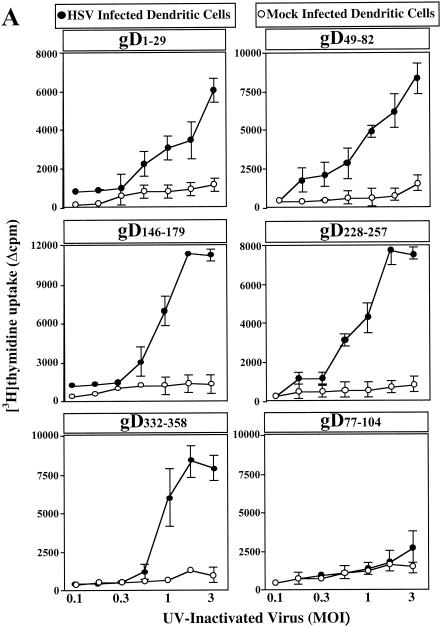
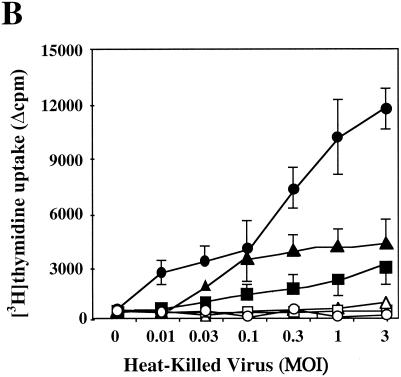
The gD peptide-induced T-cell responses were relevant to the native viral protein. (A) Splenocyte-derived CD41-T-cell lines from gD1-29-, gD49-82-, gD77-104-, gD146-179-, gD228-257-, or gD332-358-immunized H-2d mice were incubated with autologous bone marrowderived DC (at an effector-to-target ratio of T cells to DC of 50:1). Target DC had been infected with UV-inactivated HSV-1 at an MOI of 3, 1, 0.3, or 0.1 (HSV Infected Dendritic Cells). Control cultures contained CD41 T cells and mock-infected DC. The [3H]thymidine uptake as observed in three independently performed experiments is shown. (B) Proliferative responses of CD41 T cells from H-2d (closed circles), H-2b (closed triangles), and H-2k (closed squares) mice immunized with gD49-82, gD146-179, gD228-257, and gD332-358 gD peptides were determined by using heat-killed HSV-1 at an MOI of 3, 1, 0.3, 0.1, 0.03, or 0.01 for in vitro stimulation. [3H]thymidine incorporation was determined after 3 days of stimulation. Spleen cells from adjuvantinjected H-2b (open circles), H-2d (open triangles), and H-2k (open squares) mice were used as control.
FIG. 4.
FIG. 4.
The gD peptide-induced T-cell responses were relevant to the native viral protein. (A) Splenocyte-derived CD41-T-cell lines from gD1-29-, gD49-82-, gD77-104-, gD146-179-, gD228-257-, or gD332-358-immunized H-2d mice were incubated with autologous bone marrowderived DC (at an effector-to-target ratio of T cells to DC of 50:1). Target DC had been infected with UV-inactivated HSV-1 at an MOI of 3, 1, 0.3, or 0.1 (HSV Infected Dendritic Cells). Control cultures contained CD41 T cells and mock-infected DC. The [3H]thymidine uptake as observed in three independently performed experiments is shown. (B) Proliferative responses of CD41 T cells from H-2d (closed circles), H-2b (closed triangles), and H-2k (closed squares) mice immunized with gD49-82, gD146-179, gD228-257, and gD332-358 gD peptides were determined by using heat-killed HSV-1 at an MOI of 3, 1, 0.3, 0.1, 0.03, or 0.01 for in vitro stimulation. [3H]thymidine incorporation was determined after 3 days of stimulation. Spleen cells from adjuvantinjected H-2b (open circles), H-2d (open triangles), and H-2k (open squares) mice were used as control.
FIG. 5.
FIG. 5.
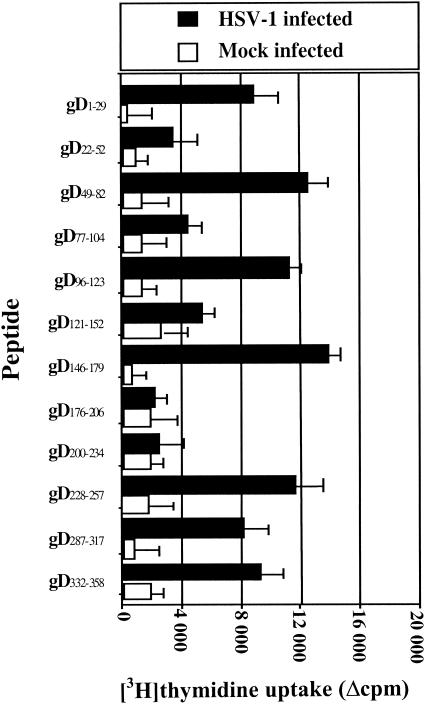
The predicted peptides contain epitopes that are naturally processed and presented to the host immune system during the course of HSV infection. T cells from spleens of H-2d mice 21 days after HSV-1 infection recognized the selected gD peptides as determined by in vitro lymphoproliferative responses to individual peptide (HSV-1 infected). Spleen cells from mock-infected mice were used as controls.

References

    1. Alexander, J., J. Fikes, S. Hoffman, E. Franke, J. Sacci, E. Appella, F. V. Chisari, L. G. Guidotti, R. W. Chesnut, B. Livingston, and A. Sette. 1998. The optimization of helper T lymphocyte (HTL) function in vaccine development. Immunol. Res. 18:79-92. - PubMed
    1. Asanuma, H., M. Sharp, H. T. Maecker, V. C. Maino, and A. M. Arvin. 2000. Frequencies of memory T cells specific for varicella-zoster virus, herpes simplex virus, and cytomegalovirus by intracellular detection of cytokine expression. J. Infect. Dis. 181:859-866. - PubMed
    1. BenMohamed, L., Y. Belkaid, E. Loing, K. Brahimi, H. Gras-Masse, and P. Druilhe. 2002. Systemic immune responses induced by mucosal administration of lipopeptides without adjuvant. Eur. J. Immunol. 32:2274-2281. - PubMed
    1. BenMohamed, L., H. Gras-Masse, A. Tartar, P. Daubersies, K. Brahimi, M. Bossus, A. Thomas, and P. Druilhe. 1997. Lipopeptide immunization without adjuvant induces potent and long-lasting B, T helper, and cytotoxic T lymphocyte responses against a malaria liver stage antigen in mice and chimpanzees. Eur. J. Immunol. 27:1242-1253. - PubMed
    1. BenMohamed, L., R. Krishnan, C. Auge, J. Primus, and D. J. Diamond. 2002. Intranasal administration of a synthetic lipopeptide without adjuvant induces systemic immune responses. Immunology 106:113-121. - PMC - PubMed

Publication types

MeSH terms