


Speech and language therapy interventions for children with primary speech and language delay or disorder
- PMID: 12918003
- PMCID: PMC8407295
- DOI: 10.1002/14651858.CD004110
Speech and language therapy interventions for children with primary speech and language delay or disorder
Abstract
Background: It is thought that approximately 6% of children have speech and language difficulties of which the majority will not have any other significant developmental difficulties. Whilst most children's difficulties resolve, children whose difficulties persist into primary school may have long-term problems concerning literacy, socialisation, behaviour and school attainment.
Objectives: To examine the effectiveness of speech and language interventions for children with primary speech and language delay/disorder.
Search strategy: The following databases were searched: The Cochrane Controlled Trials Register (Cochrane Library, CENTRAL: 2002/3), CINAHL (1982 - July 2002), EMBASE (1980 - Sept Week 4 2002), ERIC (1965 - 2002), MEDLINE (1966 - Sept Week 3 2002), PsycINFO (1872 - 2002/10 Week 2), The National Research Register (2002/3). In addition to this references were taken from reviews of the literature and reference lists from articles.
Selection criteria: The review considered randomised controlled trials of speech and language therapy interventions for children or adolescents with primary speech and language delay/disorder.
Data collection and analysis: Titles and abstracts were identified and assessed for relevance, before the full text version was obtained of all potentially relevant articles. The data were categorised depending on the nature of the control group and considered in terms of the effects of intervention on expressive and receptive phonology, syntax and vocabulary. The outcomes used in the analysis were dependent on the focus of the study with only the primary effects of therapy being considered in this review.
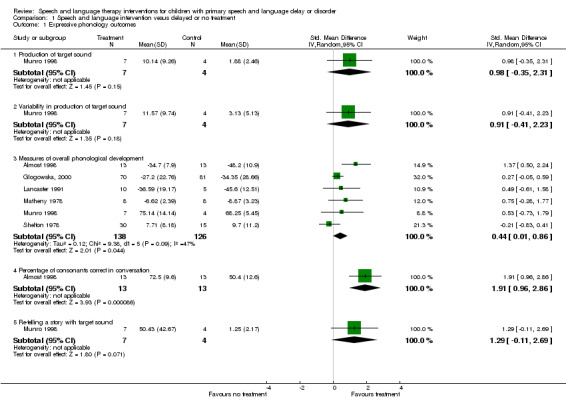
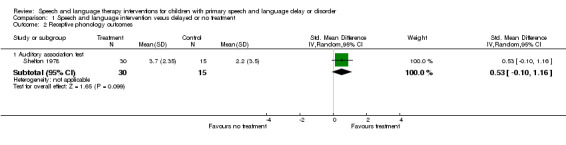
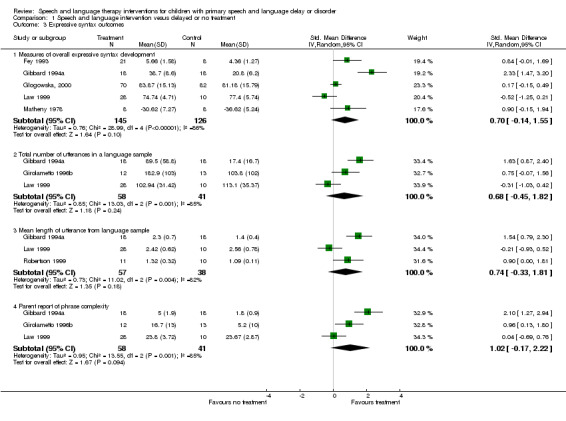
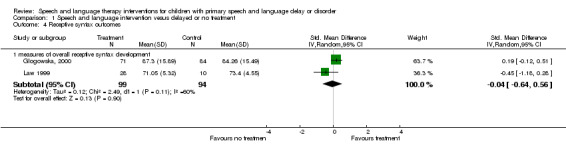
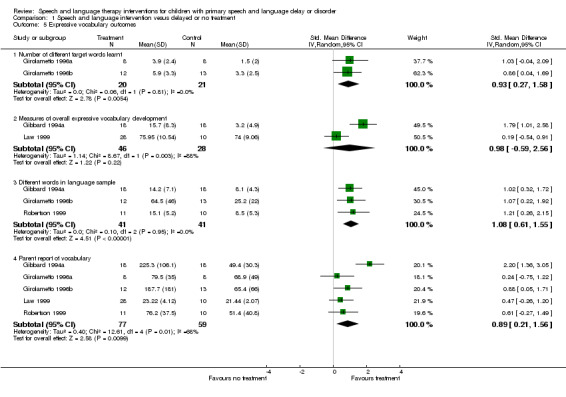
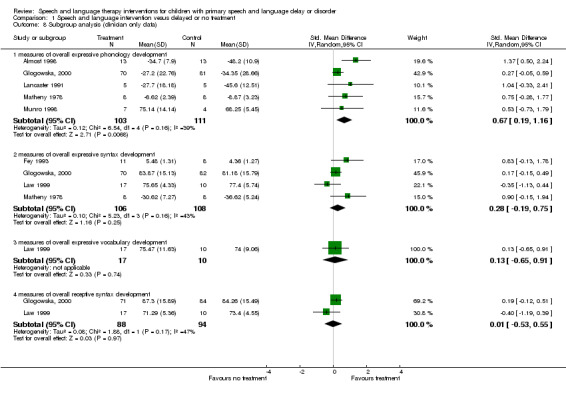
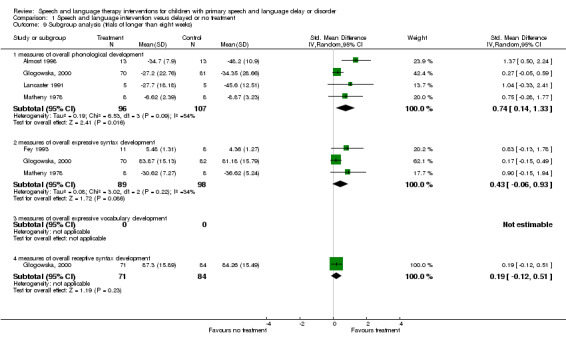
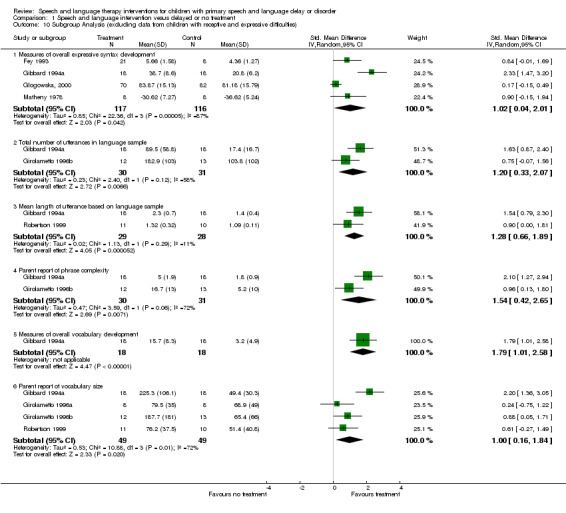
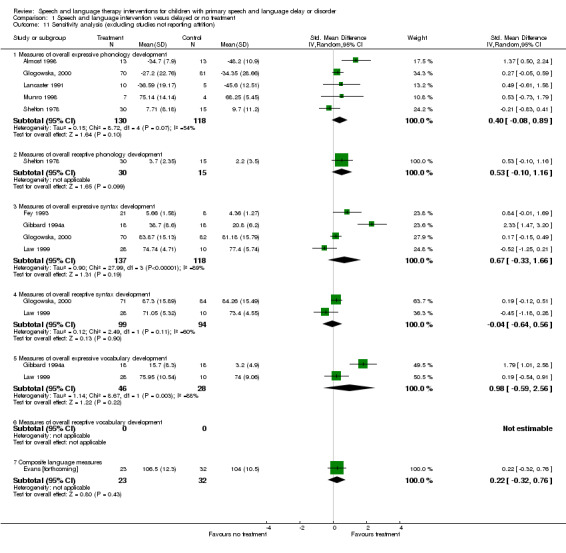
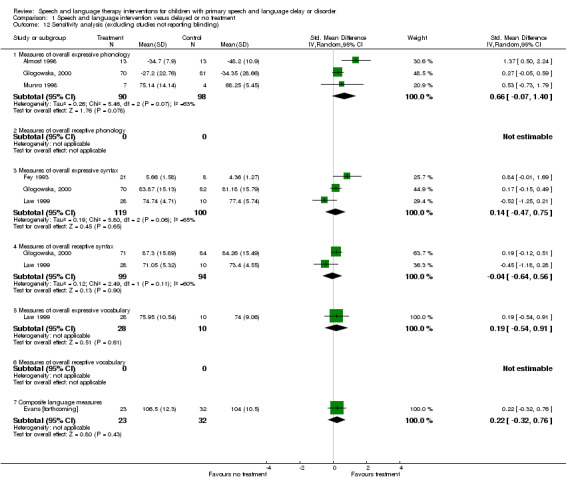
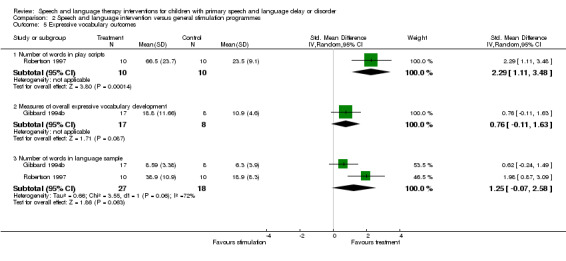
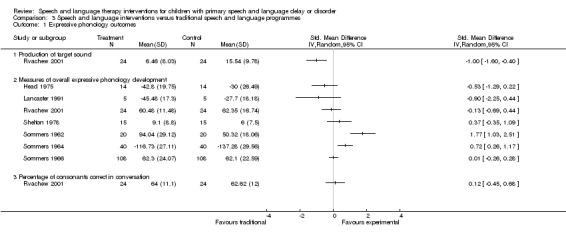
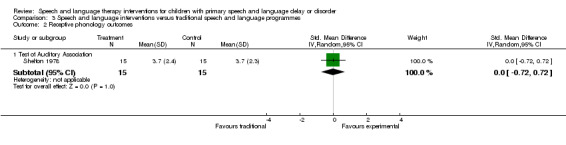
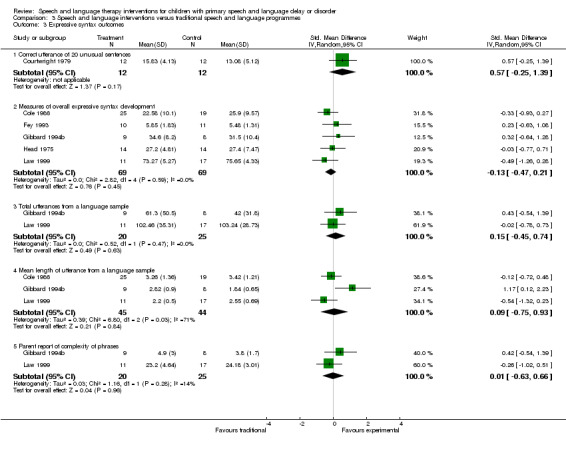
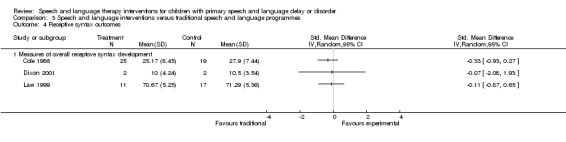
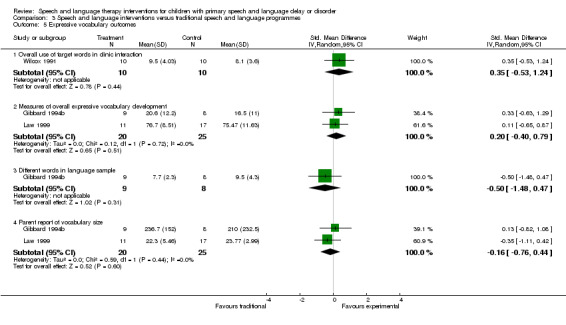
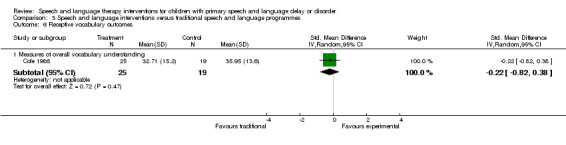
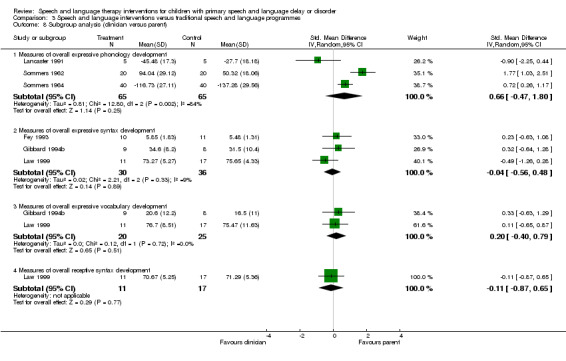
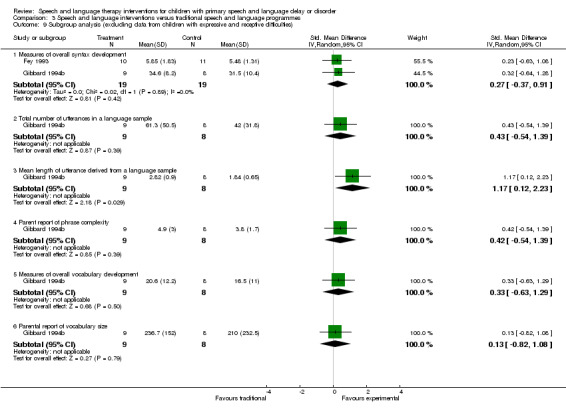
Main results: The results of twenty-five studies were used in the meta-analysis. The results suggest that speech and language therapy is effective for children with phonological (SMD=0.44, 95%CI: 0.01,0.86) or vocabulary difficulties (SMD=0.89, 95%CI: 0.21,1.56), but that there is less evidence that interventions are effective for children with receptive difficulties (SMD=-0.04, 95%CI: -0.64,0.56). Mixed findings were found concerning the effectiveness of expressive syntax interventions (n=233; SMD=1.02, 95%CI: 0.04-2.01). No significant differences were shown between clinician administered intervention and intervention implemented by trained parents, and studies did not show a difference between the effects of group and individual interventions (SMD=0.01, 95%CI: -0.26,1.17). The use of normal language peers in therapy was shown to have a positive effect on therapy outcome (SMD=2.29, 95%CI: 1.11,3.48).
Reviewer's conclusions: The review shows that overall there is a positive effect of speech and language therapy interventions for children with expressive phonological and expressive vocabulary difficulties. The evidence for expressive syntax difficulties is more mixed, and there is a need for further research to investigate intervention for receptive language difficulties. There is a large degree of heterogeneity in the results, and the sources of this need to be investigated.
Conflict of interest statement
James Law is an author on one of the included studies and one of the excluded studies in this review, and has published a non‐Cochrane review in this area.
Figures
References
References to studies included in this review
Almost 1998 {published and unpublished data}
-
- Almost D, Rosenbaum P. Effectiveness of speech intervention for phonological disorders: a randomised controlled trial. Developmental Medicine and Child Neurology 1998;40:319‐325. - PubMed
Barratt 1992 {published data only}
Cole 1986 {published data only}
-
- Cole KN, Dale PS. Direct language instruction and interactive language instruction with language delayed preschool children: a comparison study. Journal of Speech and Hearing Research 1986;29:206‐217. - PubMed
Courtwright 1979 {published data only}
-
- Courtwright JA, Courtwright IC. Imitative modeling as a language intervention strategy: the effects of two mediating variables. Journal of Speech and Hearing Research 1979;22:366‐388. - PubMed
Dixon 2001 {published data only}
-
- Dixon G, Joffe B, Bench RJ. The efficacy of visualising and verbalising: are we asking to much?. Child Language Teaching and Therapy 2001;17(2):127‐141.
Evans [forthcoming] {unpublished data only}
-
- Evans C. The Kenilworth project: a randomised controlled trial of WILSTAAR. Unpublished manuscript (Forthcoming).
Fey 1993 {published data only}
-
- Fey ME, Cleave PL, Long SH, Hughes DL. Two approaches to the facilitation of grammar in children with language impairment: an experimental evaluation. Journal of Speech and Hearing Research 1993;36:141‐157. - PubMed
Fey 1994 {published data only}
-
- Fey ME, Cleave PL, Ravida AI, Long SH, Dejmal AE, Easton DL. Effects of grammar facilitation on phonological performance of children with speech and language impairments. Journal of Speech and Hearing Research 1994;37:594‐607. - PubMed
Fey 1997 {published data only}
-
- Fey ME, Cleave PL, Long SH. Two models of grammar facilitation in children with language impairments: Phase 2. Journal of Speech and Hearing Research 1997;40:5‐19. - PubMed
Fudala 1972 {published data only}
-
- Fudala JB, England G, Ganoung L. Utilisation of parents in a speech correction programme. Exceptional Children 1972;30:407‐412. - PubMed
Gibbard 1994a {published data only}
-
- Gibbard D. Parental‐based intervention with pre‐school language‐delayed children (Study 1). European Journal of Disorders of Communication 1994;29:131‐150. - PubMed
Gibbard 1994b {published data only}
-
- Gibbard D. Parental‐based intervention with pre‐school language‐delayed children (Study 2). European Journal of Disorders of Communication 1994;29:131‐150. - PubMed
Girolametto 1996a {published data only}
-
- Girolametto L, Pearce PS, Weitzman E. The effects of focused stimulation for promoting vocabulary in young children with delays: a pilot study. Journal of Children's Communication Development 1996;17(2):39‐49.
Girolametto 1996b {published data only}
-
- Girolametto L, Steig Pearce P, Weitzman E. Interactive focused stimulation for toddlers with expressive vocabulary delays. Journal of Speech and Hearing Research 1996;39:1274‐1283. - PubMed
Girolametto 1997 {published data only}
-
- Girolametto L, Steig Pearce P, Weitzman E. Effects of lexical intervention on the phonology of late talkers. Journal of Speech Language and Hearing Research 1997;40:338‐348. - PubMed
Glogowska, 2000 {published and unpublished data}
Head 1975 {published data only}
-
- Head DG, Smith D. Speech remediation of children involved in two different physical education programs. Perceptual and Motor Skills 1975;40:261‐262. - PubMed
Lancaster 1991 {unpublished data only}
-
- Lancaster G. The effectiveness of parent administered input training for children with phonological disorders [unpublished MSc thesis]. London: City University, 1991.
Law 1999 {unpublished data only}
-
- Law J, Kot A, Barnett G. A comparison of two methods for providing intervention to three year old children with expressive/receptive language impairment [unpublished project]. London: City University, 1999.
Matheny 1978 {published data only}
-
- Matheny N, Panagos JM. Comparing the effects of articulation and syntax programmes on syntax and articulation improvement. Language Speech and Hearing Services in Schools 1978;9:50‐56.
Mulac 1977 {published data only}
-
- Mulac A, Tomlinson CN. Generalisation of an operant remediation program for syntax with language delayed children. Journal of Communication Disorders 1977;10:231‐243. - PubMed
Munro 1998 {published and unpublished data}
-
- Munro J. A study of speech and language therapy for particular speech sounds in children [unpublished MSc thesis]. London: City University, 1999.
Reid 1996 {published data only}
-
- Reid J, Donaldson ML, Howell J, Dean EC, Greive R. The effectiveness of therapy for child phonological diosorder: the Metaphon approach. In: Aldridge M editor(s). Child Language. Clevedon, Avon: Multilingual Matters, 1996.
Robertson 1997 {published and unpublished data}
-
- Robertson SB. The influence of peer models on the play scripts of children with specific language impairment. Journal of Speech, Language, and Hearing Research 1997;40:49‐61. - PubMed
Robertson 1999 {published and unpublished data}
-
- Robertson SA. The effects of treatment on the linguistic and social skills of late talkers [unpublished dissertation]. Wisconsin: University of Wisconsin‐Madison, 1997.
-
- Robertson SB, Weismer SE. Effects of treatment on linguistic and social skills in toddlers with delayed language development. Journal of Speech, Language and Hearing Research 1999;42:1234‐1248. - PubMed
Ruscello 1993 {published data only}
-
- Ruscello DM, Cartwright LR, Haines KB, Shuster LI. The use of different service delivery models for children with phonological disorders. Journal of Communication Disorders 1993;26:193‐203. - PubMed
Rvachew 1994 {published data only}
-
- Rvachew S. Speech perception training can facilitate sound production learning. Journal of Speech and Hearing Research 1994;37:347‐357. - PubMed
Rvachew 2001 {published data only}
-
- Rvachew S, Nowak M. The effect of target‐selection strategy on phonological learning. Journal of Speech, Language and Hearing Research 2001;44:610‐623. - PubMed
Schwartz 1985 {published data only}
-
- Schwartz RG, Chapman K, Terrell BY, Prelock P, Rowan L. Facilitating word combination in language‐impaired children through discourse structure. Journal of Speech and Hearing Disorders 1985;50:31‐39. - PubMed
Shelton 1978 {published data only}
-
- Shelton RL, Johnson AF, Ruscello DM, Arndt WB. Assessment of parent‐administered listening training for preschool children with articulation deficits. Journal of Speech and Hearing Disorders 1978;18:242‐254. - PubMed
Sommers 1962 {published data only}
-
- Sommers RK. Factors in the effectiveness of mothers trained to aid in speech correction. Journal of Speech Hearing Disorders 1962;27(2):178‐186. - PubMed
Sommers 1964 {published data only}
-
- Sommers RK, Furlong AK, Rhodes FE, Fichter GR, Bowser DC, Copetas FG, Saunders ZG. Effects of maternal attitiudes upon improvement in articulation when mothers are trained to assist in speech correction. Journal of Speech and Hearing Disorders 1964;29(2):126‐132. - PubMed
Sommers 1966 {published data only}
-
- Sommers RK, Schaeffer MH, Leiss RH, Gerber AJ, Bray MA, Fundrella D, Olson JK, Tomkins ER. The effectiveness of group and individual therapy. Journal of Speech and Hearing Research 1966;9:219‐225. - PubMed
Sutton 1999 {published data only}
-
- Sutton L, Tapper L. Investigating WILSTAAR. Bulletin of the Royal College of Speech and Language Therapists 1999;August.
Tufts 1959 {published data only}
-
- Tufts LC, Holliday AR. Effectiveness of trained parents as speech therapists. Journal of Speech and Hearing Disorders 1959;24(4):395‐401. - PubMed
Wilcox 1991 {published data only}
-
- Wilcox MJ, Kouri TA, Caswell SB. Early language intervention: a comparison of classroom and individual treatment. American Journal of Speech‐Language Pathology 1991;1(1):49‐61.
References to studies excluded from this review
Allen 1986 {published data only}
-
- Allen JA, Koike KJM. Use of filtered speech model in articulation therapy. [Proceedings of] American Speech Language Hearing Association Convention, Detroit Michigan. 1986.
Christensen, 1981 {published data only}
-
- Christensen M, Hanson M. An investigation of the efficacy of oral myofunctional therapy as a precursor to articulation therapy for pre‐first grade children. Journal of Speech and Hearing Disorders 1981;46:160‐165. - PubMed
Clarke 1993 {published and unpublished data}
-
- Clarke CE. The removable r‐appliance as a practice device to facilitate correct production of /r/. American Journal of Speech‐Language Pathology 1993.
Corte 2001 {published data only}
-
- Corte ED, Verschaffel L, Ven A. Improving text comprehension strategies in upper primary school children: a design experiment. British Journal of Educational Psychology 2001;71:531‐559. - PubMed
Costello 1978 {published data only}
-
- Costello D, Schoen J. The effectiveness of para‐professional and a speech clinician as agents of articulation intervention using programmed intervention. Language Speech and Hearing Services in Schools 1978;9(2):118‐128.
Elliot 2002 {published data only}
-
- Elliot J, Prior M, Merrigan C, Ballinger K. Evaluation of a community intervention programme for preschool language behaviour problems. Journal of Paediatric Child Health 2002 38:41‐50;38:41‐50. - PubMed
Evans 1974 {published data only}
-
- Evans CM, Potter RE. The effectiveness of the /s/ pack when administered by sixth grade childen to primary grade children. Language Speech and Hearing Services in Schools 1974;5:85‐90.
Gillam 2001 {published data only}
-
- Gillam RB, Crofford JA, Gale MA, Hoffman LM. Language change following computer assisted language instruction with Fast‐Forword or Laureate learning systems software. American Journal of Speech‐Language Pathology 2001;10:231‐247.
Groher, 1976 {published data only}
-
- Groher M. The experimental use of cross‐age relationships in public school speech remediation. Language Speech and Hearing Services in Schools 1976;12:250‐258.
Hesketh 2000 {published data only}
-
- Hesketh A, Adams C, Nightingale C, Hall R. Phonological awareness training and articulatory training approaches for children with phonological disorders: A comparative outcome study. International Journal of Language and Communication Disorders 2000;35(3):337‐354. - PubMed
Kot 1995 {published data only}
-
- Kot A, Law J. Intervention with preschool children with specific language impairments: a comparison of two different approaches to treatment. Child Language Teaching and Therapy 1995;11(2):144‐162.
Mowrer 1987 {published data only}
-
- Mowrer DE, Conley D. Effect of peer administered consequences upon articulatory responses of speech defective children. Journal of Communication Disorders 1987;20:319‐326. - PubMed
Powell 1984 {published data only}
-
- Powell TW, Elbert M. Generalisation following the remediation of early and later developing clusters. Journal of Speech and Hearing Disorders 1984;49:211‐218. - PubMed
Robertson 1997b {published data only}
-
- Robertson SB, Weismer SE. The influence of peer models on play scripts of children with specific language impairment (Study 2). Journal of Speech and Hearing Research 1997;40:49‐61. - PubMed
Ruscello 1979 {published data only}
-
- Ruscello DM, Shelton RL. Planning and self‐assessment in articulatory training. Journal of Speech and Hearing Disorders 1979;44:504‐512. - PubMed
Sage 2001 {published data only}
-
- Sage R. Supporting primary and secondary pupils with communication and behaviour problems. International Journal of Language and Communication Disorders 2001;36 (suppl):423‐428. - PubMed
Shelton 1978b {published data only}
-
- Shelton RL, Johnson AF, Ruscello DM, Arndt WB. Assessment of parent‐administered listening training for pre‐school children with articulation problems (Study 2). Journal of Speech and Hearing Disorders 1978;43:242‐254. - PubMed
Torgesen 1996 {published data only}
-
- Torgesen JK, Davis C. Individual difference variables that predict response to training in phonological awareness. Journal of Experimental Child Psychology 1996;63:1‐21. - PubMed
Tyler 1991 {published data only}
-
- Tyler AA, Watterson KA. Effects of a phonological versus a language intervention in preschoolers with both phonological and language impairment. Child Language Teaching and Therapy 1991;7(2):141‐160.
Zdon 1968 {unpublished data only}
-
- Zdon MM. The efficacy of auditory discrimination training in the correction of a selected misarticulation [Unpublished masters' thesis]. St. Cloud, MN: St. Cloud State College, 1968.
References to ongoing studies
Boyle, Ongoing {unpublished data only}
-
- Evaluation of Speech and Language Therapy. Ongoing study ns.
Broomfield, FC {unpublished data only}
-
- Evaluation of the clinical effectiveness of speech and language therapy for children with a primary speech/ language disability. Ongoing study 01.02.1999.
O'Hare, Ongoing {unpublished data only}
-
- The effects of adaptive training in auditory temporal processing on specific language impairment: a randomised controlled trial of 'FastForWord' on Scottish children. Ongoing study 01.08.00.
Additional references
Aram 1980
-
- Aram DVM, Nation JE. Preschool language disorders and subsequent language and academic difficulties. Journal of Communication Disorders 1980;13:159‐170. - PubMed
Aram 1984
-
- Aram D, Ekelman B, Nation J. Preschoolers with language disorders: 10 years later. Journal of Speech and Hearing Research 1984;27:232‐244. - PubMed
Baker 1987
-
- Baker L, Cantwell DP. A prospective psychiatric follow‐up of children with speech/language disorders. Journal of the American Academy of Child and Adolescent Psychiatry 1987;26:546‐553. - PubMed
Bishop 1990
-
- Bishop D, Adams C. A prospective study of the relationship between specific language impairment, phonology and reading retardation. Journal of Child Psychology and Psychiatry 1990;31:1027‐1050. - PubMed
Boyle 1996
-
- Boyle J, Gillham B, Smith N. Screening for early language delay in the 18 ‐ 36 month age‐range: the predictive validity of tests of production and implications for practice. Child Language Teaching and Therapy 1996;12:113‐127.
Bzoch 1970
-
- Bzoch KR, League R. The receptive expressive emergent language scale for the measurement of language skills in infancy. Florida: Tree of Life Press, 1970.
Catts 1993
-
- Catts HW. The relationship between speech‐language impairments and reading disabilities. Journal of Speech and Hearing Research 1993;36:948‐958. - PubMed
Clarke 2003
-
- Clarke M, Oxman AD editors. Cochrane Reviewers' Handbook 4.2.0 [updated March 2003]. In: The Cochrane Library, Issue 2, 2003. Oxford: Update Software, Updated quarterly.
Cohen 2000
-
- Cohen NJ, Vallance DD, Barwick M, Im N, Menna R, Horodezjy NB, Issacson L. The interface between ADHD and language impairment: an examination of language, achievement and cognitive processing. Journal of Child Psychology and Psychiatry 2000;41:353‐362. - PubMed
Egger 1997
Enderby 1996
Haynes 1991
-
- Haynes C, Naidoo S. Children with Specific Speech and Language Impairment. Oxford: Blackwell, 1991.
Huntley 988
-
- Huntley RMC, Holt K, Butterfill A, Latham C. A follow‐up study of a language intervention programme. British Journal of Disorders of Communication 1988;23:127‐140. - PubMed
Juni 2001
-
- Juni P, Altman GA, Egger M. Assessing the quality of randomised control trials. In: Egger M, Davey Smith G, Altman DG editor(s). Systematic Reviews in Health Care: Meta‐Analysis in Context. 2nd Edition. London: BMJ Books, 2001:87‐108.
Law 2000
-
- Law J, Boyle J, Harris F, Harkness A, Nye C. Prevalence and natural history of primary speech and language delay: Findings from a recent systematic review of the literature. International Journal of Language and Communication Disorders 2000;35:165‐188. - PubMed
Law 1997
-
- Law J. Evaluating intervention for language impaired children: a review of the literature. European Journal of Disorders of Communication 1997;32:1‐14. - PubMed
Law 1998
-
- Law J, Boyle J, Harris F, Harkness A, Nye C. Screening for speech and language delay: a systematic review of the literature. Health Technology Assessment (available on line: http://www.hta.ac.uk/fullmono/mon209.pdf). Vol. 2, Havant, UK: Health Technology Assessment NHS R&D HTA Programme, 1998. - PubMed
Leonard 1998
-
- Leonard LB. The nature and efficacy of treatment. In: Leonard LB editor(s). Children with Specific Language Impairment. Cambridge, MA: MIT Press, 1998:193‐210.
Manolson 1992
-
- Manolson A. It takes two to talk. Toronto: The Hanen Centre, 1992.
McLean 1997
-
- McLean LK, Woods Cripe JW. The effectiveness of early intervention for children with communication disorders. In: Guralnick MJ editor(s). The Effectiveness of Early Intervention. Baltimore MD: Paul H Brookes, 1997.
Moher 2001
-
- Moher D, Schultz KF, Altman D. The CONSORT statement: revised recommendations for improving the quality of reports of parallel‐group randomised trials. Journal of the American Medical Association 2001;285(15):1987‐1991. - PubMed
Nye 1987
-
- Nye C, Foster SH, Seaman D. Effectiveness of language intervention with language/learning disabled children. Journal of Speech and Hearing Disorders 1987;52:348‐357. - PubMed
Olswang 1998
-
- Olswang LB. Threatment Efficacy Research. In: Fratelli C editor(s). Measuring Outcomes in Speech and Language Pathology. New York: Thieme, 1998.
Plante 1998
-
- Plante E. Criteria for SLI: the Stark and Tallal legacy and beyond. Journal of Speech, Language and Hearing Research 1998;41:951‐957. - PubMed
RCSLT 1998
-
- Royal College of Speech and Language Therapists. Clinical Consensus Guidelines by Consensus for Speech and Language Therapists. London: The Royal College of Speech and Language Therapists, 1998.
Rescorla 1990
-
- Rescorla L, Schwartz E. Outcomes of toddlers with specific language delay. Applied Psycholinguistics 1990;11(4):393‐407.
Rice 1991
-
- Rice ML, Sell MA, Hadley PA. Social interactions of speech and language impaired children. Journal of Speech and Hearing Research 1991;34:1299‐1307. - PubMed
Rutter 1992
-
- Rutter M, Mahwood L, Howlin P. Language delay and social development. In: Fletcher P, Hall D editor(s). Specific Speech and Language Disorders in Children. London: Whurr, 1992.
Stark 1981
-
- Stark RE, Tallal RP. Selection of children with specific language deficits. Journal of Speech and Hearing Disorders 1981;46:114‐180. - PubMed
Stothard 1998
-
- Stothard SE, Snowling MJ, Bishop DVM, Chipchase BB, Kaplan CA. Language‐impaired preschoolers: a follow‐up into adolescence. Journal of Speech, Language and Hearing Research 1998;41:407‐418. - PubMed
Tallal 1997
-
- Tallal P, Allard L, Miller S, Curtiss S. Academic outcomes of language impaired children. In: Hulme C, Snowling M editor(s). Dyslexia: Biology, Cognition and Intervention. London: Whurr, 1997.
Tomblin 1997
-
- Tomblin JB, Smith E, Zhang X. Epidemiology of specific language impairment: pre‐ and perinatal factors. Journal of Communication Disorders 1997;30:325‐344. - PubMed
Ward 1994
-
- Ward S, Birkett D. Ward Infant Language Screening Test Assessment Acceleration Remediation ‐ Manual and Assessment. Manchester: Central Manchester Health Care Trust, 1994.
Ward 1999
-
- Ward S. An investigation into the effectiveness of an early intervention method for delayed language development in young children. International Journal of Language and Communication Disorders 1999;34:243‐265. - PubMed
Whitehurst 1991
-
- Whitehurst GJ, Arnold DS, Smith M, Fischel FE, Lonigan CJ, Valdez‐Menchaca MC. Family history in developmental expressive language delay. Journal of Speech and Hearing Research 1991;43:1150‐1157. - PubMed
Yoder 1991
-
- Yoder PJ, Kaiser AP, Alpert CL. An exploratory study of the interaction between language teaching methods and child characteristics. Journal of Speech and Hearing Research 1991;34:155‐167. - PubMed
Publication types
MeSH terms
LinkOut - more resources
Full Text Sources
Medical
